Independent comparisons. We may earn from shop links. More info

Pin or plain end scroll saw blades: which end fits

Updated: 22 October 2026

You are holding a packet that says plain, or you own a scroll saw that might take both, and you need to know which end to order before the teeth matter. Pin or plain end scroll saw blades is a mount question. A pin drops into a notch. A plain end is a bare shank in a clamp. Buy the end the saw seats, and do not trust the word plain without a review or a photograph of the end. The [scroll saw blade comparison](/hub/saw-accessories/scroll-saw-blade) shows what each amazon.co.uk listing in this set actually claims.

You are holding a packet that says plain, or you own a scroll saw that might take both, and you need to know which end to order before the teeth matter. Pin or plain end scroll saw blades is a mount question.

Our top picks

On this page

What the saw actually seats

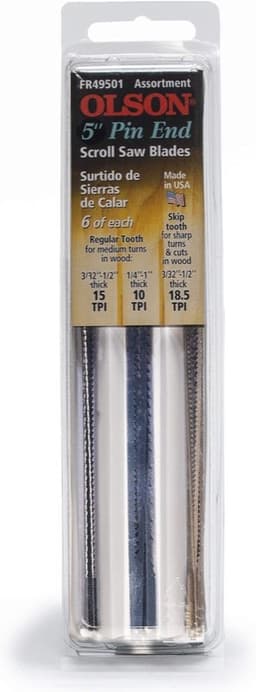
Look at the holder before the title. On the Lumberjack SS558V a pin sits in the V-notch and a plain end is locked with the handle, so that saw can take both. Many hobby saws only hook pins, and a plain-end blade will not mount. The manual, or the blade you have just removed, is the check. Olson, both Xcalibur listings, TXErfolg and the three VooGenzek packs are pinned, and a UK review says the Aeaocvo blades were pinned as well. Brrnoo does not state pin or plain. Einhell models named on the TXErfolg and VooGenzek bullets are written as pin-end, 127 mm between the pins. Seating is on how to change a scroll saw blade.

What changes when you pick plain ends

Once the saw can take both, the difference is how fast you can change the blade, the hole you can start from, and width. UK Workshop contributors find pins quicker to change. They use plain ends for an internal cut because there is no pin to pass through the drilled entry. That is workshop experience, not a measured kerf of these ASINs. VooGenzek and TXErfolg state about 3 mm wide. Olson’s listing says 0.3 cm. Olson’s pin-end chart is still far wider than a plain-end 2/0 at about 0.022 inch. Letters in 12 mm pine on a pin-end saw are a pinned spare. Internal fretwork through a small hole wants the plain end.

Titles in this set that say plain

The word plain on a listing is not a measurement. Aeaocvo, B0G6BG98ZT, is £4.49 and the title says plain-end blades. A verified UK review says both ends are pinned and the buyer returned them. A US review on the same listing also says pinned. The unit-count field says 36 against a 24-item title. Goods should match the description under the Consumer Rights Act 2015. LuLobtg, B0DW8VNLTH, is £7.99 and also says plain end. No review body confirms the ends, and the bullet count does not match the title. If a photo shows a cross pin, the blade is pinned. Mount before price is on the scroll saw blades buying guide.

What this page will not decide

Spiral is a tooth shape, not a third mount. Brrnoo’s title says spiral teeth and a bullet says every third tooth is reversed, and the listing never says pin or plain. You still have to see the end. This page does not pick Olson against the £6.99 VooGenzek mix. Both are pin-end. That comparison is on best scroll saw blades. If the saw only clamps plain ends, skip both. A 3 mm pinned blade is a poor tool for a tight internal curve. Width does that. TPI does not.

Common questions

How do I tell pin end from plain end on the saw?
Look at the holder. A V-notch or a hook is for a pin. A clamp or locking handle is for a plain shank. The Lumberjack SS558V uses both: pin in the V-notch, plain end with the locking handle. The blade you have just removed is the other check. If it has a cross pin at each end, order pins. If the shank is bare, order plain ends. The title on the next packet is not this test.
Can one saw take both?
Some can. The Lumberjack SS558V manual allows a pin in the notch and a plain end in the clamp. A saw that only hooks pins will not hold a plain end. Check your manual before you assume a “universal” 5 inch pack will fit. Einhell models named on the pinned VooGenzek and TXErfolg bullets are described there as pin-end, 127 mm between pins. Confirm the holder on your own machine anyway.
Why are plain ends used for internal cuts?
Because the shank can pass through a smaller drilled hole. A pin has to fit through that hole as well, so the entry gets larger and the start of an internal cut gets clumsier. UK Workshop contributors describe pins as quicker to change and plain ends as the route into that small hole. The blade still has to be narrow enough to turn the corner. A plain end that is as wide as a 3 mm pin blade does not solve the curve on its own.
What if the amazon title says plain and the blades have pins?
The title is wrong for your clamp. Aeaocvo says plain end, and a verified UK review says both ends were pinned and the buyer returned them. Do not fit them as plain-end blades, and do not assume the next “plain” title is safe. Goods should match the description. A photograph of the end, before you pay, is the check that would have saved that order.
Is the LuLobtg pack confirmed plain end?
No. The title says plain end. No stored review confirms the shank. The bullet also disagrees with the title on count: 60 in the title, and 20 plus 20 plus 28 in the bullet, which is 68, with 10 TPI repeated instead of 28 TPI. Leave it if you need a proven plain end. A 4.8 from six ratings, with no text, does not settle the mount.

Related pages

Sources

Public UK sources used for this comparison. Shelf prices are amazon.co.uk listings from 19 October 2026.

  1. HSE: PUWER overview (retrieved 20.10.2026)
  2. HSE: Safe use of woodworking machinery (L114) (retrieved 20.10.2026)
  3. HSE: Wood dust (retrieved 20.10.2026)
  4. HSE WD0: Wood dust – controlling the risks (retrieved 20.10.2026)
  5. Einhell TC-SS 405 E manual (retrieved 20.10.2026)
  6. Lumberjack SS558V manual (retrieved 20.10.2026)
  7. Olson scroll saw blade chart (retrieved 20.10.2026)
  8. Consumer Rights Act 2015 (retrieved 20.10.2026)