Independent comparisons. We may earn from shop links. More info

Chainsaw carb tuning tachometer

Updated: October 2026

You have the saw manual open, a tachometer that already shows a stable idle, and a high-speed screw you are tempted to lean. Chainsaw carb tuning with a tachometer can confirm that you are at or under the maximum printed for that saw. It cannot make a lean mixture safe. Fitting stays on the [how to use a chainsaw tachometer](/hub/saw-accessories/chainsaw-tachometer/sub/chainsaw-tachometer-how-to-use) page. Which meter to buy stays on the [best chainsaw tachometer](/hub/saw-accessories/chainsaw-tachometer/sub/chainsaw-tachometer-best) page. Prices stay on the [chainsaw tachometer comparison](/hub/saw-accessories/chainsaw-tachometer). We used those UK sources on 16 October 2026 and did not tune a saw. A qualifying purchase can earn a commission at no extra cost to you.

You have the saw manual open, a tachometer that already shows a stable idle, and a high-speed screw you are tempted to lean.

Our top picks

On this page

What the tachometer is allowed to decide

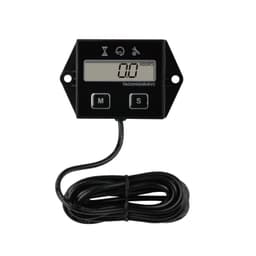
The meter shows the speed the engine is doing, so you can compare it with the maximum in the manual for this saw. It cannot stand in for that number. No source we used gives one maximum for every Stihl or Husqvarna. A forum line about an MS 260 past 14,000 rpm is one saw. A lean 2-stroke is short of oil as well as fuel, because the oil is mixed into the petrol. A £14 meter, including the YR-HM011F at about £13.99, cannot forgive a high-speed screw that is lean of the maker’s limit. If you cannot see a trustworthy maximum, leave H no leaner than the basic setting. The Jonsered workshop text for those models says the same. The H equals 1 and H equals 1¼ figures belong to those models. Do not copy the turns onto another saw.

Idle, and a chain that must stop

At idle the chain must be stopped, on a clear bench or on the ground, not in a cut. If the chain creeps, that is a stop. Idle speed and the low-speed circuit are the side the manual names. Leaning the high-speed screw will not fix a chain that turns at idle. This page does not give a universal clockwise rule. If you cannot make the chain stop with the idle setting the manual allows, stop work.

Full throttle without going lean

No-load full throttle is how these notes check maximum speed: bar and chain fitted, nothing in the wood, and the tachometer visible without your head in line with the bar. The Jonsered text for those models wants a slight burble, and it warns that an H screw that is too weak can over-rev the engine. Four-stroking is that rich burble. In this set, 0.5 second is stated for the YR-HM011E, YR-HM011F, and YR-HM011G. The IP68 RL-HM012 does not state a refresh, so you cannot know how old the digit is. Limiter caps stay on. Removing them is a modification. A rev-limited coil stays in the saw.

When a professional should take over

Hand the saw to someone who services that model when the manual has no maximum, when the chain still creeps, or when the chain brake, the throttle lock, or the anti-vibration mounts are already faulty. The same stop applies if you were about to remove limiter caps, or if the saw is for work in a tree. The Health and Safety Executive’s chainsaw guidance and leaflet INDG317 expect training and a maintained saw for work use. A tachometer is not the safety device. The chain brake, a sharp chain, and sound anti-vibration mounts are.

Common questions

Can I set the H screw with a £14 tachometer?
You can compare a reading with the manual’s maximum if the meter already shows a stable figure and updates quickly enough to watch. The YR-HM011F at about £13.99 states 0.5 second, which matches the refresh owners ask for. The meter still cannot make a lean high-speed setting safe. If you cannot see the maximum, leave H no leaner than the basic setting for that saw.
What rpm should a chainsaw reach?
Use the rpm in the manual for that model. There is no universal maximum here. Forum talk of about 12,000–15,000 rpm, or of one MS 260 that will pass 14,000 rpm, is not a specification to tune toward. If the manual is missing, do not lean the high-speed screw to find out how fast the saw will go.
Why do tuners talk about four-stroking?
Four-stroking is the rough burble of a 2-stroke that is slightly rich at no-load full throttle. Workshop text for some Jonsered models wants a slight burble and warns that a weak high-speed mixture can over-rev the engine. The oil is in the fuel, so a lean mixture is also a lubrication problem. Use the sound together with the manual’s maximum and a tachometer you can read in time.
The chain turns at idle. Which screw is that?
That is the idle speed side of the carburettor, not the high-speed screw. Your saw’s manual names the screw. This page does not give a universal clockwise rule, because saws differ. A chain that moves at idle is a reason to stop. If the idle setting in the manual cannot stop the chain, a mechanic for that model should take over.
My ignition is rev-limited. Can the meter raise that limit?
The meter can only display the speed the engine is doing. A rev-limited coil holds the engine down, and that limit stays in the saw. Leaning the high-speed screw to get past a limiter is a way to arrive at the limiter already short of oil. Stay with the maximum in the manual. If the saw never reaches a speed the manual expects, the ignition and the carburettor are a workshop diagnosis.
When do I take the saw to a mechanic?
Take it when the maximum rpm is unknown, when the chain will not stop at idle, when the brake or the anti-vibration system is faulty, or when the saw is used for work without the competence HSE describes for chainsaw operators. Also take it when the only way to reach the speed you want is to remove limiter caps or to lean the high-speed screw past the basic setting.

Related pages

Sources

Sources checked for this comparison; last retrieved on 16 October 2026.

  1. HSE, Chainsaws at work (INDG317) (retrieved 16 October 2026)
  2. HSE, Control of Vibration at Work Regulations 2005 (retrieved 16 October 2026)
  3. HSE, Training and competence (retrieved 16 October 2026)
  4. BSI, BS EN ISO 11681-1:2022 (retrieved 16 October 2026)
  5. Consumer Rights Act 2015, section 22 (retrieved 16 October 2026)
  6. GOV.UK, UKCA and CE marking in Great Britain (retrieved 16 October 2026)
  7. Arbtalk, how to check rpm (retrieved 16 October 2026)
  8. Arbtalk, chainsaw tachometers in 2022 and beyond (retrieved 16 October 2026)