Independent comparisons. We may earn from shop links. More info

24 tooth or 80 tooth circular saw blade for your cut

Updated: 22 October 2026

The blade already fits the arbor. What you cut decides whether a 24 tooth or 80 tooth circular saw blade is the one to mount. About 24 teeth suit a fast rip, about 40 to 60 suit mixed work, and about 80 suit sheet goods. An 80-tooth blade is a poor deep rip. Those bands are a rule of thumb for this size, not a lab result. A link may earn a commission. Who should skip a named product is on the [best picks page](/hub/saw-accessories/254mm-x-30mm-circular-saw-blade/sub/254mm-x-30mm-circular-saw-blade-best). The full table is the [254 mm x 30 mm circular saw blade comparison](/hub/saw-accessories/254mm-x-30mm-circular-saw-blade).

The blade already fits the arbor. What you cut decides whether a 24 tooth or 80 tooth circular saw blade is the one to mount. About 24 teeth suit a fast rip, about 40 to 60 suit mixed work, and about 80 suit sheet goods.

Our top picks

On this page

24 teeth for a fast rip

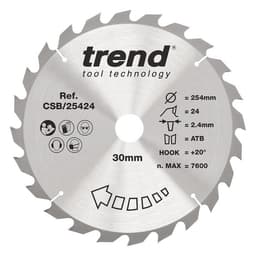
In this set the 24-tooth blade is Trend CSB/25424: ATB teeth, a +20° hook, and a description of fast coarse cuts in wood. That hook pulls the timber in, which suits a confident rip. Compel's UK chart, written for a 185–250 mm blade rather than as a test of these ASINs, puts 18–24 teeth in the ripping band. It is guidance, not a score. Twenty-four teeth leave a larger chip, so this card is the wrong blade for a veneered face. Trend also sells an 80-tooth CSB/25480, and that blade is not in this set. Use 24 teeth for a fast rip. Move up the count for ply or a kitchen panel.

40, 48 and 60 for mixed work

Forty teeth is the compromise when you will rip and cross-cut without swapping. Saxton TCT25440T is £17.99, 4.5 from 57, with UK reviews of laminate scored without chipping and one review of a blade that was not balanced. BGS 3954 is the other 40-tooth card, cheaper at £10.52, with three thickness figures that disagree. Tooth count does not repair that. Forty-eight teeth is the METAK. The bullets claim wood, aluminium, mild steel and plastic, and they do not name the grind. UK reviews include wander above 38 mm and an edge lost after one thin metal cut. Sixty teeth is Saxton TCT25460T at £18.99, 4.8 from 75, with clean oak reported. Starrett's 60-tooth blade drew a UK review that expected a fine cut and called the result coarse. A sharp 40-tooth blade can beat a blunt 60-tooth blade. That is workshop experience, not a lab result.

80 teeth, and the deep rip to avoid

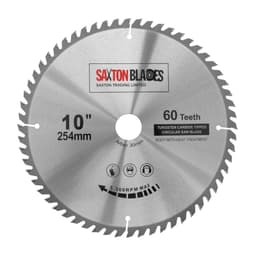
Eighty teeth are for sheet goods and a slower feed: plywood, MDF and veneered board. Saxton TCT25480T prints 80 ATB teeth, plate 1.8 mm and kerf 2.6 mm. UK reviews include chip-free cupboard panels, and one review says it stalled on the first piece. BATIOPV is the other 80-tooth listing. One UK review reports a clean cut, and another reports teeth missing on arrival, so the title did not guarantee a fine face. A slow feed does not make an 80-tooth blade a deep-rip blade. Burn on a thick rip is treated as too many teeth or too slow a feed. That is guidance, not a lab result. Stop if the plate flexes or the cut burns, and change to fewer teeth.

ATB on the card, and a metal claim that is not a grind

ATB, alternate top bevel, is the wood grind on the cards that name one. Trend, all three Saxton blades and the Starrett say ATB. Trend prints +20°. Saxton says a positive angle and does not print the degrees. BGS, BATIOPV and METAK do not name ATB, TCG or FTG. Compel's chart treats TCG as the grind for laminate, aluminium and plastics, and mild steel as a negative-hook blade on a slow dry-cut saw. That chart is not a test of these ASINs. A material list does not invent the grind. BGS says Metal and does not describe steel. METAK names mild steel and collects UK reviews of a lost edge. One review wrote 80 teeth per inch. The Saxton listing says 80 teeth on a 254 mm blade, which is a different number.

Common questions

Is 40 teeth the one-blade compromise?
It is the compromise when you will rip and cross-cut and you will not change blades. Saxton's 40-tooth ATB has UK reviews of laminate without chipping. It will not match an 80-tooth blade on a veneered sheet. The BGS 40-tooth card is the same count with thickness figures that disagree, so the count alone is not a reason to buy it.
What is 48 teeth for, on the METAK?
METAK MTM25448 is the only 48-tooth blade here, sold for wood, aluminium, mild steel and plastic. The grind is not named. UK reviews include wander above 38 mm and an edge finished after cladding or one thin metal cut. Forty-eight teeth do not prove the steel claim, and they do not replace a printed kerf.
Do 60 and 80 both count as a fine cut?
They are finer than 24 teeth, and they are not the same job. Sixty teeth are the mixed count, with reports of clean oak. Eighty teeth are for sheet goods. A Starrett buyer still found a 60-tooth cut coarse. The number is a chip size, not a finish warranty.
Will an 80-tooth blade rip a deep board if I feed slowly?
Feeding slowly gives each tooth more time in the cut, which is how a fine blade burns in thick hardwood. The rule of thumb here is that an 80-tooth blade is a poor deep rip. Stop if the plate flexes or the kerf scorches, and change to fewer teeth for that board.
Does ATB cut aluminium because the listing also says plastic?
No. ATB is the wood grind on the Trend, Saxton and Starrett cards. A UK shop chart puts aluminium and plastics with a TCG grind, and mild steel on a negative-hook dry-cut blade. Naming the material does not name the grind.
What if a review says 80 teeth per inch?
One review of the Saxton 80-tooth blade uses that phrase. The listing says 80 teeth on a 254 mm blade, not 80 teeth per inch. Use the number in the title.

Related pages

Sources

Public UK sources from the research digest, used for this page in October 2026. Prices, stars and review counts are from the eight amazon.co.uk listings captured on 20 October 2026. HSE knife and wood-dust guidance applies where the saw is work equipment. It is not a certificate for a domestic blade. No listing here is a laboratory test.

  1. HSE, Circular saw benches (retrieved 20 October 2026)
  2. HSE WIS16, Circular saw benches (retrieved 20 October 2026)
  3. HSE L114, Safe use of woodworking machinery (retrieved 20 October 2026)
  4. HSE, Wood dust (retrieved 20 October 2026)
  5. HSE WD3, Hardwood dust (retrieved 20 October 2026)
  6. BSI, BS EN 847-1:2017 (retrieved 20 October 2026)
  7. Einhell TC-TS 254 U manual (retrieved 20 October 2026)
  8. Axminster AP254TS manual (retrieved 20 October 2026)