Riving knife too thick for the saw blade: 8 mm rule
The knife stops at the mouth of the kerf and will not enter. A riving knife too thick for the saw blade is thicker than the slot the teeth cut, or no longer thicker than the plate. It must be thicker than the plate and thinner than the kerf, within 8 mm at table level, and no more than 25 mm below the top of a blade under 600 mm. Fitting steps are on the [how to change a table saw blade](/hub/saw-accessories/254mm-x-30mm-circular-saw-blade/sub/254mm-x-30mm-circular-saw-blade-how-to-change) page. Figures are from amazon.co.uk on 20 October 2026 and from HSE guidance. A link may earn a commission. The eight listings are in the [254 mm x 30 mm circular saw blade comparison](/hub/saw-accessories/254mm-x-30mm-circular-saw-blade).
The knife stops at the mouth of the kerf and will not enter. A riving knife too thick for the saw blade is thicker than the slot the teeth cut, or no longer thicker than the plate.
The knife stops at the mouth of the kerf and will not enter. A riving knife too thick for the saw blade is thicker than the slot the teeth cut, or no longer thicker than the plate. It must be thicker than the plate and thinner than the kerf, within 8 mm at table level, and no more than 25 mm below the top of a blade under 600 mm. Fitting steps are on the how to change a table saw blade page. Figures are from amazon.co.uk on 20 October 2026 and from HSE guidance. A link may earn a commission. The eight listings are in the 254 mm x 30 mm circular saw blade comparison.
Our top picks
| Badge | Product | Plate | Kerf | Knife check | Note | Price | Offer |
|---|---|---|---|---|---|---|---|
| Best overall |  BGS Do it yourself BGS 3954 40-tooth blade | Bullet 1.8 mm; title 3.2 mm | Bullet 2.8 mm | Three figures, do not choose one | 6.2 | about £10.52 | View offer |
| Alternative |  Saxton Blades Saxton TCT25480T 80-tooth blade | 1.8 mm | 2.6 mm | A 2.0 mm knife sits between | 7.9 | about £19.99 | View offer |
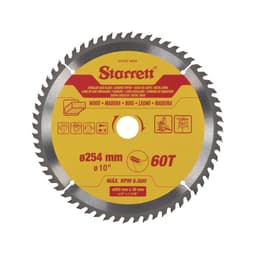
| Alternative |  Starrett Starrett CCS254-60DW 60-tooth blade | Bullet says 2 mm; field says 30 mm | Bullet also says 2 mm | Same number cannot sit between | 5.2 | about £19.99 | View offer |


On this page
Thicker than the plate, thinner than the kerf
8 mm at the table, 25 mm at the top
A 2.0 mm splitter against this set
When the listing does not let you check
Common questions
Why will the knife not enter the kerf?
How high should the top of the knife be?
Does a 2.0 mm Einhell splitter fit a plate of 1.8 mm and a kerf of 2.6 mm?
What if thickness and kerf are both printed as 2 mm?
Is a seller's (kerf + plate) / 2 the same as the HSE rule?
Related pages
Sources
Public UK sources from the research digest, used for this page in October 2026. Prices, stars and review counts are from the eight amazon.co.uk listings captured on 20 October 2026. HSE knife and wood-dust guidance applies where the saw is work equipment. It is not a certificate for a domestic blade. No listing here is a laboratory test.
- HSE, Circular saw benches (retrieved 20 October 2026)
- HSE WIS16, Circular saw benches (retrieved 20 October 2026)
- HSE L114, Safe use of woodworking machinery (retrieved 20 October 2026)
- HSE, Wood dust (retrieved 20 October 2026)
- HSE WD3, Hardwood dust (retrieved 20 October 2026)
- BSI, BS EN 847-1:2017 (retrieved 20 October 2026)
- Einhell TC-TS 254 U manual (retrieved 20 October 2026)
- Axminster AP254TS manual (retrieved 20 October 2026)