Independent comparisons. We may earn from shop links. More info

Emery cloth vs sandpaper roll: paper or cloth backing?

Updated: 21 October 2026

You are comparing two rolls that share the same grit number, and one listing says emery cloth while the other says sandpaper. On amazon.co.uk that difference is not cosmetic. The abrasive grain may both be aluminium oxide, but the backing decides whether the sheet survives your clamps, bends around a pipe, or survives a wet pass. In the twelve rolls in our [sandpaper roll comparison](/hub/sanders/sandpaper-roll), most of the wide decorating stock is paper, several narrow sets are cloth, and one peel-and-stick roll is a separate case. This page is that backing trade-off. Peter F. read the listings on 19 October 2026. There was no lab test.

You are comparing two rolls that share the same grit number, and one listing says emery cloth while the other says sandpaper. On amazon.co.uk that difference is not cosmetic.

Our top picks

On this page

Paper rolls and why they split

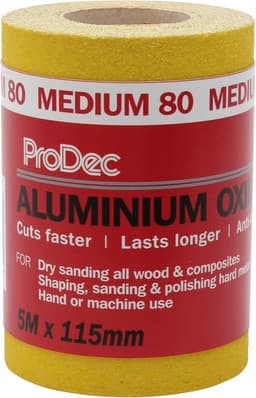
Paper-backed rolls are the default for flat wood, plaster, and paint prep. In this set the four ProDec rolls are paper at 115 mm by 5 m, and WORKPRO and SHALL are paper too, mostly at 93 mm. ProDec calls the stock E-weight and crack resistant. That holds when you clamp a length without a sharp fold. UK reviews split both ways. Some call the same papers strong. Others report tears when the sheet is creased into the clips, when SHALL is wrapped tight on a block, or when green 80 rips on an orbital. Paper fails at a fold, not because the grit is wrong. For flat doors and skirting, paper remains the sensible buy, in the same order as the sandpaper roll buying guide. These ProDec rolls do not state wet use. Ordinary paper softens if you flood it.

Cloth and emery rolls

Cloth-backed rolls, often listed as emery cloth even when the grain is aluminium oxide, flex where paper buckles. Shineboc is described as fibre-backed. KONGMING, Flintronic, and Junchamp are titled as cloth. PMIQSA is textile in the material field, so this is not one uniform emery product. KONGMING and Shineboc sit around 93 mm. Flintronic and Junchamp are about 25 mm, useful on a pipe or a tight profile, and awkward on a 115 mm pad. Rodo’s ProFlex cotton cloth at 115 mm is not among these twelve ASINs. Cloth tends to tear less on a tight shape. It is not automatically better on flat softwood. For a curved fitting or a rust spot, the narrow sets earn their place. Fit and stretch are on the how to use a sandpaper roll page.
ProDec ProDec green 80 grit roll

Testsieger

ProDec ProDec green 80 grit roll
9.2/10about £6.49

Wet use is a sentence on the listing

Wet and dry titles confuse the grain. Silicon carbide is what UK sellers usually pair with wet metal sanding. Aluminium oxide is the wood-and-paint default. Toolstation also names PET film for wet work, not ordinary decorating paper. A wet and dry title on oxide is not automatically silicon carbide. Wet use is stated on Shineboc, KONGMING, Flintronic, and Junchamp, and on PMIQSA only in one bullet. ProDec paper does not claim it. Oakey sells wet-and-dry aluminium oxide on waterproof latex, so grain and backing are separate from the headline. HSE guidance on lead, CIS79, treats wet methods seriously when you key sound old paint. A dry coarse paper roll is the wrong first tool if lead is plausible. Only the lines that state wet use are the ones to wet. Which row fits the pad is on the best sandpaper roll page.

Peel-and-stick is a third backing

Peel-and-stick is not paper versus cloth. It is pressure-sensitive adhesive on a short strip. The GZKTY roll is PSA-backed, 70 mm by 7.8 m, 240 grit, pressed onto a block without clamps. That suits a small flat touch-up. It is a weak substitute for a 115 mm sheet, and it is not emery cloth for a pipe. The colour field mentions a blue ceramic coating, while the material field lists aluminium oxide. One short UK review does not prove that ceramic overrides the oxide spec. Treat PSA as a third path: handy for a block in the cupboard, not the roll for a door in one pass. When the job is clamp-mounted and wide, stay with paper or cloth.

Common questions

Will cloth tear less than paper in the clamps?
On curves and hand work, cloth usually outlasts paper because it flexes instead of cracking at a fold. On a flat pad, good paper often lasts if you avoid creasing it into the clips. UK reviews still report tears on ProDec and WORKPRO paper when the sheet is folded hard. A split at the clamp is a backing problem, not a reason to buy a finer grit.
Is emery cloth better on wood?
Not by default. Use cloth on curves, metal, and profiles. Use 115 mm paper in this set for flat plaster and paint unless you know you need the flex. Emery cloth on these listings is often aluminium oxide on a flexible backing, not a different mineral. You pay for flexibility you may not use on a door face.
Can I wet-sand with these aluminium oxide rolls?
Only if the listing states wet use and the backing can take it. Shineboc, KONGMING, Flintronic, and Junchamp state wet use. ProDec paper rolls do not. Non-waterproof paper fails when soaked. Wet and dry on aluminium oxide is not silicon carbide waterproof paper. Oakey’s wet-and-dry oxide sits on waterproof latex, which is a different sheet.
What is PSA for?
Pressure-sensitive adhesive sticks abrasive to a block without clips. The GZKTY roll in this set is that path: 70 mm by 7.8 m, 240 grit. It suits small touch-up, not a half-sheet door, and it is not emery cloth for a pipe. You cannot tension it the way clamp paper is tensioned.
Is green paper a backing type?
No. Green is ProDec’s colour code for the grit role on that range. Those rolls are still paper-backed, at 115 mm by 5 m. Yellow ProDec 80 is paper as well. The colour does not tell you whether the sheet will survive a wet pass, and these ProDec listings do not state wet use.
Why did my paper split when I folded it?
Sharp folds and short sheets tear at the clamps. Cut a fresh length and keep the fold out of the bite. Repeated splits on flat work point to cloth, or to a wider sheet, not to a finer grit. WORKPRO, SHALL, and yellow ProDec 80 are the rows where UK notes mention that crack.
Is 25 mm cloth a substitute for a 115 mm roll?
No. Flintronic and Junchamp suit pipes and profiles, not a full half-sheet pad. Both are about 25 mm. Rodo’s ProFlex cotton cloth at 115 mm is a different product, and it is not among these twelve ASINs. A 93 mm cloth set such as KONGMING is still narrower than a 115 mm shoe.
Does ceramic on the GZKTY colour field mean ceramic grain?
The listing pairs a ceramic coating colour with aluminium oxide in the material line. Trust the oxide spec unless the maker confirms ceramic grain. One short UK review saying it works well does not settle that clash. The roll is still a 70 mm peel-and-stick strip, not a 115 mm paper roll.

Related pages

Sources

Sources taken from the research digest. Listings were checked on 19 October 2026.

  1. HSE — Wood dust (retrieved 19.10.2026)
  2. HSE — WD7 Hand-held powered sanders (retrieved 19.10.2026)
  3. HSE — Cutting and sanding wood (retrieved 19.10.2026)
  4. HSE — Lead FAQs (retrieved 19.10.2026)
  5. ISO 6344-3:2021 coated abrasives (retrieved 19.10.2026)
  6. BSI — BS EN 13743 coated abrasive products (retrieved 19.10.2026)
  7. Consumer Rights Act 2015, section 11 (retrieved 19.10.2026)
  8. Rodo — ProDec aluminium oxide green rolls (retrieved 19.10.2026)