Independent comparisons. We may earn from shop links. More info

Sandpaper grit chart UK

Updated: 21 October 2026

You have a roll in the basket, or a mixed box open on the bench, and what matters is whether the number on the label matches the defect you can still see in the timber. A sandpaper grit chart UK buyers can use starts with one rule: lower numbers cut deeper, and higher numbers leave finer scratches. This page maps stripping, bare wood, and between-coat work onto the rolls in our [sandpaper roll comparison](/hub/sanders/sandpaper-roll). Width and cutting a sheet belong on the [sandpaper roll buying guide](/hub/sanders/sandpaper-roll/sub/sandpaper-roll-buying-guide). Peter F. read the listings on 19 October 2026. There was no lab test.

You have a roll in the basket, or a mixed box open on the bench, and what matters is whether the number on the label matches the defect you can still see in the timber.

Our top picks

On this page

What the number means

On UK trade charts, the grit number describes how coarse the mineral is, not how hard you should push. Norton’s guide runs from 40 for heavy stripping, through 60 coarse, 80 for medium imperfections, 120 fine before a first coat, 180 for light imperfections, 240 before a final coat, and 320 for final smoothing. That is manufacturer guidance, not a British Standard. 60 is rougher than 120, and 240 is finer than 180. If varnish ridges catch a fingernail, a fine grade polishes the hills without removing them. Start coarse, then step finer. Sand with the grain on flat timber so scratches do not cross-hatch under gloss. A sequence quoted in home-building advice, not as regulation, is 60 to cut failed film, 120 to level, then 180 before repriming.

A grit for the job in front of you

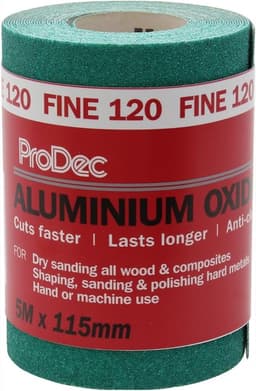
Start with the coarsest grit that removes the defect you can see, then work finer until the surface matches the next coat. That avoids fine paper on a strip, and 60 where you only needed to dull gloss between coats. ProDec puts 60 on rough timber and old coatings. In this set, 60 is on PAALV60, WORKPRO, SHALL, Shineboc’s title, and PMIQSA. KONGMING’s cloth starts at 40. Yellow and green 80 suit varnish and bare wood before paint. Green 120 prepares for a first coat and is not for stripping. Norton aligns 120 with keying before that coat. Between coats, the finest grade on the wide mixed sets here is 240, not a dedicated 320 roll. For a conditional pick, see the best sandpaper roll page.

P-grades and numbers without a P

European abrasives are often labelled FEPA P, as in P80 or P240, meaning grain sized under ISO 6344. Part 2 covers P12 to P220, and part 3 covers P240 to P5000. The P ties the number to a defined sieve stack. None of the twelve amazon.co.uk listings here print P on the title or on Amazon’s grit-number field. Treat a bare 80 or 120 as the seller’s label, not proof of P80. Norton and Compel charts are trade guidance, not a batch audit. Compel warns that FEPA P and US CAMI scales diverge above about 220, so a US 600 is not P600. One UK reviewer said ProDec green 80 felt closer to 40. That is one perception, not a retest. Stars do not sieve the grain.

Sets that skip a step

Mixed boxes trade convenience for gaps. WORKPRO jumps from 60 to 120 with no 80. If bare pine needed that medium step, spend longer on 120 or buy 80 separately. Yellow or green ProDec 80, SHALL, KONGMING, PMIQSA, Flintronic, and Junchamp include 80. Jumping from 60 to 240 leaves coarse scratches under paint. Compel’s rule of thumb is not to skip a whole grade. Shineboc’s title says 60 while a detail line mentions P40 to P50. Do not read that as P60. PMIQSA and the 25 mm Flintronic and Junchamp sets run to 400 and 600 for spindles, not a flush door, where 115 mm paper at 80 or 120 is the sensible sheet. A box with no 60 or 80 is the wrong first buy if the paint has failed. Clamping is on how to use a sandpaper roll.

Common questions

What grit do I buy for bare wood before paint?
Key the surface rather than reshape it. ProDec and Norton point to 80 on bare wood or varnish before paint, then 120 before the first coat if the surface still needs it. Raised grain under raking light usually wants 80 then 120. Smooth yard joinery may need 120 alone. Rough-sawn timber starts at 60 in this set, ProDec PAALV60 or a mixed box that includes 60, then steps to 80 or 120.
What grit strips old varnish?
Coarse work comes first. Use 40 on KONGMING’s cloth if the coating is stubborn, otherwise 60 from ProDec, WORKPRO, SHALL, or PMIQSA. Move to 80 or 120 only once the old film is gone. A fine grade polishes the ridges without removing them. ProDec’s 120 line is for a first coat, not for stripping.
What grit between coats?
Dull the gloss and knock nibs without cutting back to raw wood. Trade finishing often uses 180 to 240. In this set, 240 is the finest grade on several wide mixed sets, including WORKPRO, SHALL, and KONGMING. Sand lightly and dust off. If you need 320 for a glass-smooth topcoat, you may need a roll outside this table.
Is 240 the same as P240?
Only if the maker labelled and tested FEPA P240. These rolls print 240 without a P. That is a seller index, not a guaranteed sieve result under ISO 6344. Within one brand, 240 still means fine relative to 120. FEPA P and US CAMI scales diverge above about 220, so a US 600 is not P600.
Why does my set list 60, 120, 180, and 240 with no 80?
Some kits omit 80 to cut the number of grades in the box. WORKPRO goes from 60 to 120, with 180 and 240 after that, and no 80. Fill the gap with a single 80 roll if your sequence needs that pass on bare wood. ProDec yellow and green 80 are the single-grit 115 mm options in this set.
Can I jump from 60 to 240?
You usually should not, under pigmented finishes. Coarse 60 scratches stay until an intermediate grade cuts them. 240 polishes the peaks and leaves valleys that show through paint. Step through 80 and 120, or at least through 120. Compel’s rule of thumb is not to skip a whole grade.
Is 600 grit on a 25 mm roll the right choice for a door?
Not for flat panels. Flintronic and Junchamp at 600 grit suit narrow stock, pipes, and curves. A door face wants 115 mm paper from about 80 or 120 upward. A US 600 on a cloth roll is also not the same claim as a FEPA P600 sheet.
Does a higher star rating mean the grit is accurate?
No. Ratings reflect delivery and how the backing lasts, not a grit measurement. One UK reviewer felt ProDec green 80 cut closer to 40. That is one perception, not a retest. Trust the label, the maker’s grade copy where it exists, and a test patch before you sand the whole surface.

Related pages

Sources

Sources taken from the research digest. Listings were checked on 19 October 2026.

  1. HSE — Wood dust (retrieved 19.10.2026)
  2. HSE — WD7 Hand-held powered sanders (retrieved 19.10.2026)
  3. HSE — Cutting and sanding wood (retrieved 19.10.2026)
  4. HSE — Lead FAQs (retrieved 19.10.2026)
  5. ISO 6344-3:2021 coated abrasives (retrieved 19.10.2026)
  6. BSI — BS EN 13743 coated abrasive products (retrieved 19.10.2026)
  7. Consumer Rights Act 2015, section 11 (retrieved 19.10.2026)
  8. Rodo — ProDec aluminium oxide green rolls (retrieved 19.10.2026)