Independent comparisons. We may earn from shop links. More info

Sand inside a curve with a drum

Updated: October 2026

You have just cut a concave edge on the bandsaw, or a hole with a jigsaw or hole saw, and the surface is ridged with saw marks. A belt sander cannot follow a hollow, and a flat block rounds the shoulders instead of cleaning the bottom. A rubber sanding drum in a pillar drill can do it, if you pick the diameter and take light passes. Prices are on the [sanding roller comparison](/hub/sanders/sanding-roller), and the choice of kit is on the [sanding roller buying guide](/hub/sanders/sanding-roller/sub/sanding-roller-buying-guide). A qualifying purchase through our links can earn a commission at no extra cost to you.

You have just cut a concave edge on the bandsaw, or a hole with a jigsaw or hole saw, and the surface is ridged with saw marks.

Our top picks

On this page

Why a belt sander stays on the outside

A belt sander works on a flat platen or an outside curve. On a concave edge the belt touches only the high points, leaves the bottom of the hollow, and rounds the corners. A round abrasive on a vertical axis can sit inside the hollow. That is why a drum in a drill press, or a bobbin sander, is the usual answer to bandsaw marks on an inside curve. The drum has to be small enough to fit inside the curve. That is a diameter decision, not a grit decision. Grit matters once the drum can reach the surface.

Match the drum to the hollow

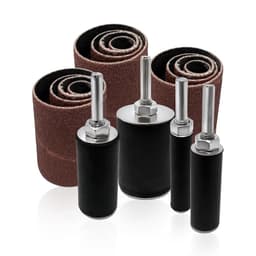
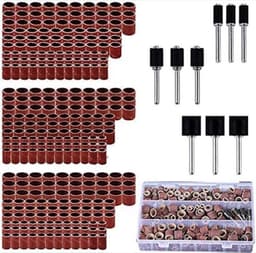
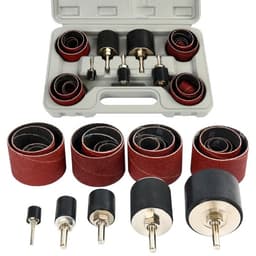
Use the largest drum that still sits in the curve. More contact smooths faster and leaves fewer flats. Too large bridges the hollow. Too small follows it in short facets. As a rule of thumb, not a tested figure, a 1 inch drum suits a tight hollow, and a gentler sweep wants something closer to 2 inch. beststar stops at 1/2 inch, so it suits tight radii on a rotary tool. Hilka runs from 3/8 to 1 1/4 inch. LINE10 goes to 1 1/2 inch, and FreeTec to 2 inch, which is the wide sweep. O'SKOOL's title says 2 × 3 inch and the listing also says 3 inch, so check the drum. The Draper's 45 mm drum is close to 1 3/4 inch, and its 5 mm flap wheel is the small radius, in 80 grit only.
LINE10 LINE10 16-piece drums

Testsieger

LINE10 LINE10 16-piece drums
8.6/10about £17.96

Holes and deep cuts

For the wall of a hole, depth matters as much as diameter. LINE10 drums are 2 inches long, and the listing says they suit holes up to 2 inches deep. Reviewers used FreeTec drums to open an undersize hole on teak garden furniture and to clean plastic soffit covers. The drum must be smaller than the hole, with room to turn. Start at 60 or 80 grit for the saw ridges, then 120 for the finish. The sleeve has to grip first, so see how to use a sanding roller.

On the pillar drill

Fit the drum, lower the quill to the work, and lock it. Support the piece on the table and bring the curve to the drum. Do not lean on the quill. Practise on scrap. An O'SKOOL reviewer cleaned bandsaw marks off an inside curve in a pillar drill with little wobble. Keep the pressure light and keep the work moving, or you burn the wood or leave a dip. UK owners disagree about sideways load on the quill, so keep drill drums for occasional jobs. Wear eye protection. Our drill kits do not state a dust port.

When the drum kit is the wrong machine

A chuck drum is for the occasional curve. If you sand concave edges every week, the job points to a bench bobbin sander, which oscillates, has a square table and a dust port. UK woodworkers describe a pillar-drill drum first, then a bobbin sander when the work is regular. HSE notes that fixed bobbin sanders throw fine dust and that the drum should be enclosed as far as the guard allows. The Draper 90469 is a handheld spindle, not a bobbin sander, and one amazon.co.uk rating is little to go on. The choice between the three is on drill drum or powered sanding roller.

Common questions

Can a belt sander do an inside curve?
Not well. A belt follows a flat or an outside curve, so on a concave edge it touches the high points and rounds the corners. A round drum that turns on a vertical axis can sit inside the hollow, which is why a drum in a drill press is the usual answer.
How do I pick the drum diameter?
Choose the largest drum that still sits inside the curve. Too small leaves flats, and too large bridges the hollow. If you cut curves of different radii, a kit with several diameters, such as LINE10 from 1/2 to 1 1/2 inch, lets you match each one.
Will a drill drum round over a hole?
It can clean the wall of a hole, and the LINE10 listing says its 2 inch drums suit holes up to 2 inches deep. It will not round over the edge as a router does. Choose a drum smaller than the hole and take light passes.
Why does a small drum leave flats?
A small drum touches the wood along a short arc, so on a gentle curve it follows the shape in short straight sections. The result is faceting. Switching to a larger drum that still fits the curve spreads contact and smooths the surface.
Can I sand the inside of a 2 inch deep hole?
Yes, with a drum long enough to reach the bottom. LINE10 drums are 2 inches long and the listing says they suit holes up to 2 inches deep. Check that the diameter is smaller than the hole, and keep the pass light.
When is this the wrong tool and I need a bobbin sander?
When you sand concave edges often, want a square table and need dust extraction. UK woodworkers describe a pillar-drill drum for occasional curves and a bobbin sander for regular work. That machine is not among our six listings. The Draper 90469 is a handheld spindle, not that bench machine.

Related pages

Sources

Public UK sources on wood dust, fixed drum sanders and the plug on a mains lead. Listing prices and star counts are from the amazon.co.uk extracts kept for this comparison on 15 October 2026. Prices move.

  1. HSE, Wood dust (retrieved 16 October 2026)
  2. HSE, WD7 Hand-held sanders (retrieved 16 October 2026)
  3. HSE, WD14 Drum and bobbin sanders (retrieved 16 October 2026)
  4. HSE, Sanders (retrieved 16 October 2026)
  5. GOV.UK, Electrical Equipment (Safety) Regulations 2016 (retrieved 16 October 2026)
  6. Electrical Equipment (Safety) Regulations 2016, regulation 35 (retrieved 16 October 2026)
  7. Draper, 90469 sanding roller 310 W (retrieved 16 October 2026)
  8. UK Workshop, spindle sander vs drill-press drums (retrieved 16 October 2026)