Independent comparisons. We may earn from shop links. More info

How to use an orbital sander

Updated: October 2026

Press a new 125 mm random-orbit sander hard onto a pine top and you can leave pigtail swirls, or watch a disc skate off the pad. How to use an orbital sander is letting the tool’s weight cut, then stepping the grit in order. The routine is the same for a six-speed 300 W model and a single-speed palm sander in the [orbital sander comparison](/hub/sanders/orbital-sander). Prices and review notes below are from those listings on 15 October 2026. This is not a lab test. A qualifying purchase through our links can earn a commission at no extra cost to you.

Press a new 125 mm random-orbit sander hard onto a pine top and you can leave pigtail swirls, or watch a disc skate off the pad.

Our top picks

DCA DCA ASA125

Best overall

DCA DCA ASA125
7.8/10about £32.99
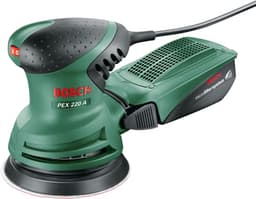
Bosch Bosch PEX 220 A

Rank 2

Bosch Bosch PEX 220 A
8.1/10about £48.49
HYCHIKA HYCHIKA FL117

Rank 3

HYCHIKA HYCHIKA FL117
7.6/10about £26.99
On this page

Fit the disc and the dust path before you switch on

Keep a corded sander unplugged while you fit a disc. Ten of the twelve tools here are 125 mm, also sold as 5 inch. Line the eight holes up with the pad. A crooked disc blocks the port, so dust packs under the paper and cooks the hooks. Reviews for DESOON, DEKOPRO DKOS30XL125, HYCHIKA FL117 and Bosch PEX 220 A say clip-on boxes vibrate loose or bags let fine dust out. A hose that fits clears the cut better than the bag. HSE cites respiratory protection around APF 20, with FFP3 as the example, indoors. The setup is the orbital sander dust extraction guide. The DCA ASA125 listing says walls and ceilings are not recommended.

How to move the pad

Leaning on the housing stops the free spin while the orbit continues. The pad stalls, which reviews report on WORKPRO W125264 and DESOON, or it carves pigtail scratches. 3M’s guidance says the weight of the tool, plus the resting weight of your hand, is the force the abrasive needs. Put the pad flat on the timber before you switch on. Guide it in overlapping passes at a walking pace, with the whole face level. Lift it off before you switch off, so a slowing pad does not scuff the finish. Keep the round pad out of a tight internal corner. That angle is the orbital sander vs sheet sander job.
DCA DCA ASA125

Testsieger

DCA DCA ASA125
7.8/10about £32.99

Grit order for furniture and paint that is not lead

BLACK+DECKER ships with one sheet and Bosch PEX 220 A with three, while several budget kits include 12 to 20 discs. A P240 disc will not strip old varnish. Do not dry-sand old paint that may contain lead, a live risk before the 1980s. On bare wood or a finish you know is lead-free, start at P80 for rough timber or P120 for flat joinery. A rule of thumb is not to skip more than about 50% in grit number: P80, P120, P180, then P240. Use a lower step between coats of varnish. Choosing a dial is the orbital sander buying guide. Finish with a light hand pass along the grain.

When the disc will not stick, or the tool smells

Discs fly off when heat flattens the hooks. Reviews on DESOON, DEKOPRO, BLACK+DECKER, HYCHIKA and Bosch PEX 220 A say the pad lost its grip after a few projects. Brush dust off without blowing it into the air, peel a disc from one edge, and replace the 125 mm backing pad once the hooks are smooth. Smoke or a sudden jump in vibration is different. Reviews on DESOON and HYCHIKA include early smoke, and one DEKOPRO 3-in-1 review says the head snapped off. Switch off and unplug. Under the Consumer Rights Act 2015 you can seek a repair, replacement or refund if the tool is not of satisfactory quality. Leave a whole floor to a hired drum sander, and leave suspected lead paint to someone equipped for it.

Common questions

Where do I start with grit?
For rough bare timber or an uneven board, start at P80. For planed softwood, an interior door or furniture that is already reasonably flat, start at P120. After the first pass, step up, for example from P80 to P120, then P180, then P240. Each finer disc removes the scratches of the previous grade. Do not jump from P80 to P240.
How hard should I press?
Do not add force beyond the resting weight of your hand on the grip. 3M’s random-orbital guidance says the weight of the tool is enough for the grains to cut. Pressing harder slows or stalls the random rotation of the 125 mm pad, gouges swirl marks and melts the hooks on the backing pad.
How do I avoid swirl marks?
Keep the pad flat, switch on only after it is resting on the timber, and lift it off before you switch off. Move at an even pace and do not tip the disc edge into a high spot. Line the eight dust holes up so debris does not ball up under the paper. Follow the grit steps, then a light hand-sand along the grain.
Why do the discs fly off?
Discs fly off when heat flattens the hooks on the backing pad. UK reviews report that on budget sanders and on the Bosch PEX 220 A. Heavy pressure, clogged dust holes or torn paper generate the heat. Unplug the tool, look at the hooks, and replace the 125 mm backing pad if they are melted smooth.
Should I sand paint?
Dry-sand paint only when you are sure the coating is modern and lead-free. Use a lower speed, coarse-to-medium open-coat paper and extraction, so softened paint does not clog the disc. HSE says never dry-sand old paint that may contain lead, a live risk in UK homes built before the 1980s, because powered sanding makes that dust breathable.
Can I sand a whole floor with this?
No. A 125 mm corded random-orbit sander around 220 W to 300 W is for doors, worktops, furniture and small patches, not a room of floorboards. A long run under load overheats the motor and wears the backing pad. A hired walk-behind floor sander and an edging sander do that job in hours rather than days.

Related pages

Sources

Public UK sources on wood dust, hand-held sanders, electrical safety and vibration limits. Listing prices and star counts are from the amazon.co.uk extracts kept for this comparison on 15 October 2026. Prices move.

  1. HSE, Wood dust (retrieved 15 October 2026)
  2. HSE, WD7 Hand-held powered sanders (retrieved 15 October 2026)
  3. HSE, Cutting and sanding wood (retrieved 15 October 2026)
  4. HSE, Lead FAQs (retrieved 15 October 2026)
  5. Control of Vibration at Work Regulations 2005, regulation 4 (retrieved 15 October 2026)
  6. GOV.UK, Electrical Equipment (Safety) Regulations 2016 (retrieved 15 October 2026)
  7. BSI, BS EN 62841-2-4:2014 (retrieved 15 October 2026)
  8. Electrical Safety First, Sanders (retrieved 15 October 2026)