Independent comparisons. We may earn from shop links. More info

Orbital sander vs sheet sander

Updated: October 2026

Search amazon.co.uk for a sander to prep an interior door and two tools share a muddled name. Round-pad machines are labelled random orbital, or simply orbital. Rectangular machines are labelled sheet, 1/3-sheet, 1/4-sheet or palm sanders. An orbital sander vs sheet sander choice is whether the timber is mostly flat, or framed with internal corners a round disc cannot reach. Round-pad models are in the [orbital sander comparison](/hub/sanders/orbital-sander). Square-pad models are in the [sheet sander comparison](/hub/sanders/sheet-sander). Prices below are from the orbital listings on 15 October 2026. This is not a lab test. A qualifying purchase through our links can earn a commission at no extra cost to you.

Search amazon.co.uk for a sander to prep an interior door and two tools share a muddled name. Round-pad machines are labelled random orbital, or simply orbital.

Our top picks

DCA DCA ASA125

Best overall

DCA DCA ASA125
7.8/10about £32.99
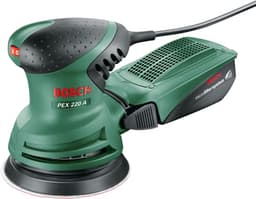
Bosch Bosch PEX 220 A

Rank 2

Bosch Bosch PEX 220 A
8.1/10about £48.49
HYCHIKA HYCHIKA FL117

Rank 3

HYCHIKA HYCHIKA FL117
7.6/10about £26.99
On this page

Two pads, two jobs

UK shop names cause the mix-up. A sheet sander, often called a palm sander, moves a rectangular plate in tiny circles and does not spin. What amazon.co.uk usually calls an orbital sander is a random-orbit tool. Ten of the twelve listings here use a 125 mm disc that spins and orbits. That combined motion does not repeat the same scratch, so it takes varnish off flat timber with fewer cross-grain marks. A square sheet removes stock more slowly and sits into skirting, window frames and recesses a circle cannot reach. Round pads take perforated hook-and-loop discs. Many sheet sanders take strips, or paper from a roll under clamps.

Doors, tops and panels

On a flush door, a worktop or a wide table, a 125 mm round pad is faster than a small palm sander. Reviews for DCA ASA125, Bosch PEX 220 A and DEKOPRO DKOS30XL125 include buyers who switched after a detail sander proved too slow on wide timber. On a panel door or a casement, a 125 mm disc bridges the corner and leaves an unsanded triangle of about 25 mm to 30 mm. Spinning the rim against the upright chews the wood and the pad. A 1/4-sheet or a triangular detail sander reaches that angle, and it suits a light rub between coats. Keeping the round pad off those edges is how to use an orbital sander.
DCA DCA ASA125

Testsieger

DCA DCA ASA125
7.8/10about £32.99

The 3-in-1 in this set

DEKOPRO B0DXK4NCJH at about £36.99 is 4.1 from 320 ratings. It pairs 300 W and six speeds with a 125 mm round pad, a 90×187 mm rectangle and a 101×146 mm triangle, plus 15 sandpapers from P40 to P240. Reviews say the base screws arrived over-tight, burred or seized, so the plate would not change. Hooks wore quickly, and one review says the head snapped off. At 2.13 kg it is heavier than the 1.29 kg Bosch or the 1.31 kg DCA. Unless the screws turn on day one, a dedicated round pad plus a later detail sander is the sturdier setup.

What to buy if you only want one

If you store one corded sander, buy a 125 mm random-orbit tool and finish an internal corner by hand. Flat doors, shelves, garden furniture and small patches suit the spin-and-orbit cut. Choose a square sheet, or a triangle, as the only machine when the work is window frames, skirting corners and a light rub between coats. Either body still needs 230 V or 240 V and a BS 1363 plug. A dial is on most 300 W tools around £27 to £34, and absent on BLACK+DECKER BEW210-GB and Bosch PEX 220 A. Both tools make fine wood dust. Neither is a reason to dry-sand pre-1980s paint that could contain lead. That limit is the orbital sander dust extraction guide.

Common questions

Which should I buy first?
If you own one electric sander for general DIY, buy a 125 mm corded random-orbit sander first. It strips and smooths flat doors, tabletops, shelves and furniture faster than a sheet or detail sander, and it blends cross-grain scratches. Hand-sand the small internal corners it leaves behind.
Can an orbital sander do corners?
A round random-orbit sander cannot sand into an internal right angle. The 125 mm disc bridges the two edges and leaves a small unsanded triangle. Pressing the spinning rim into the upright scuffs the adjacent wood and wears the backing pad. Finish that corner by hand, or with a sheet or detail sander.
Is a palm sander the same as a sheet sander?
In UK shops, palm sander, finishing sander and sheet sander, usually 1/4-sheet or 1/3-sheet, often mean the same square or rectangular tool held in one hand. Unlike a round random-orbit sander, it moves in tiny orbits and does not spin. It is slower on wide timber and it can reach a square corner.
What about panel doors?
A panel door mixes flat stiles and rails with recessed panels and many internal corners. A 125 mm random-orbit sander is the faster tool for the flat stiles, rails and centre panels. A square sheet sander or a triangular detail sander is the better tool for moulded edges and the corners where a spinning disc would catch the frame.
Will a 3-in-1 replace both?
DEKOPRO B0DXK4NCJH at about £36.99 includes a 125 mm round pad, a 90×187 mm rectangle and a 101×146 mm triangle. Stored UK reviews report seized or burred base screws, fast hook-and-loop wear, and a 2.13 kg body against about 1.3 kg for a dedicated palm sander. The carton does not replace two sound tools.
Which leaves fewer marks?
On flat bare timber, a random-orbit sander leaves fewer visible cross-grain marks because the pad spins and orbits, so the scratch path changes. A sheet sander moves in fixed tiny circles, which can leave swirls if you use coarse paper across the grain. With fine paper, about P180 to P240, it is gentle enough to rub down between coats.

Related pages

Sources

Public UK sources on wood dust, hand-held sanders, electrical safety and vibration limits. Listing prices and star counts are from the amazon.co.uk extracts kept for this comparison on 15 October 2026. Prices move.

  1. HSE, Wood dust (retrieved 15 October 2026)
  2. HSE, WD7 Hand-held powered sanders (retrieved 15 October 2026)
  3. HSE, Cutting and sanding wood (retrieved 15 October 2026)
  4. HSE, Lead FAQs (retrieved 15 October 2026)
  5. Control of Vibration at Work Regulations 2005, regulation 4 (retrieved 15 October 2026)
  6. GOV.UK, Electrical Equipment (Safety) Regulations 2016 (retrieved 15 October 2026)
  7. BSI, BS EN 62841-2-4:2014 (retrieved 15 October 2026)
  8. Electrical Safety First, Sanders (retrieved 15 October 2026)