Independent comparisons. We may earn from shop links. More info

What to look for in an orbital sander

Updated: October 2026

A page of corded sanders on amazon.co.uk looks repetitive when tools in a row claim 300 W, a 125 mm pad and a plastic dust box for around £30. What to look for in an orbital sander is the motion of the pad, the disc diameter, speed under load, the dust port and the UK voltage plate. The [orbital sander comparison](/hub/sanders/orbital-sander) lines twelve listings up in one table. Prices, review counts and stated sizes are from those listings on 15 October 2026. This is not a lab test. A qualifying purchase through our links can earn a commission at no extra cost to you.

A page of corded sanders on amazon.co.uk looks repetitive when tools in a row claim 300 W, a 125 mm pad and a plastic dust box for around £30.

Our top picks

DCA DCA ASA125

Best overall

DCA DCA ASA125
7.8/10about £32.99
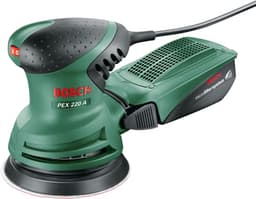
Bosch Bosch PEX 220 A

Rank 2

Bosch Bosch PEX 220 A
8.1/10about £48.49
HYCHIKA HYCHIKA FL117

Rank 3

HYCHIKA HYCHIKA FL117
7.6/10about £26.99
On this page

What orbital means on a UK listing

On a UK retail page, orbital sander almost always means a random-orbit tool: a round pad that spins and orbits, blending the scratch on flat doors and tops. A sheet sander only orbits on a rectangular plate. Ten of the twelve listings stored on 15 October 2026 are dedicated round pads. DEKOPRO B0DXK4NCJH at about £36.99 is a 3-in-1 with round, rectangular and triangular bases. One review of the Enventor AJ3 at about £23.89 disputes whether the pad truly spins. A round pad bridges an internal corner. The two designs are in the orbital sander vs sheet sander guide.

Pad size and the orbit figure you will not find

Ten listings use 125 mm, sometimes printed as 5 inches, so eight-hole hook-and-loop paper is the easy UK consumable. VeftBltrem at about £134.99 claims 150 mm. MAXXT R7308 at about £158.99 specifies a 6 inch pad on a 2.29 kg body. None of the twelve pages states an orbit diameter. Around 2 mm to 2.5 mm on comparable machines is a rule of thumb for a finer finish, and a larger orbit cuts faster. You cannot compare that from these tables. BLACK+DECKER at about £30.95 ships with one sheet, Bosch PEX 220 A at about £48.49 with three, and DESOON and WORKPRO with 20 discs.
DCA DCA ASA125

Testsieger

DCA DCA ASA125
7.8/10about £32.99

Speed, brake and what happens if you press

Between about £23.89 and £36.99, almost every 300 W listing advertises six steps, often 6,000 to 13,000 RPM. DCA states 4,000 to 12,000 OPM. MAXXT claims six speeds in the title and two settings in a bullet. BLACK+DECKER and Bosch PEX 220 A show no dial, and reviews describe them as on or off. DESOON and the DKOS30XL125 pages claim a pad brake near 500 RPM or OPM. Heavy pressure stalls the spin while the motor keeps revving. The bands are the best orbital sander page.

Dust port and the UK plug

HSE sheet WD7 wants a Class M or Class H extractor on a proper hose, not tape. Reviews say boxes vibrate off or bags let fine dust out, and some HYCHIKA and BLACK+DECKER buyers found no vacuum fitting. The hose rules are the orbital sander dust extraction guide. UK mains are nominally 230 V with a BS 1363 plug. DCA, WORKPRO, BLACK+DECKER and Bosch state 230 V or 240 V. HYCHIKA omits voltage. Bosch prints 220 Amps and Enventor 120 Amps, neither a credible current. MAXXT prints 110 V in the table and 220–240 V in a bullet. Read the plate.

Common questions

Is an orbital sander the same as a random orbital sander?
UK listings often shorten random orbital sander to orbital sander, even though the motions differ. A random-orbit sander uses a round pad that both rotates and orbits, which reduces cross-grain swirl marks on flat timber. A traditional orbital or sheet sander uses a square or rectangular base that moves in tiny circles and does not spin, which suits an internal corner better than a wide board.
Is 125 mm enough for doors?
A 125 mm random-orbit sander is the usual size for flat interior doors, tabletops and shelving, and ten of the twelve tools in this set use that diameter. It can sit on door rails and stiles, and 125 mm eight-hole hook-and-loop discs are widely stocked. A 150 mm or 6 inch sander covers a wide benchtop faster. In this set those larger pads sit on bodies over 2.2 kg.
Do I need variable speed?
Variable speed helps on painted trim, veneer and between coats of varnish, where top speed can overheat the finish and clog the disc. Most of the about £24 to £37 corded sanders here include a six-speed dial between roughly 6,000 and 14,000 RPM. BLACK+DECKER BEW210-GB at about £30.95 and Bosch PEX 220 A at about £48.49 have no speed dial in the listing bullets, so they suit bare-wood preparation more than delicate finishing.
Will the dust bag keep the room clean?
No. The plastic box or cloth bag catches only a fraction of the coarser dust. UK reviews for DEKOPRO, DESOON, HYCHIKA and Bosch PEX 220 A often say the box vibrates loose or fine dust escapes. HSE sheet WD7 calls for a Class M or Class H extractor on a proper hose, rather than the bag that arrives in the carton.
What plug should it have?
A corded sander for domestic use in the United Kingdom should be rated 230 V or 240 V and fitted with a BS 1363 three-pin plug. Electrical Safety First warns against a two-pin travel adaptor on a power tool. Some amazon.co.uk listings omit voltage or print conflicting lines. MAXXT R7308 shows 110 V in the attribute table and a 220–240 V bullet. Read the plate on the body before you plug it in.
Why do discs fly off?
Discs usually fly off because the hooks on the backing pad have flattened from pressure and heat. If you lean on a 300 W random-orbit sander, the pad slows while friction heats the hook-and-loop face until the disc loses its grip. Light pressure, dust holes lined up with the pad, and a new backing pad once the hooks are smooth, keep the disc on the tool.

Related pages

Sources

Public UK sources on wood dust, hand-held sanders, electrical safety and vibration limits. Listing prices and star counts are from the amazon.co.uk extracts kept for this comparison on 15 October 2026. Prices move.

  1. HSE, Wood dust (retrieved 15 October 2026)
  2. HSE, WD7 Hand-held powered sanders (retrieved 15 October 2026)
  3. HSE, Cutting and sanding wood (retrieved 15 October 2026)
  4. HSE, Lead FAQs (retrieved 15 October 2026)
  5. Control of Vibration at Work Regulations 2005, regulation 4 (retrieved 15 October 2026)
  6. GOV.UK, Electrical Equipment (Safety) Regulations 2016 (retrieved 15 October 2026)
  7. BSI, BS EN 62841-2-4:2014 (retrieved 15 October 2026)
  8. Electrical Safety First, Sanders (retrieved 15 October 2026)