Independent comparisons. We may earn from shop links. More info

In wall safe or bolted safe

Updated: October 2026

The listing says wall mount, and you still do not know whether to bury the cabinet. In this amazon.co.uk set the phrase covers two shapes. Shop pages use wall safe for a third: a graded body set in concrete. Depth and the fixings settle an in wall safe or bolted safe choice. Ten listings are deep cabinets with holes in the back. One is a flat body for the gap between studs. Wall-mount on these cabinets means bolts through the back. Depths come from the [wall safe comparison](/hub/safes-and-secure-storage/wall-safe), checked on 16 October 2026. A qualifying purchase can earn a commission at no extra cost to you.

The listing says wall mount, and you still do not know whether to bury the cabinet. In this amazon.co.uk set the phrase covers two shapes. Shop pages use wall safe for a third: a graded body set in concrete.

Our top picks

On this page

The depth test

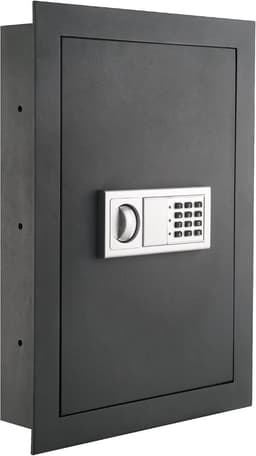
Measure the depth on the attribute line, not the lifestyle photo. The Paragon 7725 is about 10.2 cm deep and is sold as a flat between-studs safe, so it is the only in-wall listing here. The Yale mini is about 19 cm, the Amazon Basics cabinet about 25 cm, the NALULI and HSGCJS models about 32 cm, the WASJOYE about 37 cm, and the large Yale about 38 cm. Anything in that 19 cm to 38 cm range stands proud of the wall once it is bolted on. The Paragon listing uses inch sizes and US 16 inch stud centres, so measure the clear gap before you treat in-wall as a promise. A flat unrated box is still outside EN 1143-1, EN 14450, Sold Secure, and LPS 1183. Who that flat body suits is on best wall safe.

When a bolted cabinet is the better door

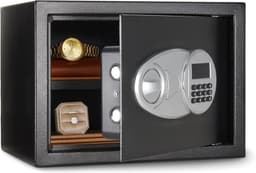
Choose the bolted cabinet when you open the safe often, when the papers are A4, or when the wall is brick or block and you can get bolts into the centre of the masonry. A door you can reach without moving a panel is the better daily door. The small Yale, about 8.6 litres, is the modest end of that choice for passports. The Amazon Basics cabinet, about 14 litres and 25 cm deep, is the step up if you want more volume and you accept a box that remains visible unless you put a cupboard in front of it. Lock & Key's type guide is the limit: a wall safe is not automatically safer than a freestanding safe, because the wall can be the weak point. Plasterboard still fails even if the label says wall mount. How to fix it, and when to stop, is on how to fit a wall safe.

When the wall itself has to hold a graded safe

A third shape sits outside this comparison. Certified EN 1143-1 bodies are set into a solid wall, often in concrete, and the wall thickness is part of the product. Shop pages cite a Burton Unica Grade 0 with a £6,000 cash figure and about £60,000 valuables, at roughly £882 to £1,289, and Simply Safes states that the Unica is not fire resistant. That is the purchase when an insurer has named a grade and you have the masonry to take it. It is a poor match for a stud bay. Indicative cash figures are not your policy. If the sum matters, read home insurance safe rating and get the model and the fixing confirmed in writing.

Floor safe, in one pass

A floor safe is set into the floor rather than hung on or in a wall. The Yale Y-FLS0000 is that product and it is not in this comparison, so it is not a row in the table. Safe.co.uk's floor-versus-wall table assumes the wall option is a cavity, not a cabinet with extra bolts, which is why that table mis-sorts the Amazon Basics and Yale cabinets. Floor safes are harder to find and are set in concrete, while a wall safe is easier to reach and easier to spot. A timber floor is a question for the insurer if anchoring is a policy condition. Underfoot concealment means a floor safe or a graded wall safe, not a wall-mount cabinet.

Common questions

When is the Paragon the right shape?
It is the right shape when you have a clear stud bay, you want the body inside the wall, and the contents fit a shallow box with a compromised middle shelf. It is the wrong shape when you need A4 laid flat, a certificate, or a door you open every day from a brick wall. Measure the clear gap, because the listing's 16 inch centres are a US figure.
Is a wall safe safer than one bolted to the floor?
Lock & Key says a wall safe is not automatically safer than a freestanding safe, because the wall can be the weak point. A bolted cabinet on good brick can be the stronger everyday choice. A shallow body in a hollow stud wall can be the weaker one. Floor fixing and wall fixing are both only as good as the substrate.
Can I hide a 32 cm deep safe behind a picture?
A 32 cm cabinet will not sit behind a normal picture. The frame would stand well clear of the wall, which advertises the void. Concealment for that depth means a cupboard or a robe in front, not a frame. The flat Paragon is the body that can sit inside a wall or a cupboard back.
What about a floor safe instead?
Choose a floor safe when you want the body in the floor and you can set it properly, often in concrete. That product is not in this comparison. Safe.co.uk's wall column assumes a cavity, so do not use it to describe a bolted cabinet. A timber floor and an anchoring clause belong in a question to the insurer.
Do I need concrete?
You need concrete, or a fitter's equivalent bedding, for a graded wall safe the maker specifies as set into masonry, and often for a floor safe. You do not need it for a cabinet with back holes, or for the Paragon's stud fixing. A stud wall can take that flat body, or a surface cabinet bolted into the studs, and it is a poor home for a concrete-set grade. If the next step is opening a party wall, book a fitter.

Related pages

Sources

Public UK sources on home safes, grades and party walls. amazon.co.uk listings in this set were checked on 16 October 2026. Prices move.

  1. Police.uk, home safes (retrieved 16 October 2026)
  2. Secured by Design, home safes (retrieved 16 October 2026)
  3. De Raat, insurance rating (retrieved 16 October 2026)
  4. ESSA, EN product insurance amounts (retrieved 16 October 2026)
  5. BSI, EN 15659 light fire storage units (retrieved 16 October 2026)
  6. GOV.UK, Party Wall etc. Act 1996 booklet (retrieved 16 October 2026)
  7. Wickes, how to fit a safe (retrieved 16 October 2026)
  8. Simply Safes, Burton Unica wall safe (retrieved 16 October 2026)