Palm router vs plunge router
You searched for a router and the results mixed a 2.5 kg trimmer with an 11 kg machine that takes 1/2 inch cutters. A palm router vs plunge router choice is which base may start the cut. The compact rows are on our [palm router comparison](/hub/routers/palm-router). The Trend T8 and T14 sit outside this category. The Products Compared editorial team wrote it on 16 October 2026 from Maker UK, Howe Tools, and those amazon.co.uk extracts. A qualifying purchase through our links can earn a commission at no extra cost to you. If you are still choosing a collet and a plug inside the palm class, use the [palm router buying guide](/hub/routers/palm-router/sub/palm-router-buying-guide).
You searched for a router and the results mixed a 2.5 kg trimmer with an 11 kg machine that takes 1/2 inch cutters. A palm router vs plunge router choice is which base may start the cut.
You searched for a router and the results mixed a 2.5 kg trimmer with an 11 kg machine that takes 1/2 inch cutters. A palm router vs plunge router choice is which base may start the cut. The compact rows are on our palm router comparison. The Trend T8 and T14 sit outside this category. The Products Compared editorial team wrote it on 16 October 2026 from Maker UK, Howe Tools, and those amazon.co.uk extracts. A qualifying purchase through our links can earn a commission at no extra cost to you. If you are still choosing a collet and a plug inside the palm class, use the palm router buying guide.
Our top picks
| Badge | Product | Base | Stated output | Collet | Note | Price | Offer |
|---|---|---|---|---|---|---|---|
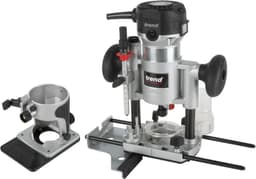
| Best overall |  Trend Trend T1EPS dual-base | Trim and plunge; 37 mm trim and 60 mm plunge claimed | 710 W; 0.95 hp; 2.96 A | 1/4 inch | 9.2 | about £116.00 | View offer |
| Best value |  KATSU KATSU 710W trimmer | Fixed, 89 mm diameter | 710 W | 1/4 inch and 3/8 inch claimed | 9.0 | about £41.99 | View offer |
 Anesty Anesty palm router | Fixed, 64 mm diameter | Spec line says 2 hp; a bullet is in the 710 W class | 1/4 inch claimed | 9.0 | about £49.20 | View offer |


On this page
What each base can start
Power and shank
The one dual-base tool in this set
Which to buy
Common questions
What is the difference between a palm router and a plunge router?
Can a fixed base start a cut in the middle of a board?
Is the Trend T1 a plunge router?
Do I need 1/2 inch collets?
Which should I buy first?
Can I put a palm router in a table instead of buying a plunge router?
When is the palm router the better choice?
Related pages
Sources
Public UK sources used for the dust, noise, electrical and consumer-rights points on this page. Prices, stars and review counts are from the amazon.co.uk listings in this set, as in the digest of 16 October 2026.
- HSE — Wood dust (retrieved 16 October 2026)
- HSE WD5 — On-tool extraction (retrieved 16 October 2026)
- British Woodworking Federation — Portable on-tool extraction (retrieved 16 October 2026)
- HSE WIS23 — COSHH and wood dust (retrieved 16 October 2026)
- HSE L108 — Controlling noise at work (retrieved 16 October 2026)
- HSE — Electrical equipment (retrieved 16 October 2026)
- PUWER 1998 (retrieved 16 October 2026)
- Consumer Rights Act 2015, section 22 (retrieved 16 October 2026)