Independent comparisons. We may earn from shop links. More info

How to use a palm router

Updated: October 2026

The cutter grabbed on the first pass, the base tipped, and the groove is deeper at one end than the other. This is how to use a palm router once it is already in your hand. Model choice sits on our [palm router comparison](/hub/routers/palm-router). The Products Compared editorial team wrote this on 16 October 2026 from Machine Mart, Trend’s router notes, and HSE wood-dust guidance. A qualifying purchase through our links can earn a commission at no extra cost to you. Hinge layout and the jig stay on [palm router door hinges](/hub/routers/palm-router/sub/palm-router-hinge-recess). The collet you should have checked before paying is on the [palm router buying guide](/hub/routers/palm-router/sub/palm-router-buying-guide).

The cutter grabbed on the first pass, the base tipped, and the groove is deeper at one end than the other. This is how to use a palm router once it is already in your hand.

Our top picks

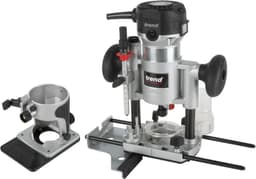
Trend Trend T1EPS dual-base

Best overall

Trend Trend T1EPS dual-base
9.2/10about £116.00
KATSU KATSU 710W trimmer

Best value

KATSU KATSU 710W trimmer
9.0/10about £41.99
Anesty Anesty palm router

Rank 3

Anesty Anesty palm router
9.0/10about £49.20
On this page

Fit the cutter

Unplug the tool, or take the battery off, before the spanner touches the collet. The shank must match the collet. A 6 mm bit is not a 1/4 inch bit, and a 1/4 inch shank is 6.35 mm. If the bit will not enter, stop. One SINGTIP review describes bits that would not go in. Seat the shank well into the collet and leave a small gap so the bit is not bottomed, then tighten with both spanners. Trend’s preparation notes say the router should be at full speed before the cutter meets the wood.

Set a shallow depth

Set the cutter proud of the base by a small amount, lock it, and try the lock by pushing the cutter with the tool still unplugged. If the cutter moves under hand pressure, it will move in oak. The older KATSU has a review in which the height moved during the cut. A fixed base cannot copy a plunge turret: you set the depth, you enter from an edge, and you do not drop the cutter by releasing a spring.
Trend Trend T1EPS dual-base

Testsieger

Trend Trend T1EPS dual-base
9.2/10about £116.00

Feed against the rotation

Look down on the palm router. The cutter turns clockwise, and you feed against that rotation. Wonkee Donkee’s Trend note describes the hand-held direction, and the opposite direction once the same router is upside down in a table. One UK review says the Trend T1EPS cannot go in a router table. If the motor screams or the barrel twists in your hand, switch off and reduce the depth.

Dust, heat, and stopping

A dust hood on the listing is the port. It is not the extractor. One Anesty reviewer could not see the line without extra light. Call a professional when the site is 110 V and the tool is 230 V, or after a thrown cutter.

Common questions

How do I fit a bit in a palm router?
Unplug the cord or remove the battery. Match the shank to the collet, seat it without bottoming the bit, and tighten with both spanners. A 6 mm shank does not belong in a 1/4 inch collet. If the nut is soft or the spanner is the wrong size, which CtopoGo reviewers report, stop rather than rounding the nut. Switch on only after the base is on the wood and your hands are clear of the cutter.
How deep should the first pass be?
Shallower than the finished groove. Machine Mart suggests about 6–8 mm on a conventional router. A rule of thumb is about one cutter diameter or less, and less again in oak or with a wide bit. Neither number is a standard clause for these palm tools. Prove the lock and the finish on scrap of the same thickness before you touch the job. One full-depth pass is how a lock that creeps ruins an edge.
Which way do I move the tool?
Feed against the clockwise rotation you see from above. On an outside edge, with the face towards you, that is usually left to right. Wonkee Donkee notes that a table-mounted router is fed the other way. Keep the base flat, and ease off if the motor note drops or the timber burns. A palm barrel has no side handles, so both hands stay on the body and the base, not on the cutter.
What is climb cutting?
Climb cutting feeds with the cutter’s rotation, so the bit can pull the tool along the edge. Machine Mart says to avoid it. A finishing skim is sometimes used by people who already know the grab. A first rebate, a laminate edge, or a hinge recess is the wrong place to learn it. If the tool runs away once, stop, deepen nothing, and take the next pass in the ordinary direction at a shallower setting.
Why is the body too hot to hold?
Friction, a deep bite, and a housing used as the handle. Several UK reviews of the INMOZATA say the metal body became too hot during a longer cut. Raise the cutter, let the tool cool, and take less per pass. If the same tool has shocked you, which two UK reviews of that listing describe at switch-on, stop using it. Heat alone is a reason to pause. A shock is a reason to unplug and not resume.
Do I need a dust extractor for a short job?
You need the dust out of the air you are breathing. For work, HSE WD5 expects on-tool extraction to a Class M or H unit, with the viewing panel left on. A household vacuum is not that class. Anesty reviewers describe a room full of dust without a hose, even on DIY. A short edge still warrants a hose if the tool has a port. A hood with nothing attached does not clear the cut.
When should I stop and not carry on?
Stop when the cutter is loose, the lock creeps, the body is too hot to hold, you cannot see the cut for dust, or the tool has shocked you. Stop when the work is a fire door and this is your first router. A thrown cutter or a damaged base, which one Trend review describes after a loose bit, is the end of that session. Scrap is the place to find the limit, not the finished stile.

Related pages

Sources

Public UK sources used for the dust, noise, electrical and consumer-rights points on this page. Prices, stars and review counts are from the amazon.co.uk listings in this set, as in the digest of 16 October 2026.

  1. HSE — Wood dust (retrieved 16 October 2026)
  2. HSE WD5 — On-tool extraction (retrieved 16 October 2026)
  3. British Woodworking Federation — Portable on-tool extraction (retrieved 16 October 2026)
  4. HSE WIS23 — COSHH and wood dust (retrieved 16 October 2026)
  5. HSE L108 — Controlling noise at work (retrieved 16 October 2026)
  6. HSE — Electrical equipment (retrieved 16 October 2026)
  7. PUWER 1998 (retrieved 16 October 2026)
  8. Consumer Rights Act 2015, section 22 (retrieved 16 October 2026)