Independent comparisons. We may earn from shop links. More info

Palm router door hinges

Updated: October 2026

The hinge sits proud of the door, or the recess is deeper at the pin than at the knuckle, and the leaf rocks. Palm router door hinges come out level when the depth is the leaf and the cutter stays in a guide. Which of these tools reviewers used is on our [palm router comparison](/hub/routers/palm-router). The Products Compared editorial team wrote it on 16 October 2026 from Trend’s hinge-jig guidance, the Axminster UJK jig notes, and those amazon.co.uk reviews. A qualifying purchase through our links can earn a commission at no extra cost to you. Feed, collet, and when to put the tool down are on [how to use a palm router](/hub/routers/palm-router/sub/palm-router-how-to-use).

The hinge sits proud of the door, or the recess is deeper at the pin than at the knuckle, and the leaf rocks. Palm router door hinges come out level when the depth is the leaf and the cutter stays in a guide.

Our top picks

Trend Trend T1EPS dual-base

Best overall

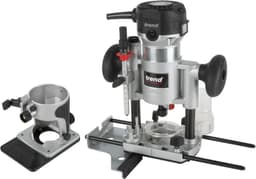
Trend Trend T1EPS dual-base
9.2/10about £116.00
KATSU KATSU 710W trimmer

Best value

KATSU KATSU 710W trimmer
9.0/10about £41.99
Anesty Anesty palm router

Rank 3

Anesty Anesty palm router
9.0/10about £49.20
On this page

Jig, bush, and cutter

Trend’s own hinge-jig guide uses a 12 mm straight cutter and a 16 mm guide bush, with the router running inside the jig aperture. Axminster’s UJK jig asks for the same cutter and bush. None of these router boxes is that jig, and a bearing on a kit bit is not a 16 mm bush. A fixed-base palm router cannot drop the cutter the way Trend’s manual assumes. The Trend T1EPS is the dual-base row here if the manual insists on a plunge.

Depth and passes

Take the hinge leaf you are fitting and use it as the depth gauge. A 2 mm leaf and a 3 mm leaf are different doors. If the recess is too deep, the screw heads sit low and the leaf cups. Lock the router, offer the base and the leaf against a straight block of scrap, and see whether the cutter just meets the leaf thickness. If the lock creeps on the scrap, which DEWINNER and KATSU 101742 reviews both describe, fix or reject the tool before the door.
Trend Trend T1EPS dual-base

Testsieger

Trend Trend T1EPS dual-base
9.2/10about £116.00

Corners and the latch

Do not nibble a square with the side of the bit. That is how the stile splits. The same sequence fits a latch plate, which UK reviews of the KATSU 101742 mention. INMOZATA reviews include a trim guide that would not stay tight. Keep the base flat and move clockwise inside the jig.

What this set can and cannot do

UK reviews mention hinges, latch plates, or rebates on several of these listings. That is evidence of the job, not evidence that the kit cutter was the right 12 mm bit. Buy the 12 mm straight cutter, and treat the boxed set as practice. Do not choose the INMOZATA because someone recessed a hinge on a good day. A fixed base can do an edge-entry recess if you control the entry. The same stop applies after a shock or a cutter that has already come loose.

Common questions

Can a palm router cut a hinge recess?
Yes, on a timber door or frame, if you set the depth from the hinge leaf, guide the cutter, and take more than one light pass. A fixed base is a different setup from Trend’s plunge-router jig manual. If that manual is the method you must follow, use a plunge base such as the T1EPS. The boxed bits are the weak part in several of those same reviews.
How deep should the recess be?
The thickness of the leaf you are fitting. Set the cutter against that leaf on scrap, then lock it. A guessed 3 mm is wrong for a 2 mm leaf and still wrong if the lock creeps. Take the depth in more than one pass even when the leaf is shallower than Machine Mart’s 6–8 mm general figure. Offer the leaf in the recess before you drill the screw holes. Proud at one end means the depth or the guide moved.
Do I need a jig and a guide bush?
You need a guide that holds the cutter to the leaf outline. The bush has to fit your base. A roller guide from a trim-router box can follow an edge, and it is not the same aperture. The jig is not in these router listings. Buy it as a separate tool, and confirm the bush clamps before you cut the door.
Why are the corners round?
The cutter is round, so the recess corners are radiused. The hinge leaf is square. Square them with a chisel or a corner chisel after the routing, which is what Trend’s hinge guide describes. Trying to carve the square with the router still running is how the edge breaks out. Knife the corner lines first so the chisel has a place to stop.
Will the bits in the box do an oak door?
Do not plan on it. UK reviews of the CtopoGo, Anesty, SINGTIP, and INMOZATA say kit bearings and cutters fail early, including bits that burn on MDF. One CtopoGo review did manage oak hinge work, and that single report is not a reason to trust a 12-piece case for a pair of oak doors. Fit a 12 mm straight cutter with a shank that matches the collet, and keep the kit bits for scrap.
Can I rout a fire door?
Leave a fire door to a joiner if you have not used a router, and do not treat this page as a method for altering one. A fire door is a rated assembly. Cutting it can spoil that rating. Practise on an ordinary timber door or on scrap. The same pause applies if the tool has shocked you or thrown a cutter. Those are stop points, not steps to rout through.
Which tools in this set were used for hinges?
UK review texts mention hinges, rebates, or latch plates for the KATSU 710 W, the KATSU 101742, the CtopoGo CT-370, the SINGTIP, the DEWINNER, and the INMOZATA. The Trend T1EPS reviews mention hinge jigs on doors. The INMOZATA also has two UK shock reports, so it is the one to leave despite the hinge comments. Kit cutters remain the part those reviews criticise. The main comparison has the prices.

Related pages

Sources

Public UK sources used for the dust, noise, electrical and consumer-rights points on this page. Prices, stars and review counts are from the amazon.co.uk listings in this set, as in the digest of 16 October 2026.

  1. HSE — Wood dust (retrieved 16 October 2026)
  2. HSE WD5 — On-tool extraction (retrieved 16 October 2026)
  3. British Woodworking Federation — Portable on-tool extraction (retrieved 16 October 2026)
  4. HSE WIS23 — COSHH and wood dust (retrieved 16 October 2026)
  5. HSE L108 — Controlling noise at work (retrieved 16 October 2026)
  6. HSE — Electrical equipment (retrieved 16 October 2026)
  7. PUWER 1998 (retrieved 16 October 2026)
  8. Consumer Rights Act 2015, section 22 (retrieved 16 October 2026)