Independent comparisons. We may earn from shop links. More info

Palm router buying guide

Updated: October 2026

You are on amazon.co.uk with compact routers that look alike until the collet, the speed line, and the plug do not. This palm router buying guide is the order of checks before you pay. Shelf prices sit on our [palm router comparison](/hub/routers/palm-router). The Products Compared editorial team wrote it on 16 October 2026 from those amazon.co.uk extracts and from HSE guidance on wood dust. We did not run the tools in a workshop. A qualifying purchase through our links can earn a commission at no extra cost to you. If you already want a named pick, the short decision is on [best palm router UK](/hub/routers/palm-router/sub/palm-router-best).

You are on amazon.co.uk with compact routers that look alike until the collet, the speed line, and the plug do not. This palm router buying guide is the order of checks before you pay.

Our top picks

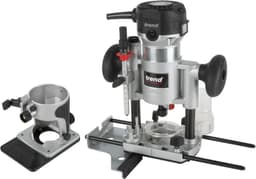
Trend Trend T1EPS dual-base

Best overall

Trend Trend T1EPS dual-base
9.2/10about £116.00
KATSU KATSU 710W trimmer

Best value

KATSU KATSU 710W trimmer
9.0/10about £41.99
Anesty Anesty palm router

Rank 3

Anesty Anesty palm router
9.0/10about £49.20
On this page

Collet first

The shank has to match the collet. A 6 mm bit is a different shank from a 1/4 inch bit. A 1/4 inch shank is 6.35 mm, and UK reviews in this set include bits that would not enter. If the bit stops at the mouth of the collet, that listing is the wrong purchase for the cutters in your drawer. The KATSU at £41.99 claims 1/4 inch and 3/8 inch collets, and one UK review says a 1/4 inch bit would not fit. The other KATSU, model 101742 at £42.99, claims 6 mm, 8 mm, and 1/4 inch. A 3/8 inch collet does not turn the older KATSU into a 1/2 inch workshop router.

Speed and power

A speed dial lets you slow a wider cutter or a timber that burns. The highest rpm figure on the title is a poor reason to choose. The KATSU 710 W says variable speed and does not print a range. The Avhrit is the clash to leave unresolved: a bullet says 0–3,300 rpm and the specification line says 33,000 rpm. The Anesty specification line says 2 horsepower while a bullet stays in the 710 W class. None of these watt figures is a 2,200 W plunge router.
Trend Trend T1EPS dual-base

Testsieger

Trend Trend T1EPS dual-base
9.2/10about £116.00

Mains, battery, and the plug

Home use in the UK is a 230 V tool with a BS 1363 plug. A printed 220 V or 220–240 V line is not that plug, and it is not a UKCA mark. None of these files is a 110 V site tool. The Anesty and the Trend T1EPS state 240 V. The KATSU 101742, DEWINNER, and INMOZATA do not state a voltage. If the plug in the photos is a two-pin European plug, leave the listing. The Avhrit at £89.99 lists two batteries and a charger, and the charger plug type is still not described.

Bits and dust

The CtopoGo reviews include bits that burn on MDF. The Trend T1EPS included-components line names the 240 V UK router and does not name a bit set. A dust hood is a different object from extraction. The INMOZATA claims a dust hood and still has two UK reviews of an electric shock at switch-on. Those shock reports are a reason to reject the listing. The order is collet, then a speed line you can read, then the plug or the battery, then a cutter you will actually use.

Common questions

What should I check before I buy a palm router?
Check the collet against the shank you own, then whether a speed range is actually printed, then the plug or the battery, then whether you will use the bits in the box. Wattage comes after those. In this set a 6 mm shank is a different size from a 1/4 inch shank, and a 220 V line is not proof of a BS 1363 plug. Shelf prices stay on the main comparison.
Is 6 mm the same as 1/4 inch?
No. A 1/4 inch shank is 6.35 mm. A 6 mm bit will not seat as a 1/4 inch bit, and a 1/4 inch bit will not enter a 6 mm collet. The KATSU 101742 and the DEWINNER claim both sizes as separate collets. One SINGTIP review says the supplied bits would not enter and suspects a 6 mm collet against a 6.35 mm title. Confirm the collet on the tool before you order a set of cutters.
Do I need variable speed?
You need a dial when the cutter is wide or the timber burns. A single maximum, such as the CtopoGo’s 30,000 rpm line, is not a dial. One UK review says the SINGTIP has no speed control. The Avhrit page lists both 0–3,300 rpm and 33,000 rpm, so you should leave that speed claim unsettled until the listing agrees with itself. A fixed speed can still trim a narrow bit in softwood.
Corded or cordless for a shed?
A corded 240 V tool is the simpler buy when a socket is within reach of the lead. The Anesty states 240 V at £49.20. A cordless kit fits a shed or a door you cannot trail a lead across, and in this set that means the BATOCA at £69.99 or the Avhrit at £89.99. The BATOCA’s stored reviews are not marked United Kingdom, and the Avhrit’s speed figures conflict. Either cordless row still needs the collet check.
Are the bits in the box worth using?
Often they are the weak part. UK reviews of the Anesty, CtopoGo, SINGTIP, and INMOZATA complain about bearings and early failure. Use them to learn the depth lock on scrap if you want, and buy a separate cutter for an oak edge or a hinge. The Trend T1EPS does not list starter bits on its included-components line, so that price assumes a cutter you already own or will buy.
Is a dust hood the same as extraction?
No. A hood or a spout only helps if it is connected to a suitable extractor. HSE guidance in WD5 expects on-tool extraction with a Class M or H unit when the work is done as work, and an L-class vacuum is the wrong class. Anesty reviewers say the cut is a dust cloud without a hose. A hood on the INMOZATA listing does not answer the two UK shock reports.

Related pages

Sources

Public UK sources used for the dust, noise, electrical and consumer-rights points on this page. Prices, stars and review counts are from the amazon.co.uk listings in this set, as in the digest of 16 October 2026.

  1. HSE — Wood dust (retrieved 16 October 2026)
  2. HSE WD5 — On-tool extraction (retrieved 16 October 2026)
  3. British Woodworking Federation — Portable on-tool extraction (retrieved 16 October 2026)
  4. HSE WIS23 — COSHH and wood dust (retrieved 16 October 2026)
  5. HSE L108 — Controlling noise at work (retrieved 16 October 2026)
  6. HSE — Electrical equipment (retrieved 16 October 2026)
  7. PUWER 1998 (retrieved 16 October 2026)
  8. Consumer Rights Act 2015, section 22 (retrieved 16 October 2026)