Independent comparisons. We may earn from shop links. More info

Raised bed on concrete or paving

Updated: October 2026

You are on a patio of slabs with an open-bottom kit, and the listing treats that hole as a drainage feature. A raised bed on concrete does not behave like the same frame on a lawn. On soil the opening lets roots out and rain away. On paving the mix can slide onto the slabs, and water sits because the surface does not drain downwards. This page is for a courtyard where the sunny spot is hard standing. You should finish knowing when that frame is usable, and when 30 cm is too shallow. The [raised bed comparison](/hub/raised-beds-greenhouses-and-compost/raised-bed) covers the steel kits.

You are on a patio of slabs with an open-bottom kit, and the listing treats that hole as a drainage feature. A raised bed on concrete does not behave like the same frame on a lawn.

Our top picks

On this page

Open bottom is not one situation

Open bottom for drainage describes soil. On open ground the frame is a collar, moisture and roots move into the garden, and many growers put nothing in the base. Grass is the middle case: cardboard on the turf blocks the light for a season, then breaks down so the bed meets soil. Concrete, poured or laid as tight slabs, is a third case. Nothing underneath takes the water, and plants can root only in the volume you put in the frame. Block paving on sand is a different job from a solid slab. You can sometimes lift the blocks and let the bed meet the ground, whereas poured concrete gives no downward drain. A 30 cm steel frame on a sealed yard works as a large planter.

Holding soil without making a pond

One hard-ground method lines the whole bed, base included, and adds pin holes plus a drainage layer if the lining waterlogs. That conflicts with advice to avoid a sealed floor. Both sides still share one rule: water must leave, and soil must not. A solid sheet with no exit is a pond after a wet week, and a fabric that does not turn up the sides leaks at the first watering. A Harbour UK note on concrete lines the lower half so the mix stays in. KING BIRD’s UK notes say there is no bottom, so you plan a liner before you fill. The hard-surface mix ratio sits on the how to fill a raised bed page. The decision here is the floor under that mix, and whether water can still get out.

Depth when nothing is underneath

Salads, herbs and compact annuals can live in 30 cm if you water as you would a container. A frame about 1 m by 2 m and 30 cm deep holds roughly 600 litres. A 30 cm kit will not reach 50 cm. Accept a shallow container, choose a deeper frame, or move the bed onto soil. Cutting the concrete is a builder’s job, and a frame tight against a house wall is a damp question for the building.

Which kits in this set have no floor

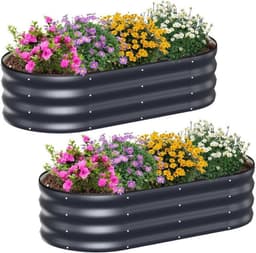
Harbour, Willow Weave, Ergohortus, HEALSTOK, GoCampDirect, the VIREO round and KING BIRD are sold open or bottomless. On slabs you supply the base, or the first heavy watering carries soil onto the paving. A drainage tick only says water is supposed to leave. INNO STAGE’s 60 cm three-pack says reinforced bottom, so that row is not a bottomless bed. FOUBAM and the long beds do not print “open bottom” even where drainage is marked yes. A bottomless metal bed still needs fabric or a pierced lining, a way for water to leave, and a depth you can live with. The reinforced-bottom set sits more like a trough, provided you keep its drainage holes clear of a plastic sheet. If you are still choosing between two-packs and want a shortlist, use the best raised beds page. On concrete, settle the floor before you compare the frames.

Common questions

Can you put a bottomless bed on concrete?
Yes, once you add a floor that holds soil and still lets water out. On concrete the open hole lets the mix creep onto the slabs, and an unpunctured liner holds the rain in the frame. Fit that draining base as part of the build. If you will not, set the frame on soil or choose a kit that already has a bottom.
What stops the soil falling through?
A woven fabric across the open base holds the mix and still lets water pass. Tuck it up the lower sides, because a finger-width gap at a corner lets compost track onto the paving. Cardboard suits grass, where it rots and the bed meets soil. On concrete it turns to mush within a season.
Is plastic sheeting the liner you want?
Only when water can leave. A solid sheet keeps the soil in and then keeps the rain in, so the bed becomes a pond after a wet week. One hard-ground method still lines the base, then adds pin holes if water sits, plus a drainage layer. The shared point is an exit, so a sheet with none stays in the shed.
Is 30 cm enough if roots cannot go into the ground?
It is enough for salads and herbs if you water and refresh the mix like a pot. It misses the RHS figure for tarmac, at least 50 cm, and HEALSTOK at about 43 cm still falls short. Longer-rooted crops hit the slab and stall. If those crops are why you bought the frame, a short kit on paving is the wrong container.
What did the RHS say about tarmac?
Its school note on creating raised beds asks for a weed suppressant and at least 50 cm on tarmac. The hard-surface fill is three parts organic matter, four parts sharp sand and seven parts topsoil, and you refresh it like a container. That depth is for a bed that cannot root downwards. The short frames in this set do not meet it.
Will water stain the slabs?
It can. Runoff carries fine soil and feeds algae on damp stone, especially along a shaded side of the frame. No liner layout promises a clean patio. Sending the water away from stone you care about limits the stain, though it will not erase it.
Should you lift block paving instead?
Lift the blocks when they sit on sand and you can spare that patch. The bed then meets the ground, and the open bottom works as it does on soil. Poured concrete and slabs bedded on mortar do not offer that route. Leave the blocks if they are your only level surface, or if a builder would have to cut what lies beneath.

Related pages

Sources

Public UK sources from the research digest, last checked on 16 October 2026.

  1. RHS — How to make a raised bed (retrieved 16.10.2026)
  2. RHS — Growing veg in raised beds (retrieved 16.10.2026)
  3. RHS — No-dig gardening (retrieved 16.10.2026)
  4. RHS — Creating raised beds for schools (retrieved 16.10.2026)
  5. Thrive — Wheelchair-friendly garden design (retrieved 16.10.2026)
  6. GOV.UK — Permitted development technical guidance (retrieved 16.10.2026)
  7. legislation.gov.uk — Consumer Rights Act 2015 (retrieved 16.10.2026)
  8. Quickcrop — Timber raised beds vs metal raised beds (retrieved 16.10.2026)