Independent comparisons. We may earn from shop links. More info

Raised bed buying guide

Updated: October 2026

You are choosing a raised bed for a UK back garden or allotment, and the metal kits on the screen look like the same low box. This raised bed buying guide settles the ground, the crop and the reach before a brand. The [raised bed comparison](/hub/raised-beds-greenhouses-and-compost/raised-bed) holds the eleven amazon.co.uk listings we checked, mostly open galvanised or painted steel from £30.63 to £59.99 in the extracts. The rankings stay on that page. The Products Compared editorial team checked those extracts against RHS, Thrive and GOV.UK guidance, and updated this page on 16 October 2026. We did not laboratory-test the steel. If you buy through our links, we may earn a commission at no extra cost to you.

You are choosing a raised bed for a UK back garden or allotment, and the metal kits on the screen look like the same low box. This raised bed buying guide settles the ground, the crop and the reach before a brand.

Our top picks

On this page

What the bed is sitting on

On soil, an open bottom is the useful choice. Water can leave, and roots can continue into the ground, which suits a heavy plot that is soil rather than a sealed yard. On grass the same opening works once you cover the turf, and those layers belong with the fill rather than in the box. If the bed is for a patio, read the guide to a raised bed on concrete or paving before you buy bags. Breaking a slab, or building the sides in brick, is work for a tradesperson.

Depth and width

Side height follows the crop, and the soil wall is the figure that counts, not a trellis above it. Width is how far you can work without standing on the soil. The RHS keeps a bed under 1.5 m so you can reach the centre, and its no-dig guidance uses about 1.2 m. A trough around 60 cm suits one side along a fence. A 120 cm frame needs both sides or you will step in the middle.

Braces, edges and the number that is missing

Wet soil bows a thin side, and you notice once the bed is full, when adding a rod means digging the mix back out. Fit the braces before you fill, and add the soil in stages. A long wall with nothing across it is the frame wet soil pushes out of shape.

The price of the frame and the price of the fill

The frames in these extracts cost £30.63 to £59.99, and the soil is often the larger bill. Litres are length times width times soil depth, in metres, times 1,000. Read the height that was multiplied. Ordering compost to the top of a trellis pays for soil the frame was never meant to hold. The RHS mix is mostly topsoil, because compost on its own slumps. How to layer it, including cardboard on grass, is set out in how to fill a raised bed.

Common questions

How deep should a raised bed be for vegetables?
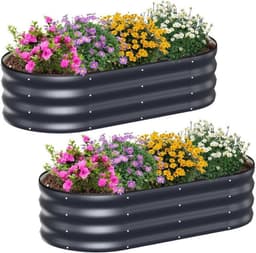
The Royal Horticultural Society puts about 30 cm of side height with salad, strawberries and dwarf bulbs, and 45 cm or more with most other plants, especially fruit bushes and shrubs. Measure the soil wall, not a trellis. In the eleven kits on our comparison, most walls are about 30 cm, and the HEALSTOK pair is about 42.7 cm, so it sits nearer the 45 cm line than the rest. A 30 cm bed is a reasonable salad bed on soil. It is a short bed for fruit bushes, or for anyone who wanted much less bending.
Does an open bottom matter on a raised bed?
It matters once you know the surface. On soil or grass an open base lets water drain and lets roots continue, which is how most of these galvanised kits are made. On concrete, mortared slabs or tarmac there is nothing underneath, so the same opening lets the mix leak and water sit. The RHS guidance for beds on tarmac asks for at least 50 cm of height, and a 30 cm kit does not provide it. Some listings state an open base. Others only mark drainage as yes, so read that line before you assume there is no floor.
Is a 30 cm raised bed high enough if you use a wheelchair?
Not against Thrive’s seated working height of about 615 mm. A 30 cm kit is roughly half that, and it is not a standing-height table. The same guidance wants paths of about 1.2 m and about 2.4 m to turn, which you plan in the garden rather than in the box. One UK review of the Ergohortus oval pair, which is 30 cm high, says a wheelchair user could plant again at that height. That is one person’s report. A seated-height bed is a build for someone who sets out access gardens.
Do you need planning permission for a normal raised bed kit?
A low kit in a house garden is often outside planning control, as a matter of fact and degree. That still leaves flats, listed buildings and a large permanent run as questions for the local authority. GOV.UK’s permitted-development guidance treats a platform over 0.3 m as a different limit from a low planter, so a 30 cm bed is not that platform rule, and a tall structure is not automatically allowed either. Ask the council when the run is large, fixed or on a listed site. A product listing is not consent.
Why can the fill cost more than the raised bed frame?
The frames in these extracts are £30.63 to £59.99, while one bed of 180 × 90 × 30 cm holds about 486 litres. A two-pack is twice that soil. One UK buyer of the Harbour Housewares pair used about 12 large bags in each bed, plus cardboard and garden waste. Bag prices are not in the extracts, so this is not a quoted compost bill, but that volume can overtake a frame at the top of this price band once you fill two beds. The KING BIRD figure of 2,916 litres uses the 180 cm trellis height. The soil wall is still about 30 cm.
What does a rubber edge or a pair of gloves tell you?
They describe the rim during and after assembly, not the thickness of the steel. Gloves, included with kits such as the INNO STAGE trough, match UK reviews of cuts before the trim is fitted. A rubber edge, named on the VIREO GARDEN round pair, covers that rim once the bed is up. In this set only GoCampDirect states a thickness, at 0.6 mm, and the other listings omit it. A covered edge does not stop a thin side bowing, so the braces still have to be in the box before the soil goes in.

Related pages

Sources

Public UK sources from the research digest, last checked on 16 October 2026.

  1. RHS — How to make a raised bed (retrieved 16.10.2026)
  2. RHS — Growing veg in raised beds (retrieved 16.10.2026)
  3. RHS — No-dig gardening (retrieved 16.10.2026)
  4. RHS — Creating raised beds for schools (retrieved 16.10.2026)
  5. Thrive — Wheelchair-friendly garden design (retrieved 16.10.2026)
  6. GOV.UK — Permitted development technical guidance (retrieved 16.10.2026)
  7. legislation.gov.uk — Consumer Rights Act 2015 (retrieved 16.10.2026)
  8. Quickcrop — Timber raised beds vs metal raised beds (retrieved 16.10.2026)