Independent comparisons. We may earn from shop links. More info

Best raised garden bed: which shape suits your space?

Updated: October 2026

Choosing the best raised garden bed is less about finding one universal winner and more about matching a frame to the way you garden. A narrow side return needs a different bed from an open allotment, while a climber such as a tomato or bean needs support that salad leaves do not. Our [raised bed comparison](/hub/raised-beds-greenhouses-and-compost/raised-bed) covers all 11 amazon.co.uk listings; this shortlist focuses on the practical reason to choose or reject a few of them. Decide first whether reach, two separate growing areas, extra side height or an included trellis matters most, then check the fill volume before ordering soil.

Choosing the best raised garden bed is less about finding one universal winner and more about matching a frame to the way you garden.

Our top picks

On this page

Best if you work from one side

A bed about 60 cm wide is the more manageable choice when a fence, wall or shed blocks access along one edge. You can usually reach its centre without leaning heavily on the rim or stepping into the soil. The 244 x 60 cm INNO STAGE trough fits that job better than a 120 cm-wide bed, provided you have room for its considerable length. Its stated volume is 439.08 litres, so it still requires a substantial soil order despite looking narrow. By comparison, a 120 cm-wide bed works best only when you can reach it from both long sides. Use the access test in our raised bed buying guide: mark the footprint on the ground, kneel or stand where the path will be, and check whether you can reach the middle comfortably.

Best if you want two separate beds

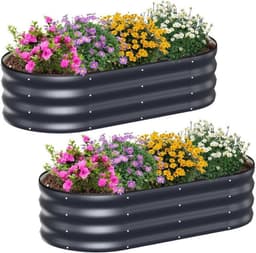
The Harbour Housewares two-pack is the clearest option when you want matching beds rather than one divided trough. Each bottomless frame measures 180 x 90 x 30 cm, giving you two substantial growing areas for crop rotation or plants with different soil needs. The VIREO round two-pack was listed at £30.63, which makes it the lowest extracted price in this set. Its material thickness was not stated, though, so price alone cannot establish rigidity or lifespan. If you only have room for one planted area, skip every two-pack unless the spare frame has a definite use; otherwise you are paying for storage and twice the soil decision.

Best if a taller side matters

HEALSTOK stands out here because its side is about 43 cm high rather than the common 30 cm seen in several listings. The extra 13 cm can provide more root-zone depth and reduce how far you bend, but it does not turn the bed into an accessible seated-height planter. If reducing bending is your main aim, measure the working height against your own chair or standing posture before treating “taller” as sufficient. Thirty-centimetre beds remain sensible for many vegetables when they sit over workable soil, because roots are not necessarily confined to the frame. On paving, the full growing depth and drainage arrangement become much more consequential. Read the separate guidance on using a raised bed on paving before choosing an open-bottom kit for a courtyard.

Best if you need an included trellis

The KING BIRD kit is the frame to look at when you specifically want an integrated support for climbing crops. A trellis can keep tomatoes, peas, beans or cucumbers upright without requiring a separate frame, and it makes most sense where the support can face the sun without blocking lower plants. If you mainly grow roots or low salads, however, the extra structure adds cost and visual bulk without solving a real problem. Do not use the listing’s apparent 2,916-litre cuboid as your compost order. That figure results from multiplying 180 x 90 cm by the full 180 cm overall height, which includes the trellis rather than representing the soil wall. If the planting section is 30 cm deep, the corresponding rectangular soil volume is about 486 litres. Confirm the current dimensions on amazon.co.uk before purchase, because an incorrect soil calculation could mean dozens of unnecessary bags.

What “best” cannot mean here

This comparison is not a laboratory test of sheet thickness, coatings or long-term corrosion. Star ratings help reveal recurring assembly or stability issues, but they do not prove that the highest-rated frame uses better steel. Be cautious when several variants share one review line. The displayed 267-review total attached to more than one option may cover different dimensions or colours, while Willow Weave’s 4.0 from 51 also mixes sizes. FOUBAM should be skipped if you need one unambiguous footprint because its title and metre measurements conflict. Choose a 60 cm trough for one-sided reach, Harbour Housewares when two large rectangular beds are genuinely useful, HEALSTOK when the 43 cm side earns its extra fill, and KING BIRD when an integrated trellis matches the crop.

Common questions

Which raised bed is best if I can only reach from one side?
A bed around 60 cm wide is the safer shortlist because its centre is easier to reach from one edge. The INNO STAGE 244 x 60 cm trough suits a long narrow run, while the Ergohortus 120 x 60 cm pair suits two smaller spaces. Mark the footprint first, as the INNO STAGE length may be the limiting dimension.
Is a two-pack better value than one raised bed?
Only if you need both frames. Harbour Housewares supplies two 180 x 90 cm beds, while VIREO offers a round pair at a lower extracted price. Two beds also mean more assembly and potentially twice the fill: the Harbour pair has a geometric capacity near 972 litres before settlement.
Is a 43 cm raised bed high enough for seated gardening?
Not necessarily. HEALSTOK’s roughly 43 cm side is taller than a common 30 cm frame, but comfortable seated access depends on chair height, knee clearance and how far you must reach. Measure those positions in your garden rather than assuming any “tall” product is an accessible planter.
Does the highest star rating identify the best metal bed?
No. Star lines can combine reviews from several sizes and do not measure steel thickness, coating quality or long-term corrosion under controlled conditions. Use reviews to find repeated, size-specific problems, then judge the footprint, braces, stated dimensions and fill requirement separately.
When should I avoid a 120 cm-wide bed?
Avoid it when you can approach only one long side. Reaching 60 cm to the centre may already be uncomfortable once plants mature, and the far edge is harder still. A 60 cm-wide trough is usually the more workable layout beside a fence or wall.

Related pages

Sources

Public UK sources from the research digest, last checked on 16 October 2026.

  1. RHS — How to make a raised bed (retrieved 16.10.2026)
  2. RHS — Growing veg in raised beds (retrieved 16.10.2026)
  3. RHS — No-dig gardening (retrieved 16.10.2026)
  4. RHS — Creating raised beds for schools (retrieved 16.10.2026)
  5. Thrive — Wheelchair-friendly garden design (retrieved 16.10.2026)
  6. GOV.UK — Permitted development technical guidance (retrieved 16.10.2026)
  7. legislation.gov.uk — Consumer Rights Act 2015 (retrieved 16.10.2026)
  8. Quickcrop — Timber raised beds vs metal raised beds (retrieved 16.10.2026)