Independent comparisons. We may earn from shop links. More info

Best greenhouse for a small UK garden

Updated: October 2026

You are choosing a cover for a patio, a small garden, or a raised bed, and amazon.co.uk calls each option a greenhouse. Here that means a 45 cm rack, a 90 cm tunnel, a corridor, a square tent, or a VegTrug lid without the planter. This buying guide sets the order for the best greenhouse for a small UK garden in the £17 to £99 plastic class. The rows are the [greenhouse comparison](/hub/raised-beds-greenhouses-and-compost/greenhouse). Products Compared used the amazon.co.uk listings and RHS guidance, not a lab test. A qualifying purchase can earn a commission at no extra cost to you.

You are choosing a cover for a patio, a small garden, or a raised bed, and amazon.co.uk calls each option a greenhouse.

Our top picks

On this page

What you are actually choosing

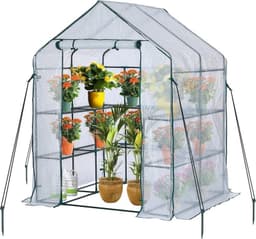
Start with the job. Star lines here only run from 4.2 to 4.6, and they do not tell you the floor plan. A tiered mini greenhouse is a zip cover over shelves, about 45 to 105 cm wide and still about 45 cm deep. A low tomato house is about 100 × 50 × 150 cm. A long tunnel is 270 × 90 × 90 cm. A narrow walk-in is about 143 to 200 cm long, 73 to 77 cm deep and 170 to 195 cm high. A square walk-in is about 143 to 145 cm square and 195 cm high. The VegTrug row is PE and micromesh for a Classic 1.8 m, and the bed is not in the box. The RHS treats a polythene tunnel as a summer cover for tomatoes and cucumbers, and as a poor winter home for tender plants. Read the centimetres before you read the brand.

Footprint before brand

Measure the ground, then your height. A four-tier at 50 × 45 × 130 cm holds seed trays in a corner. It is not a path. An extra-wide four-tier at 105 × 45 × 160 cm is still 45 cm deep, so the extra figure is width. The heyfurni and one VOUNOT are both 143 × 73 × 195 cm. You can stand, and you cannot turn with a watering can. The Ohuhu tomato house is 200 × 77 × 170 cm, and a UK review says that walk-in title only works for a child or if you walk on your knees.

Cover, frame, and claims that disagree

Several rows claim polyethylene, sometimes at 130 or 135 g/m². The small DIVCHI and the twelve-shelf Ohuhu are PVC in the technical details. A UK review of that Ohuhu says the PVC zip tore within weeks and the cover failed within a year. That is one listing, not every PVC sheet. Both DIVCHI weights read 200 g, which the listings do not reconcile with a four-tier frame, and a UK review says the small DIVCHI's steel title is not what the photos show. The narrower VOUNOT is the clearest clash. Technical details say plastic, and the bullets say 135 g/m² polyethylene and a painted metal frame. If two fields cannot both be true, buy on the centimetres you can tape.

When this set is the wrong purchase

Buy glazed or polycarbonate when you want eaves you can work under, roof vents, and a base. The RHS asks for eaves of at least 1.5 m, ideally 1.8 m, and roof vents of about 15 to 20 percent of the floor area. A door is only a partial vent. Do not copy 1.8 m eaves onto a PE cover. None of the twelve listings claims design to BS EN 13031-1.

Common questions

Is a £20 cover a greenhouse or a waste of money?
About £17 to £25 buys a four-tier rack, a three-tier wood frame, or a 150 cm tomato house. It is a cover for trays or a few plants if you can weight it. It is a waste if you wanted standing room or a winter home for tender plants. The RHS treats polythene as a summer cover. A 4.4 or 4.6 star line does not measure a second winter.
Walk-in or four-tier for a patio?
Choose the four-tier if the job is seed trays and you have about 50 cm of depth. Choose a walk-in if you need to step in, then check that depth. A 145 cm square needs that much patio. A 73 cm walk-in is a corridor. The extra-wide four-tier is still 45 cm deep.
Will it survive a British winter outside?
None of these listings states a frost temperature. The RHS says a polythene tunnel is a poor place for tender plants through winter. UK reviews describe lifted covers and torn zips. Some Ohuhu tomato-house reviews report a second season only if the cover comes off and the ropes are used. That is a review habit, not a guarantee.
Do I need planning permission for a pop-up cover?
A freestanding cover you peg down is rarely what Class E is written for. Permission becomes the question when you build a base, site it forward of the principal elevation, or work on a listed building or a flat. England, Wales, Scotland, and Northern Ireland do not share one height figure for a tent. If you are pouring concrete, use your nation's guidance.
Glass or plastic if I want it to last ten years?
These twelve rows are PE or PVC covers on light frames, not a ten-year glazed house. The RHS point on polythene is summer cropping. A small glazed house is the other class, and one retailer's small range starts around £229 in that shop's own copy. Nothing in this set was lab-tested for a ten-year life.
Why do two similar tents show the same review count?
The 143 × 73 cm VOUNOT and the 143 × 143 cm VOUNOT both show 4.2 from 1,636 reviews, with overlapping text. Treat that as shared listing text. Do not add the numbers. Judge each row by its footprint, its shelf count, and whether the material lines agree.

Related pages

Sources

Public UK sources from the research digest, last checked on 17 October 2026.

  1. Planning Portal — Outbuildings (retrieved 17.10.2026)
  2. Class E, GPDO 2015 (retrieved 17.10.2026)
  3. GOV.WALES — Planning permission: outbuildings (retrieved 17.10.2026)
  4. mygov.scot — Build a shed, garage or greenhouse (retrieved 17.10.2026)
  5. Building Regulations 2010, Schedule 2 (retrieved 17.10.2026)
  6. Approved Document P (2013) (retrieved 17.10.2026)
  7. RHS — Choosing a greenhouse (retrieved 17.10.2026)
  8. RHS — Ventilation and shading (retrieved 17.10.2026)