Independent comparisons. We may earn from shop links. More info

How to anchor a plastic greenhouse

Updated: October 2026

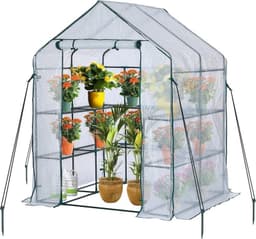
The cover is still in the bag, and you need it to stay put on a British night. This is how to anchor a plastic greenhouse in this PE and PVC class: site it, weigh more than the pegs, then open the door. Prices stay on the [greenhouse comparison](/hub/raised-beds-greenhouses-and-compost/greenhouse). Products Compared used the amazon.co.uk listings and RHS guidance, not a pull test. A qualifying purchase can earn a commission at no extra cost to you.

The cover is still in the bag, and you need it to stay put on a British night. This is how to anchor a plastic greenhouse in this PE and PVC class: site it, weigh more than the pegs, then open the door.

Our top picks

On this page

Where it should stand

Give the cover sun, and keep a north or east wind off a loose skirt. The Royal Horticultural Society wants uninterrupted light and shelter from cold northerly or easterly winds. For a glazed house it says an east-west ridge extends winter light slightly, and a north-south ridge suits summer crops such as tomatoes. A 45 cm rack has no ridge. Point the door at the path you use. A south-westerly prevailing wind is a rule of thumb, not a measurement of your street. Treat it as experience, not a test of the ropes in these boxes. A balcony cannot take a soil peg. Leave room to open the zip. A base in the front garden can be a planning question. A portable cover rarely is.

What to do with the pegs, ropes, and skirt

Read the kit before you invent one. Bullets name stakes or ropes on the heyfurni, the Jungle Stone, the small VOUNOT tomato house, both VOUNOT walk-ins, the Ohuhu tomato house, and the Ohuhu twelve-shelf. The Jungle Stone adds a 10 cm skirt, eight stakes and four ropes. The heyfurni lists four guylines, and a UK review says the rope went brittle and snapped. Both DIVCHI racks and the Bamworld state no peg kit. The long tunnel's listing bullets do not count ropes. Pegs and a floating skirt are the weak end. Do not pour concrete for a £17 rack. Do the step UK reviews repeat: bricks or sand on the skirt, garden staples where a Bamworld review asks for them, and a tie to a fence where Jungle Stone reviews suggest a shed or a fence. Do not use the zip as an anchor.

Paving, deck, and rented balconies

On soil, drive a peg only if the kit includes one and the ground will take it. On slabs, deck, or a balcony, the peg does nothing. Weight replaces it. Extra-wide DIVCHI reviews describe side pockets filled with rocks, and some say outside tie points are missing, so the pocket is the place for that weight. A brick on each corner of a hem does the same job. A water container on the bottom shelf of a four-tier works where you have no soil. Do not drill a balcony you do not own. A square tent is a poor sail for a rail. The rack can live on paving if the lease allows it and you weight it without fixing into the building. If you cannot weight the cover and you cannot tie it, take it down.

After it is up

These covers ventilate through a zip and, on some rows, mesh windows. They have no ridge vent. The RHS says a door only partly replaces roof vents, and that small houses overheat. Its ventilation notes treat about 27°C as a point where plants are damaged. Open the door on a warm day. A closed zip cooks the crop and holds damp air on the leaves and on the greenhouse film. The long VOUNOT tunnel states three mesh windows. A new mains circuit from the house is notifiable under Part P. Sun, shelter, weight or a real tie, and the door open when the air is hot: that is the standard.

Common questions

Will the pegs in the box be enough?
Often no. Rows that include ropes still draw reviews about lift and brittle cord. Both DIVCHI racks and the Bamworld state no peg kit. Add weight or a fence tie. A peg in turf is not a fixing on slabs.
What do I do on paving, where pegs will not go in?
Weight the skirt or the bottom shelf. Bricks, sandbags, or gravel in a side pocket are what reviews describe. Do not drill a rented balcony. If you cannot add weight, take the cover down in a wind rather than hoping the zip holds the frame.
Which way should the door face?
Face it to the path you use, and keep the loose side out of the wind you get. RHS and Gardeners' World talk about an east-west or north-south ridge for a glazed house. A 45 cm rack has no ridge. A south-westerly prevailing wind is a rule of thumb, not a siting law.
Should I take the cover off in winter?
The RHS treats polythene as a poor winter home for tender plants, so a cover left up is not frost insurance. Some Ohuhu tomato-house reviews report a second season when the cover comes off and the ropes are used. In a gale, taking any of these light frames down is a precaution, not a calendar ritual.
How do I stop condensation?
Open the zip, and open any mesh window the listing includes. These tents have no ridge vent, and the RHS treats a door as only a partial substitute. A closed house holds damp air on the leaves. Wiping the film does less than airing it.
Can I run a cable from the house while I am at it?
A new circuit from the house is notifiable under Part P. Do not add a socket as a weekend extra to the pegging. If you need power, use an electrician. Do not put a combustion heater inside a zip tent.
Is a concrete base required for these tents?
No. Slabs and a bolted plinth are glazed-house practice. Pegs, ropes, and weight on the skirt are what this class uses, and they still fail if you skip the weight. Concrete matters only if you have left this set and you are building a permanent house.

Related pages

Sources

Public UK sources from the research digest, last checked on 17 October 2026.

  1. Planning Portal — Outbuildings (retrieved 17.10.2026)
  2. Class E, GPDO 2015 (retrieved 17.10.2026)
  3. GOV.WALES — Planning permission: outbuildings (retrieved 17.10.2026)
  4. mygov.scot — Build a shed, garage or greenhouse (retrieved 17.10.2026)
  5. Building Regulations 2010, Schedule 2 (retrieved 17.10.2026)
  6. Approved Document P (2013) (retrieved 17.10.2026)
  7. RHS — Choosing a greenhouse (retrieved 17.10.2026)
  8. RHS — Ventilation and shading (retrieved 17.10.2026)