Independent comparisons. We may earn from shop links. More info

Greenhouse frost protection heater

Updated: October 2026

The bench froze, the pelargoniums are brown at the edge, and you only wanted the house just above freezing. A greenhouse frost protection heater is that small job: a few degrees in the plant air, after you have slowed the heat loss, not a growing temperature and not a seed tray. The RHS calls an unheated house enough shelter for H3 plants, and frost-free at 4°C for H2 plants over winter. This page stays on that low target. The [greenhouse heater comparison](/hub/raised-beds-greenhouses-and-compost/greenhouse-heater) lists the hardware. Products Compared used the RHS, Thompson & Morgan, Two Wests and Heathfield. We did not measure your glass. A qualifying purchase can earn a commission at no extra cost to you.

The bench froze, the pelargoniums are brown at the edge, and you only wanted the house just above freezing.

Our top picks

On this page

Frost-free is a low number

Write the target down before you buy watts. On the RHS heating page, frost-free for H2 plants is 4°C. Thompson & Morgan’s bare minimum is 3°C. Those are two publishers, not one official UK figure. Fleece, in the RHS note, is about 2°C. Leave 7°C and 10°C off this job. Thompson & Morgan uses 7°C for pelargoniums and citrus and 10°C as safer for young plants. That is a warmer house than a background tube. A max-min thermometer near the plants is how you know which number you held. The dial on the heater is the wrong place to read it.

Insulate before you add watts

Bubble wrap cuts the watts you need, and it costs light. The RHS puts the light loss at about 10 per cent. Heathfield’s method, checked on 3 October 2026, takes about 30 per cent off the heating sum when the house is wrapped. One figure is light and the other is watts. Do not turn either into a claim that wrap halves the heater. Keep the plastic off the element. Then look at the house you have. A 6 × 8 ft apex and a smaller lean-to are not the same glass. Measure, wrap, and read the thermometer before you decide a second tube has failed.

A 6 × 8 is not a 28 W job

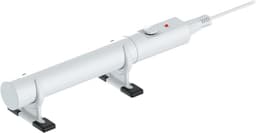
Keep the two retailer pictures separate. Two Wests prints about 1,170 W for a bare 6 ft × 8 ft frost-free apex house and about 936 W if it is insulated, aimed near 4.5°C. Heathfield uses about 6.25 W per square metre of glass per degree. Their wrapped 6 × 8 is about 420 W on a light frost, 4°C inside and −1°C outside. Do not average 936 W and 420 W. The Hylite 300 mm is 28 W. The LightHouse title says 45 W and the spec field says 50 W. The Hylite 1,000 mm and the Morris are 120 W. All sit under a 420 W example, and further under 936 W. A UK review of the 1,000 mm Hylite says an insulated 6 × 8 in a cold snap still needed a fan. Cheap to run is not the same as enough glass.

What still counts as frost protection in this set

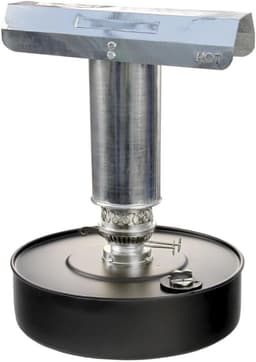
A frost setting you can name is still worth having, because an unscaled tube may run all night or not at all. The Airmaster states 5–30°C and 520 W at 240 V, with coverage up to 10 m² and no IP rating. 520 W can sit near Heathfield’s 420 W light-frost example and still misses Two Wests’ 936 W insulated figure, so the method you trust changes whether one convector is in range. A review says the booklet limits it to well insulated spaces or occasional use. Morris’s 90° cut-out is not a frost stat. Hylite claims a thermostat and prints no scale. Use the short tubes as background heat in a small volume, and check the morning minimum, whether the unit is an electric or paraffin heater.

Common questions

What temperature is frost-free?
The RHS page used here says 4°C for H2 plants over winter. H3 plants may cope in an unheated house used as shelter. Read a max-min thermometer at plant height, not the heater dial. Fleece is about 2°C in that RHS note, which is a margin, not a heater.
Is 3°C the same advice as 4°C?
No. Thompson & Morgan’s bare frost-free line is 3°C. The RHS line used here is 4°C. Keep both as named sources. Their 7°C and 10°C figures are for pelargoniums, citrus and young plants, and they are outside a frost-only page.
Does bubble wrap change the heater I need?
It can cut the heating demand. Heathfield’s figure is about 30 per cent less with bubble wrap. The RHS figure on light is about 10 per cent less light, which is a separate cost. Do not claim a 50 per cent saving. Keep the wrap off the heater itself.
Is one 28 W or 120 W tube enough for a 6 × 8?
Not on either retailer picture used here. Two Wests is about 936 W insulated or 1,170 W bare. Heathfield’s wrapped light-frost example is about 420 W. A UK review said the 1,000 mm 120 W Hylite still needed a fan in an insulated 6 × 8 during a cold snap. A small house is a different volume. Check it with a thermometer.
Why do the watt tables disagree?
They use different methods. Two Wests publishes a frost table for an apex house. Heathfield uses watts per square metre of glass per degree, then a bubble-wrap reduction. Quote one method. Do not blend 936 W and 420 W into a third number.
Do I still need a thermostat if I only want frost protection?
Yes, if you want the heater off once the air is above your line. The Airmaster states 5–30°C. A cut-out, such as Morris’s 90° line, does not hold 4°C. A Hylite dial with no scale needs the thermometer to do the judging. Without any control, a tube runs whenever it is plugged in.
Is a heated propagator this job?
No. Gardeners’ World describes basic propagators at about 15–21°C in the compost, for seed and cuttings. Use one when a few pots replace heating the house. It does not hold the air around a bench of H2 plants at 4°C, and it is not a substitute for the watt sums above.

Related pages

Sources

Public UK sources from the research digest, last checked on 17 October 2026.

  1. RHS — Heating greenhouses efficiently (retrieved 17.10.2026)
  2. RHS — Electricity in the garden (retrieved 17.10.2026)
  3. Ofgem — Energy price cap, 1 October to 31 December 2026 (retrieved 17.10.2026)
  4. Approved Document P (2013) (retrieved 17.10.2026)
  5. Electrical Equipment (Safety) Regulations 2016, regulation 35 (retrieved 17.10.2026)
  6. NHS — Carbon monoxide poisoning (retrieved 17.10.2026)
  7. Two Wests — Greenhouse heaters (retrieved 17.10.2026)
  8. Hylite — Greenhouse heater data sheet (retrieved 17.10.2026)