How often to turn compost: a practical schedule

How often to turn compost depends on the heap: a few times a year for a slow bin, when a hot batch cools, and less often in winter so heat stays in.
On this page
If you have been told to mix a compost bin every week, an untouched dalek can quickly feel like a failed project. The useful answer to how often to turn compost is less rigid: an ordinary slow heap may need attention only several times a year, while an actively managed hot heap is turned in response to cooling. Your container, method and season matter more than a calendar reminder copied from a different kind of composting. The notes below follow published UK guidance from the RHS, Garden Organic and the shorter rules of thumb on compostthis.co.uk. We have not run a composting trial. A qualifying purchase through our links can earn us a commission at no extra cost to you.
In short
For a slow garden heap or dalek, use the RHS guidance of several turns a year as a sensible starting point; even forking through it every few months can help. A hot batch follows a different signal: Garden Organic advises turning when it cools, moving the outside material into the middle. In winter, keep disturbance to a minimum because turning releases heat.
What turning compost actually does
Turning changes the arrangement of a heap. Material around the outside can be moved towards the centre, while compacted contents can be loosened and exposed to more air. That redistribution is particularly relevant in a hot heap, where the centre and edges are not experiencing the same conditions. Garden Organic's practical instruction is to turn the heap when it cools so that the outside becomes the inside.
It is easy to turn that useful technique into a rule that is much stronger than the evidence. The RHS says a heap can compost without turning when speed is not your goal. Turning is a way to manage the process, not an entry requirement. If you are content to wait, an unturned or rarely turned heap is not automatically doing anything wrong. Frequent turning also costs effort and can disturb conditions you want to keep. A full open heap is a substantial job to rearrange, and a narrow plastic bin may be awkward to mix from the top. Redistributing an active batch and loosening compacted material respond to the heap. A weekly reminder does not.
A slow bin and a hot heap need different schedules
The apparent conflict in turning advice usually comes from comparing different systems. For an everyday slow heap, the RHS advises turning several times a year if you can. It also says that forking through the contents every few months still helps. That is a much lighter routine than weekly turning and is a realistic reference point for a dalek that you fill gradually with household and garden material.
A hot heap is managed as a batch. Garden Organic links the turning point to a change in the heap rather than to a fixed weekday: when the hot heap cools, turn it so that material from the outside moves to the middle. The cooling is the prompt. This gives previously cooler material a position in the centre instead of repeatedly mixing the batch whether or not anything has changed.
One UK composting site, compostthis.co.uk, gives a rule of thumb of about weekly for a hot heap and about monthly for a cool one. Treat those intervals as that site's practical shorthand, not as a universal law. Its weekly figure makes much more sense when attached to active hot composting than when imposed on every slow dalek in the country.
If you keep adding small amounts to a slow bin, begin with occasional checks and a fork-through every few months. If you have assembled a hot batch, watch for cooling and turn in response. Calling both activities composting does not make their maintenance identical.
A practical turning routine
Start by identifying the system in front of you: a slow bin filled over time, a hot batch managed as one heap, or a tumbler built for easier mixing. That decision is more useful than one number that must fit all three.
For a slow heap or dalek, set a modest baseline of several turns across the year, or a fork-through every few months. That matches RHS guidance. When you mix it, loosen compacted sections and move material between the outer and inner parts, rather than disturbing only the top layer. For a hot batch, follow the change Garden Organic identifies: once it cools, move the outside material into the middle. Compostthis.co.uk's weekly hot-heap suggestion is a rough reference. The cooling of your own heap is the more method-specific trigger.
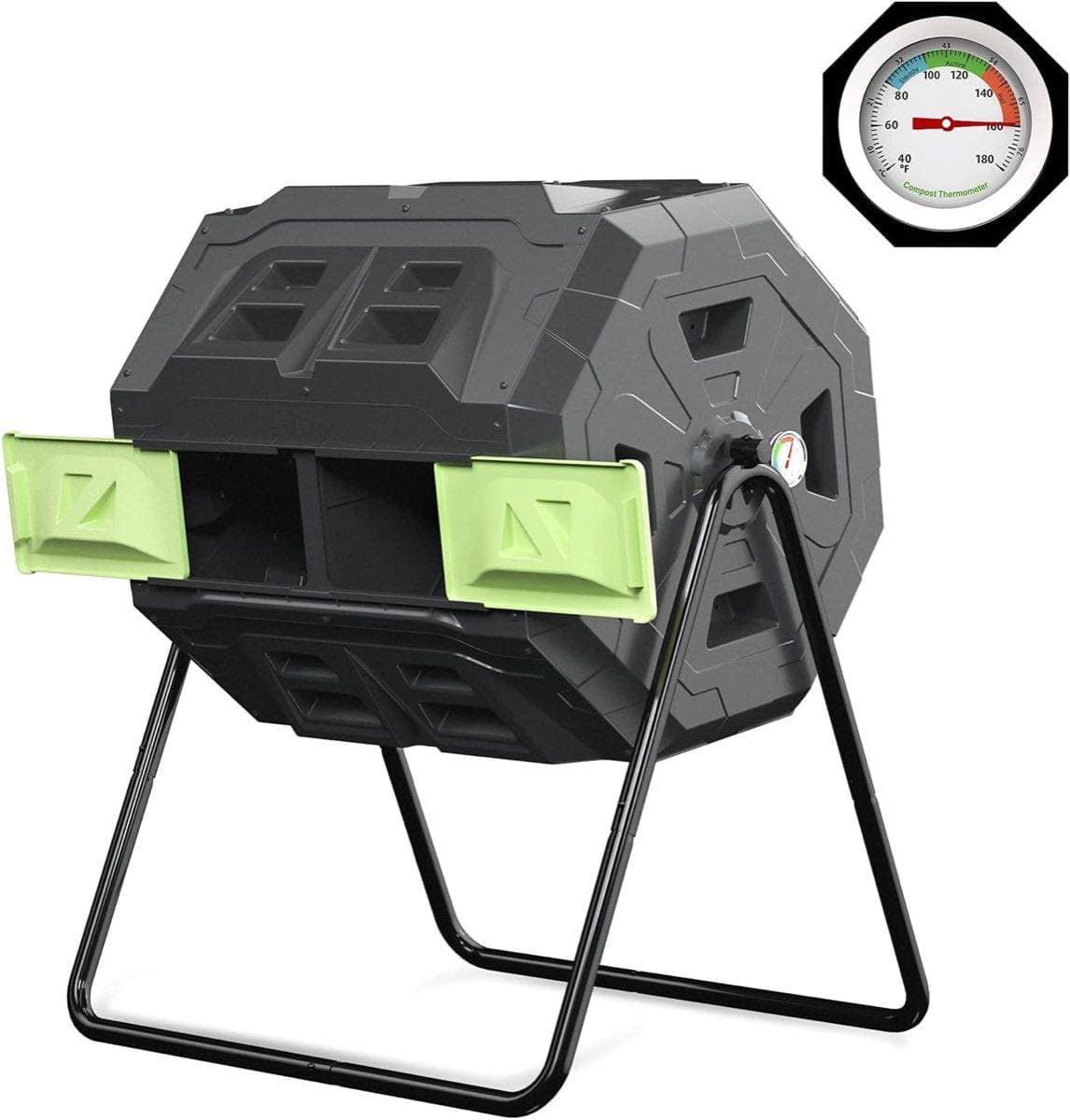
Mixing does not prove that the contents are balanced, and it does not guarantee a finish date. If you want a container that makes repeated mixing physically simpler, the top pick on our drum composter comparison is the Squeeze master 160 litre thermometer tumbler at about £58.63, with 4.4 from 194 amazon.co.uk reviews. That label compares the listings on that page. It is not a composting trial, and it does not create a universal turning schedule.
Why turning compost in winter is different
Winter changes the trade-off because opening and mixing a heap lets heat escape. The RHS advises keeping winter turning to a minimum for that reason. A routine that seems helpful in warmer conditions can therefore work against heat retention when the weather is cold. This is especially important if you are tempted to turn solely because a recurring reminder says that another week has passed.
Not every source phrases the winter advice in the same way. Love Essex tells readers to keep turning through winter, while the RHS winter feature recommends minimal turning. That is a genuine clash, not something to hide behind a single confident sentence. For a slow home heap, the heat-loss explanation supports a restrained approach: avoid unnecessary disturbance and wait for a clear reason before mixing. Winter compost bin care is the place for insulation and stored leaves, which can matter more than another mix.
Winter compost can still be touched when redistribution outweighs the heat you lose. A fixed weekly turn is hard to justify for a slow dalek, and a slower-looking heap does not by itself prove that it needs more mixing. Resume an occasional routine as the weather changes.
Tools, smells and accelerators
You do not need a specialist compost aerator to follow this advice. The RHS refers to turning with a fork and also makes clear that composting can continue without turning if speed is not the priority. A tool may make a particular movement easier, but ownership of that tool does not decide whether the heap needs to be moved. Aerators are therefore not reviewed as products here.
A smell can be a reason to investigate, but it is not an instruction to turn indefinitely. Lack of air may be part of the problem, in which case loosening and redistributing compacted contents may help. A smell can also sit alongside too much wet green material. Turning does not change the fact that the material was added, so use it as one response to a diagnosis. Why a compost bin smells separates excess wet material from too little air.
An accelerator does not add oxygen, so adding one does not replace redistribution or create a same-day turning rule. A tumbler is the clearer equipment change, because mixing is part of its format. It reduces the need to lift and rebuild an open pile. You are still managing compost, not collecting turns for their own sake.
When not to turn the heap
Do not turn merely because a weekly figure was quoted without saying it belonged to a hot heap. Compostthis.co.uk offers that interval as a rule of thumb. The RHS says several times a year can be enough, and that composting without turning is possible. Applying the most intensive number to a slow bin creates work without showing that the heap needs it.
Pause winter turning when the only reason is the calendar, because the RHS says turning releases heat. Turning also cannot explain a smell by itself, supply oxygen indefinitely, or make an accelerator do a different job. Turn to move a cooled hot batch, to loosen a slow heap, or to answer a diagnosed lack of air. If none of those reasons applies, watching the heap is more useful than another scheduled mix.
Common questions
How often should I turn a compost heap?
What happens if I never turn compost?
Should I turn compost in winter?
Is a compost aerator required?
Does turning a hot heap differ from mixing a dalek?
Will turning stop a compost smell?
How does a tumbler change the turning routine?
Should I turn compost when I add an accelerator?

Peter F. is the editor for DIY & tools at productscompared.co.uk. Comparisons in this category are checked against amazon.co.uk listings, review evidence and public UK sources.
Related articles

Why a compost bin smells
Work out whether excess wet material or too little air is behind an unpleasant compost-bin smell.

Looking after a compost bin in winter
See why insulation and saved leaves can matter more than repeatedly disturbing a cold-weather compost bin.

Greens and browns for a compost heap
Understand the two broad material groups and why published composting advice does not use one universal ratio.