Independent comparisons. We may earn from shop links. More info

Ryoba vs dozuki

Updated: 2026-10-22

You are about to cut your first dovetails, and the basket is full of double-edge pull saws with no spine on the back. Ryoba vs dozuki is that choice: one general saw with two tooth edges, or a short, stiff, spine-backed saw for shoulders and pins. The [Japanese saw comparison](/hub/power-saws/japanese-saw) is twelve amazon.co.uk listings from October 2026, and none of them is a classic dozuki. Peter F. used those listings plus Woodsmith’s note and SUIZAN’s beginner guide. A qualifying purchase can earn a commission at no extra cost to you. It does not become a dozuki because the title says joinery.

You are about to cut your first dovetails, and the basket is full of double-edge pull saws with no spine on the back.

Our top picks

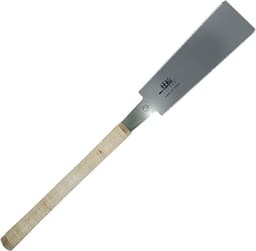
SUIZAN SUIZAN 240 mm ryoba

Best overall

SUIZAN SUIZAN 240 mm ryoba
9.2/10about £39.80
WORKPRO WORKPRO 200 mm pull saw

Best value

WORKPRO WORKPRO 200 mm pull saw
9.2/10about £15.99
On this page

What a ryoba does in this set

A ryoba has rip teeth on one edge and crosscut teeth on the other. You roll the saw rather than pick up a second tool. SUIZAN’s SR-001 prints that split as 9 and 15 TPI on a 240 mm, 0.5 mm plate, at £39.80, with 4.6 from 657 reviews, and the country-of-origin field says Japan. Temple Tool’s R-180 prints 180 mm at £33.50, with 4.6 from 93 reviews, and the bullets name dovetails, tenons, and boards cut to length and width. WORKPRO prints 200 mm with 7–9 TPI and 18 TPI at £15.99. JORGENSEN prints 250 mm with a progressive rip edge and 18 TPI at £18.99. The ryoba’s advantage is reach and range. One plate rips a cheek with the grain and crosscuts a shoulder across it, as long as you change edge. SUIZAN’s guide treats the ryoba as the saw for someone who has not decided on a specialist yet. That matches a UK DIY bench better than buying a spine saw you will not use for ordinary crosscuts. The limit is stiffness. There is no spine, so a 0.5 mm plate can wander if you push, twist, or start in the middle of the face. Review keywords on the SUIZAN include bent and flimsy. That is the cost of a plate thin enough to leave a narrow kerf. Temple’s £45 R-240 is also sold as a ryoba, with 4.7 from 434 reviews, and the title’s 9.5 mm figure is not a length to quote as fact. If you cannot read the blade length, you cannot yet compare it with a 240 mm SUIZAN. Length and origin sit on the Japanese saw buying guide.

What a dozuki adds

A dozuki is a crosscut saw with a steel or brass spine along the back, the way a Western tenon saw has a back. The spine stops the plate flexing, which is what you want when a shoulder must stay square for the length of the cut. Woodsmith’s selection piece puts the dozuki on joinery and the ryoba on general bench work. The spine also limits depth. You cannot bury a backed saw in a deep rip the way you can bury a ryoba, because the spine hits the wood. That is why a dozuki does not replace a ryoba for breaking down a board, and a ryoba does not automatically replace a dozuki for a long, fine shoulder. UK shops such as Axminster and Classic Hand Tools sell dozuki saws. Those are not ASINs here, and this page does not invent a price. Flush-cut saws flex on purpose. Temple’s K-265 kataba title claims a single edge while a bullet describes two. Neither is a backed saw. This capture has no dozuki TPI, so 15 TPI or 18 TPI is not a spine. The spine is the feature.
SUIZAN SUIZAN 240 mm ryoba

Testsieger

SUIZAN SUIZAN 240 mm ryoba
9.2/10about £39.80

When a ryoba here is enough

For a first set of through dovetails in pine or a similar softwood, a ryoba is enough if you mark the lines, start at the far corner, and use the crosscut edge on the pins and tails that run across the grain. Temple’s 180 mm plate is the easier one to keep inside a short pin. SUIZAN’s 240 mm plate is the easier one when the same saw also has to crosscut a shelf or rip a cheek on a larger tenon. You do not need both on day one. You need one plate whose length you have read, and the habit of pulling rather than pushing. If shoulders are already square on the 15 TPI or 18 TPI edge, a dozuki is optional. If the shoulder goes hollow because the plate flexed, that is stiffness, not a reason to buy a flush saw. Switch edge before you switch category. Magicbox still has no backed dozuki. Which length suits the stock is on the Japanese saw for joinery page.

When to buy a dozuki separately

Buy a dozuki when the ryoba shoulders are the problem you have already met, not the problem you are imagining. A fair sequence is one ryoba from this table, a month of marked cuts, then a spine saw if the cheeks are fine and the shoulders are not. Softwood dovetails for a drawer that will be painted do not require that second saw. Hardwood pins with a show face often do, because a 0.5 mm unbacked plate is harder to keep dead straight over a 20 mm shoulder than a backed plate is. Do not buy a dozuki instead of a ryoba if you still have boards to rip: the spine bottoms out. The aieieii twin pack at £6.45 with 15 reviews, and AIMAX at 4.0 from nine reviews, stand in for neither tool. The SUIZAN 240 mm is the saw that states Japan and 9 and 15 TPI. Add a dozuki only after the shoulders demand a spine. The 180 mm Temple is the tighter first saw for small joints, with Japan only as a listing claim. WORKPRO is the first saw at £15.99 if China as origin is acceptable. None of those three is a dozuki.

Common questions

Can I cut dovetails with only a ryoba?
Yes, for practice joints and for many real drawers, if you use the crosscut edge across the grain and keep the plate from twisting. Temple’s 180 mm listing is marketed at dovetails and tenons. SUIZAN’s 240 mm saw does the same cuts with a longer stroke that is harder to steer in a tight pin. A ryoba has no spine. If the pins wander, fix the start of the kerf before you change saw family.
Why is a dozuki stiffer?
The spine along the back stops the plate bending in the cut. A ryoba has no spine, which is why SUIZAN can claim a 0.5 mm plate and a narrow kerf, and why the same plate can kink. The spine also stops you sawing deeper than the tooth line allows. That trade is the whole of ryoba vs dozuki: reach and two edges, or a short cut that stays straight.
Which listing here is closest to a dozuki?
None. The nearest idea is a finer crosscut edge on a ryoba, such as SUIZAN’s 15 TPI or WORKPRO’s 18 TPI, and those plates are still unbacked. A flush-cut saw is finer and more flexible, which is the opposite of a spine. Temple’s kataba title sounds specialist and does not show a back. If you need the spine, it is a different product from a different search.
Should a beginner skip the dozuki?
Skip it as the first purchase if you do not yet own a saw that can rip and crosscut. SUIZAN’s beginner guidance points you at a ryoba for that reason, and Woodsmith still treats the ryoba as the general saw. Add a dozuki when a specific shoulder is failing, not because a forum said joinery requires one before you have marked a joint. A first dozuki with no ryoba leaves you unable to size the board.
Does 180 mm or 240 mm matter for shoulders?
It matters for control, not because one length is a dozuki. The 180 mm Temple is easier to keep on a short shoulder. The 240 mm SUIZAN carries more saw past the work, which helps on a wider cheek and can feel long in a pin. Neither length adds a spine. If both lengths leave a hollow shoulder, the missing part is the back of the saw, not another 60 mm of plate.

Related pages

Sources

Public sources named in the research digest, plus the amazon.co.uk listings compared on this page. Retrieved October 2026.

  1. SUIZAN: how to choose a Japanese saw (retrieved October 2026)
  2. Woodsmith: selecting and using Japanese saws (retrieved October 2026)
  3. Knivesandtools UK: how to use a pull saw (retrieved October 2026)
  4. Z-Saw: pull-stroke reference (retrieved October 2026)
  5. HSE: PUWER overview (retrieved October 2026)
  6. Consumer Rights Act 2015, section 22 (retrieved October 2026)
  7. RHS: pruning guide (retrieved October 2026)
  8. amazon.co.uk listings for this set (retrieved October 2026)