Independent comparisons. We may earn from shop links. More info

Japanese saw buying guide

Updated: 21 October 2026

You are looking at a row of amazon.co.uk titles that all say Japanese, and the country-of-origin line does not say the same thing. This Japanese saw buying guide is the order to use before you open the basket: which family the job needs, then length and tooth pitch, then whether Japanese is the cutting action or the place it was made. The [Japanese saw comparison](/hub/power-saws/japanese-saw) holds the twelve listings read in October 2026, from about £6.45 to £45.00. Peter F. used those amazon.co.uk pages and public notes from SUIZAN, Woodsmith, and Knivesandtools. There was no lab test. Prices and review counts below are that capture. If two lines on one listing disagree, trust the spec table and the origin field over a marketing bullet. A qualifying purchase can earn a commission at no extra cost to you.

You are looking at a row of amazon.co.uk titles that all say Japanese, and the country-of-origin line does not say the same thing.

Our top picks

Temple Tool Temple Tool R-240 ryoba

Best overall

Temple Tool Temple Tool R-240 ryoba
9.4/10about £45.00
SUIZAN SUIZAN 240 mm ryoba

Rank 2

SUIZAN SUIZAN 240 mm ryoba
9.2/10about £39.80
WORKPRO WORKPRO 200 mm pull saw

Best value

WORKPRO WORKPRO 200 mm pull saw
9.2/10about £15.99
On this page

Ryoba, kataba, flush-cut, and sets

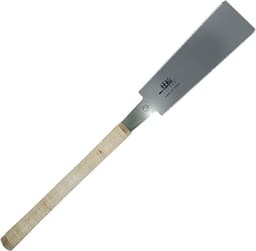
Start with the job, because the word Japanese does not tell you which edge you are buying. A ryoba is the general bench saw here: rip teeth on one edge, crosscut teeth on the other, both used on the pull. SUIZAN’s SR-001 (B093WJQJMX) is that pattern at 240 mm and £39.80. Temple Tool’s R-180 is the shorter version, listed at 180 mm and £33.50. WORKPRO, JORGENSEN, Dandelionsky, and the cheap twin pack are also sold as double-edge pull saws, though not all of them print a TPI pair. A kataba is single-edged, so the unused edge stays off the bench. Temple’s K-265 is the only title that says kataba, at 10.5 inches and £32.80, and a bullet still describes teeth on both sides. Until the live photos match the title, treat it as unresolved. A flush-cut saw is a different tool: the plate flexes so you can take a dowel, peg, wedge, or proud tenon down to the face. Temple’s F-6 is the 6 inch flush saw at £23.10. Yuiturt’s 150 mm version is £6.99. Buying either for a long rip kinks a thin plate. Magicbox is four pieces at £17.99, with double-edge and flush-cut saws named and no length or TPI in the row. The ryoba vs dozuki page is the next split if you want a spine-backed saw. None of these twelve is that saw.

Length and tooth pitch

Once the family is clear, read the length the listing actually prints. SUIZAN’s bullets give a 240 mm blade, a 0.5 mm plate, 9 and 15 TPI, and about 59 cm overall. Nine teeth per inch is the coarser edge, for cutting with the grain; 15 is the finer edge, across it. WORKPRO (B0D6QVNW2X) prints 200 mm, with 7–9 TPI on the rip side and 18 TPI on the crosscut side, on a 0.6 mm SK5 plate. JORGENSEN prints 250 mm, with 7–12 TPI progressive teeth for rip and 18 TPI for crosscut, on a 0.5 mm plate. Those three rows are the ones you can compare without guessing. Shorter is not automatically finer. Temple’s 180 mm ryoba is sold for control on dovetails and tenons. A 180 mm stroke is easier on a short cheek and the wrong reach if you are ripping a wide board. Dandelionsky’s title says 10 inch and “17 teeth”, and the captured row also prints 255 mm. Seventeen teeth is not the same fact as “18 TPI on the crosscut edge”. Temple’s R-240 puts 9.5 mm in the name. The model code is R-240. Do not file 9.5 mm as the cutting length until a spec row says so. Yuiturt’s 11/16 TPI is a fine-tooth claim for a short flexible plate, not a reason to use it as your only bench saw. The stroke itself is on the how to use a Japanese pull saw page.

Origin, SK5, and listing conflicts

Japanese saw on amazon.co.uk usually means a pull saw. It does not mean the saw was made in Japan. In this capture, only SUIZAN’s country-of-origin field prints Japan. WORKPRO, JORGENSEN, Dandelionsky, Yuiturt, AIMAX, aieieii, and Magicbox print China. Temple Tool bullets often say made in Japan, and the spec table for those Temple ASINs does not repeat Japan as country of origin. When the bullet and the origin field disagree, keep the origin field. SK5 is a high-carbon steel grade named on WORKPRO, JORGENSEN, Dandelionsky, and similar budget rows. It does not override a China line, and it does not make the saw a SUIZAN. Stars need the count beside them. SUIZAN’s 4.6 from 657 reviews and Temple’s flush saw at 4.6 from 798 are samples you can read. AIMAX is 4.0 from 9 reviews, and the weight field says 10 g, which is not a credible mass for a handsaw. aieieii is 4.7 from 15 reviews at £6.45 for two saws. JORGENSEN is 4.4 from 357, with bent, cheap, and snap in the review extract. At work, HSE treats a handsaw as work equipment under PUWER 1998. If a plate arrives already bent, the Consumer Rights Act 2015 gives a short-term right to reject. It does not cover a plate you bent by pushing a pull saw.

Spare blades and guards

A replaceable blade is worth having on a thin plate, because a kink is often the end of that plate rather than a sharpening job. The comparison rows mark a replaceable blade for WORKPRO, JORGENSEN, SUIZAN, the Temple saws in this set, Yuiturt, and AIMAX. Magicbox, Dandelionsky, and the aieieii twin pack do not state it. “Yes” on the row means the listing claimed it. Open the live page and see whether a spare is in the box or only sold separately. WORKPRO’s bullets include a PVC tooth guard for the drawer or the site bag. It is not a spine and it is not a fence. Take it off before you cut, and put it back when the saw goes away, especially if the review extract already mentions rust. Screw-on handles show up in WORKPRO and JORGENSEN marketing as the way the blade comes off. If the handle in the photo is riveted and the bullet says replaceable, believe the photo until the two agree. Dandelionsky names a beech and rattan handle and does not claim a spare blade, so a kink on that £10.98 plate is closer to a new saw than to a new blade. Conditional picks are on the best Japanese saw page.

Common questions

Should I buy a ryoba or a flush-cut saw first?
Buy the ryoba if you still need to rip and crosscut stock. A flush-cut saw only makes sense once something is already proud of a surface: a dowel, a peg, a wedge, or the end of a tenon. Temple’s 6 inch flush saw has the most reviews in the set, and it is still the wrong first plate if the board has not been sized. One general ryoba covers more of a DIY weekend than a flexible trim saw does.
What do 9 and 15 TPI mean on the SUIZAN?
SUIZAN’s bullets print 9 and 15 teeth per inch on the 240 mm ryoba. The coarser edge is the one to use with the grain, and the finer edge is the one to use across it. You change edge by rolling the saw, not by buying a second tool. Other rows in this set use different pairs, such as WORKPRO’s 7–9 and 18, so compare the printed numbers rather than assuming every double-edge saw matches SUIZAN.
Does SK5 mean the saw was made in Japan?
No. SK5 is the steel grade named on several China-origin listings, including WORKPRO, JORGENSEN, and Dandelionsky. Only SUIZAN’s country-of-origin field prints Japan in this capture. A bullet that says Japanese steel does not replace that field. If the origin line says China, the saw can still cut well and it is still not a Japan-made saw.
Why does one Temple Tool title say 9.5 mm?
The R-240 title prints 9.5 mm in the place where buyers expect a blade length. The model code is R-240, which is a different kind of number. We do not treat 9.5 mm as the length of the plate. Open the live listing and read the spec row before you compare it with the 180 mm Temple ryoba or the 240 mm SUIZAN.
Is a kataba listing always single-edge?
Not on this page. Temple’s K-265 title says kataba and single edge, and a bullet block still describes teeth on both sides. That is a listing conflict, not a small wording slip. Check the photographs. If you need a documented two-edge saw today, use a row that prints both pitches, such as SUIZAN or WORKPRO, and leave the kataba until the page agrees with itself.
Are the set saws comparable with a single ryoba?
Only loosely. Magicbox is four saws at £17.99, with double-edge and flush-cut pieces named in the bullets, and no blade length or TPI in the comparison row. A single SUIZAN or WORKPRO row tells you one length and one tooth layout. The set is reasonable as a starter parcel. It is a poor row to use if your question is whether 180 mm or 240 mm suits the joint in front of you.

Related pages

Sources

Public sources named in the research digest, plus the amazon.co.uk listings compared on this page. Retrieved October 2026.

  1. SUIZAN: how to choose a Japanese saw (retrieved October 2026)
  2. Woodsmith: selecting and using Japanese saws (retrieved October 2026)
  3. Knivesandtools UK: how to use a pull saw (retrieved October 2026)
  4. Z-Saw: pull-stroke reference (retrieved October 2026)
  5. HSE: PUWER overview (retrieved October 2026)
  6. Consumer Rights Act 2015, section 22 (retrieved October 2026)
  7. RHS: pruning guide (retrieved October 2026)
  8. amazon.co.uk listings for this set (retrieved October 2026)