Independent comparisons. We may earn from shop links. More info

How to use a Japanese pull saw

Updated: 2026-10-22

You already own a hardpoint panel saw, and the first stroke with a Japanese pull saw feels as if the teeth are on backwards. They are meant to be. Cut on the pull, start the kerf so the show face does not splinter, and stop twisting when the plate binds. The [Japanese saw comparison](/hub/power-saws/japanese-saw) holds the twelve October 2026 listings and prices. Peter F. did not film a bench test. The stroke notes come from Knivesandtools in the UK, Z-Saw, and SUIZAN’s start-cut note. A qualifying purchase can earn a commission at no extra cost to you.

You already own a hardpoint panel saw, and the first stroke with a Japanese pull saw feels as if the teeth are on backwards. They are meant to be.

Our top picks

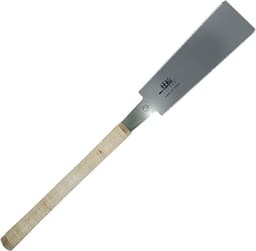
SUIZAN SUIZAN 240 mm ryoba

Rank 2

SUIZAN SUIZAN 240 mm ryoba
9.2/10about £39.80
WORKPRO WORKPRO 200 mm pull saw

Best value

WORKPRO WORKPRO 200 mm pull saw
9.2/10about £15.99
On this page

Pull stroke and grip

A British panel saw cuts on the push. A pull saw is the other way round. The teeth point towards the handle. You set the plate in the kerf and draw it back. On the return, towards the work, you carry little more than the weight of the saw. Z-Saw’s reference and the Knivesandtools UK note both describe that split. If you push with the same force you use on a 22 inch hardpoint, a 0.5 mm plate bends. SUIZAN’s bullets claim 0.5 mm. WORKPRO claims 0.6 mm. Neither thickness is a push saw. Hold the handle so the index finger can point along the plate, and keep the wrist quiet. A short pull that stays in the kerf beats a yank that lifts the teeth out. Use the rip edge with the grain and the crosscut edge across it: 9 and 15 TPI on the SUIZAN, 7–9 and 18 TPI on the WORKPRO. At work, PUWER 1998 expects a suitable method. A pull saw used as a push saw is not one. Length, family, and origin are on the Japanese saw buying guide.

Starting the kerf

Most splinters happen in the first centimetre, not at the end of the board. SUIZAN’s beginner note tells you to start at the far corner: the teeth meet an arris, not a flat face, and the kerf has somewhere to go before it reaches the show edge nearest your body. Rest the plate on that far corner, lift the handle slightly so only a few teeth touch, and draw back with almost no pressure. Three or four of those strokes should leave a groove you can see. Only then lengthen the stroke. A knife line on the show face helps, especially across plywood or a soft arris. The knife severs the fibres the teeth would lift. A marking knife along a square is enough. Put the waste side of the line under the teeth. If you start in the middle of a face, the plate skates and the corner breaks out. Support the offcut with a bench hook, or a clamp and a scrap. Your free hand stays behind the teeth. Flush saws are the exception people mishandle here: you may lay the flexible plate flat on the surface to trim a peg, and you still start with a light pull, not a stab. Marked joinery, dovetail baselines, and tenon shoulders belong on the Japanese saw for joinery page. This page stops at the stroke.

Binding and a kinked plate

The plate binds when the kerf closes, when you twist to correct a wandering line, or when a flush saw is flexed and then pushed. Knivesandtools’ advice is to ease the cut rather than force it. Back the saw out. Look for the spot where the wood is pinching. A thin wedge of scrap in the kerf, behind the teeth, opens it. Then pull again with less pressure. Twisting a stuck 0.5 mm plate is how the kink starts. A kink on the tooth line is a replacement, not a tune-up. SUIZAN’s 657 reviews include bent, flimsy, broke, and rust. The 180 mm Temple ryoba mentions kink. JORGENSEN’s 357 reviews include snap. If the saw arrives kinked, the Consumer Rights Act 2015 gives a short-term right to reject. If you bent it by pushing, that rejection does not apply. Photograph a bend that was in the box. WORKPRO’s PVC sleeve is storage, not a fence, and not something you cut with.

Flush plates and stiff ryoba plates

A ryoba wants to stay flat. SUIZAN at 240 mm, WORKPRO at 200 mm, and JORGENSEN at 250 mm are there to track a line through a board. If you bend them sideways to sneak up on a dowel, you are using the wrong saw and you are teaching the plate a curve. The flush saws are the ones built to lie down. Temple’s 6 inch F-6, about 90 g, is the one with 798 reviews. Yuiturt’s 150 mm plate is the £6.99 version, and its defect keyword includes snap, so flex it only as far as the dowel requires. Magicbox’s set includes a flush piece among four saws. Use that piece for the peg, and use a double-edge piece in the same box for the rip, if the kit is what you own. Do not rip with a flush saw because it feels sharper. The flex that helps beside a tenon becomes a fold in the middle of a board. If the kerf closes on a ryoba, wedge it. If it closes on a flush saw, the section is too deep for that plate.

Common questions

Do I push or pull a Japanese saw?
You pull. The teeth cut as the saw comes back towards you, and the return into the wood should be little more than the weight of the plate. Pushing the way you push a panel saw is how a 0.5 mm or 0.6 mm plate kinks. Knivesandtools and Z-Saw both describe that stroke. Speed comes after the kerf exists, not on the first shove.
How do I start without splintering the show face?
Start on the far corner so a few teeth meet an arris, with almost no pressure, until a groove shows. A knife line on the show face cuts the fibres the teeth would lift. Keep the offcut supported so the last bit does not tear out. Starting in the middle of a face is the usual way to lose the corner. SUIZAN’s own start-cut note is the far-corner method, and it works on the other pull saws in this set too.
What should I do if the blade binds?
Stop, draw the saw back, and open the kerf with a thin scrap wedge behind the teeth. Then pull again with less force. Do not twist the plate to make it move. A twist is what leaves a permanent kink, and a kinked tooth line is usually a new blade or a new saw. Binding from a closed kerf is a support problem. Binding from a bent plate is a different one: check whether it arrived that way.
Can I flex a flush-cut saw?
Yes, within the job it is for. Lay the Temple 6 inch or the Yuiturt 150 mm against the face and pull a dowel or a proud tenon off. Do not fold it into a long rip, and do not push while it is flexed. Yuiturt’s reviews include snap, so a sharp kink is a real risk on that cheaper plate. A stiff ryoba should stay flat. Flex is not a general technique for every saw in the comparison.
Do I need a bench hook?
You need the work held still and the offcut supported. A bench hook does that on a short crosscut. A clamp and a sacrificial board do it on a wider panel. Your free hand stays out of the kerf. If the piece can drop as the last fibres part, the exit splinters even when the stroke was right. The hook is a holding method, not a particular brand.
What is the PVC guard for?
On the WORKPRO listing it is a tooth protector for storage, not a guide and not a spine. Take it off to cut. Put it on before the saw goes into a bag, especially if the workshop is damp. Rust is already a review theme on that ASIN and on the SUIZAN. The sleeve does not sharpen teeth and it does not stop a push stroke from kinking the plate.

Related pages

Sources

Public sources named in the research digest, plus the amazon.co.uk listings compared on this page. Retrieved October 2026.

  1. SUIZAN: how to choose a Japanese saw (retrieved October 2026)
  2. Woodsmith: selecting and using Japanese saws (retrieved October 2026)
  3. Knivesandtools UK: how to use a pull saw (retrieved October 2026)
  4. Z-Saw: pull-stroke reference (retrieved October 2026)
  5. HSE: PUWER overview (retrieved October 2026)
  6. Consumer Rights Act 2015, section 22 (retrieved October 2026)
  7. RHS: pruning guide (retrieved October 2026)
  8. amazon.co.uk listings for this set (retrieved October 2026)