Independent comparisons. We may earn from shop links. More info

Japanese saw for joinery

Updated: 2026-10-22

You have marked the board and knifed the pins, and the saw in the amazon.co.uk basket might be 150 mm or 250 mm with no clue which edge meets the line. A Japanese saw for joinery, in this October 2026 set, is a pull saw you match to the cut: a double-edge ryoba to size stock and cut cheeks, a finer crosscut edge for shoulders and dovetail pins, and a flush plate only when something is left proud. The [Japanese saw comparison](/hub/power-saws/japanese-saw) holds the twelve listings and the prices. Peter F. read those pages. There was no test joint. A qualifying purchase can earn a commission at no extra cost to you.

You have marked the board and knifed the pins, and the saw in the amazon.co.uk basket might be 150 mm or 250 mm with no clue which edge meets the line.

Our top picks

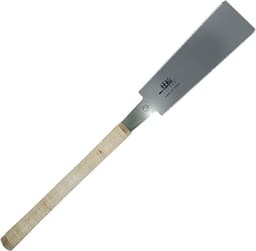
SUIZAN SUIZAN 240 mm ryoba

Best overall

SUIZAN SUIZAN 240 mm ryoba
9.2/10about £39.80
WORKPRO WORKPRO 200 mm pull saw

Best value

WORKPRO WORKPRO 200 mm pull saw
9.2/10about £15.99
On this page

Sizing stock to length and width

Most joinery time is getting the piece to length without a blown-out arris. Use the rip edge with the grain and the crosscut edge across it. On the SUIZAN SR-001 that pair is 9 and 15 TPI on a 240 mm, 0.5 mm plate, at £39.80 with 4.6 from 657 reviews, and the origin field says Japan. A 240 mm stroke suits a bookshelf end or a table apron. WORKPRO’s 200 mm plate, 7–9 and 18 TPI, at £15.99, is the shorter stroke with China as the origin. JORGENSEN’s 250 mm plate at £18.99 is the longest budget stroke, with a weaker 4.4 from 357 reviews. Temple’s R-180, at 180 mm and £33.50, is enough for narrow stock and leaves the kerf sooner on a wide board. Dandelionsky’s 10 inch title, about 255 mm in the captured row, says 17 teeth, which does not name the rip edge. A printed pair beats a longer mystery plate. Ten identical shelf ends belong on a mitre saw. If the plate keeps binding, the stroke is on the how to use a Japanese pull saw page.

Dovetails and tenons

Pins and tails are mostly cross-grain. Use 15 TPI on the SUIZAN, or 18 TPI on the WORKPRO and the JORGENSEN, not the coarse rip edge. The rip edge is for a tenon cheek that runs with the grain. Mixing those up leaves a furry shoulder and a slow cheek. Temple’s 180 mm bullets name dovetails and tenons. The £45 Temple ryoba talks about medium-sized woodwork, and the 9.5 mm title is still not a length. On a 60 mm drawer side the 180 mm plate stays nearer the pin than a 250 mm JORGENSEN. A table-leg tenon wants the longer plate so the cheek stays in one kerf. The 240 mm SUIZAN does both, with more steering in a small pin. Woodsmith treats a spine-backed dozuki as the joinery saw and the ryoba as the general saw. A hollow shoulder may need that spine, which is the split on the ryoba vs dozuki page. None of these twelve listings is a dozuki, and the Temple kataba is not a substitute until its title and double-edge bullet agree. Saw to the waste side of the knife line.
SUIZAN SUIZAN 240 mm ryoba

Testsieger

SUIZAN SUIZAN 240 mm ryoba
9.2/10about £39.80

Flush tenons and pegs

A peg, a wedge, or a proud tenon is the flush saw’s job. Temple’s F-6 is 6 inches, about 90 g, £23.10, and 4.6 from 798 reviews, the largest sample in the set. Lay the plate on the face and pull so the teeth shave the peg without a trench beside it. Yuiturt’s 150 mm saw at £6.99, with 11/16 TPI and 4.6 from 99 reviews, does the same job with snap in the defect keywords. Flex it only as far as the peg needs. Magicbox at £17.99 includes a flush piece and double-edge saws, origin China, with no printed lengths. Use the flush piece for the peg and a double-edge piece to size the stock. Do not flush with the stiff 240 mm SUIZAN, or the teeth scar the stile. Do not rip with the flush plate either. Leave a millimetre proud and take two light pulls. The return is only the weight of the saw.

When this set is the wrong tool

This set is for marked joinery and for what the joint leaves proud. It is the wrong tool for a long rip in thick hardwood that has closed on a 0.5 mm plate. Wedge the kerf, then move that rip to a saw you can push, or to a machine, rather than folding the ryoba. A stack of identical 45-degree cuts belongs on a mitre saw. The pull saw still follows a knife line on one show piece. Bent-plate complaints on the SUIZAN and the 180 mm Temple are a joinery limit: a kink will not cut a straight shoulder. A bend on arrival is a Consumer Rights Act question for a faulty good. A bend from pushing is a spare blade where the comparison row claims one, on SUIZAN, WORKPRO, JORGENSEN, and the Temple saws. Confirm the spare on the live page. Dandelionsky does not state one. Start with a ryoba whose length and TPI you can read, and add the flush saw when the first peg is proud.

Common questions

Which edge do I use for dovetail cheeks?
Use the crosscut edge where the cut runs across the grain, which is the usual pin and tail cut. On the SUIZAN that is the 15 TPI edge. On the WORKPRO it is the 18 TPI edge. Use the coarser rip edge for a tenon cheek that runs with the grain. The wrong edge still cuts, and the surface looks torn. Roll the saw before you blame the steel.
Is 180 mm enough for a bookshelf panel?
It will crosscut a narrow shelf end, and you will take more strokes as the board gets wider, because the teeth leave the kerf. Temple sells the 180 mm ryoba for boards cut to length and width as well as for joints. A 240 mm SUIZAN or a 200 mm WORKPRO stays in a wider panel more easily. If the panel is a full sheet, this is no longer a handsaw job.
Can I flush a proud tenon with the ryoba?
You can try, and the stiff plate usually marks the face. A flush-cut saw is meant to lie flat: Temple’s 6 inch saw if you want the 798-review sample, or Yuiturt’s 150 mm saw if £6.99 is the limit and you accept the snap complaints. Leave the tenon slightly proud and pull. Do not push the flexible plate into the stile.
Which listing mentions dovetails?
Temple’s 180 mm ryoba, B0F92P54TP, names dovetails and tenons in the bullets, and the £45 Temple ryoba talks about joinery-sized work in the same kind of copy. SUIZAN does not need the word dovetail to be usable: it prints 9 and 15 TPI and 240 mm. Marketing that names a joint is not a test of that joint. Read the length, then decide.
When should I switch to a powered saw?
Switch when the cuts repeat, when the section is thick enough to bind a 0.5 mm plate after you have wedged the kerf, or when the line is a production crosscut rather than a knife line on one piece. A mitre saw or a circular saw is the better tool for that pile of shelf ends. Come back to the pull saw for the joint itself, where the show face and the marked line matter more than speed.

Related pages

Sources

Public sources named in the research digest, plus the amazon.co.uk listings compared on this page. Retrieved October 2026.

  1. SUIZAN: how to choose a Japanese saw (retrieved October 2026)
  2. Woodsmith: selecting and using Japanese saws (retrieved October 2026)
  3. Knivesandtools UK: how to use a pull saw (retrieved October 2026)
  4. Z-Saw: pull-stroke reference (retrieved October 2026)
  5. HSE: PUWER overview (retrieved October 2026)
  6. Consumer Rights Act 2015, section 22 (retrieved October 2026)
  7. RHS: pruning guide (retrieved October 2026)
  8. amazon.co.uk listings for this set (retrieved October 2026)