Which saw for a sheet of timber: choose the right tool
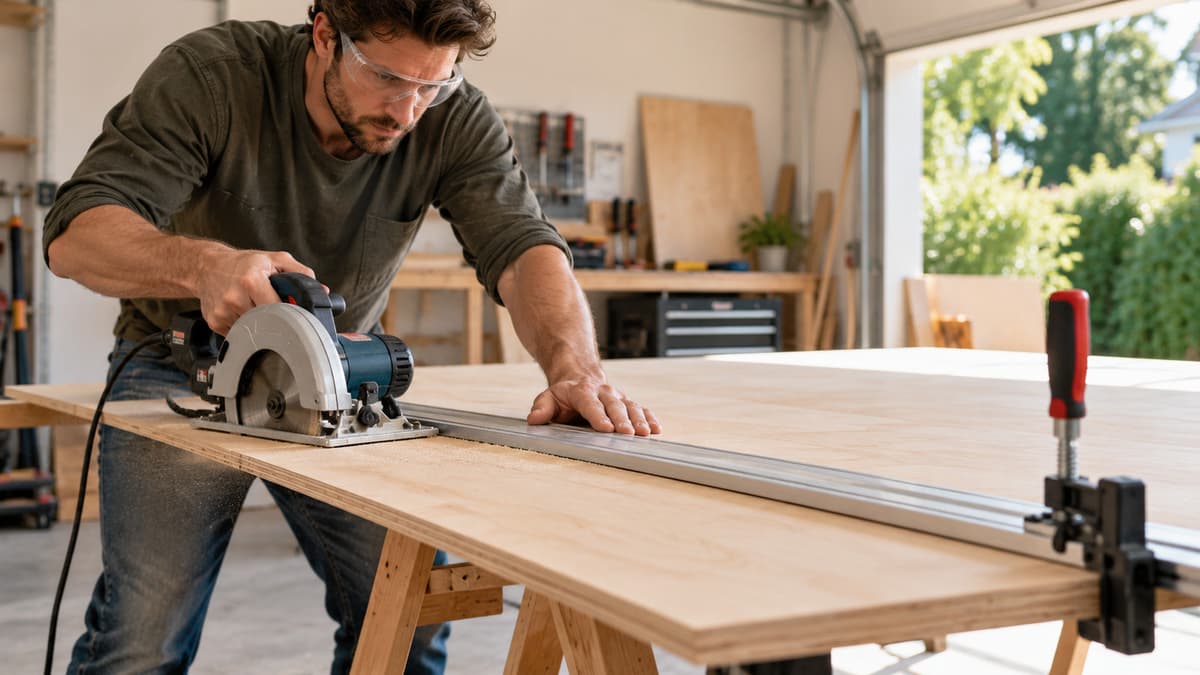
Choose between a circular saw, jigsaw, table saw and track saw for plywood, MDF or a worktop, based on the cut, sheet size and your UK workspace at home.
On this page

A full sheet of plywood, MDF or a worktop can make three familiar saws look interchangeable. If you are asking which saw for a sheet of timber, start with the line you need to cut and the space around the sheet. A circular saw suits long straight cuts, a jigsaw suits curves and smaller cut-outs, and a table saw earns its place when widths must be repeated. Controlling a 2.44 m panel is a different job from trimming a shelf. The depths cited later are the published Bosch circular-saw figures of 48, 53 and 57 mm, used as arithmetic against an 18 mm sheet, not as a cutting test.
In short
Use a hand-held circular saw with a properly clamped straight edge for most one-off, straight cuts in large sheet material. Choose a jigsaw when the line curves, and consider a table saw when you can support the material and need the same narrow width repeatedly. A track saw is the clearer upgrade when guided sheet cutting becomes a regular job rather than an occasional one.
Name the cut before the saw
The material name does not choose the tool by itself. Plywood, MDF and a worktop can all need a straight crosscut, a long rip, a curved opening or a series of identical strips. Those jobs put different demands on the blade and, more importantly, on how you guide and support the work. Decide whether the edge must be straight, whether the line curves, and whether you are making one cut or repeating it.
A hand-held circular saw brings the tool to the sheet, which can be easier than manoeuvring a 2.44 m panel through a fixed machine. A jigsaw's narrow blade can follow a sink opening. A table saw gives a fixed reference when the same width must be repeated and the workshop can support the sheet. Straight and large points towards a circular saw, a curve towards a jigsaw, and repeated widths towards a table saw. Define the finished edge before you buy on the promise that a tool cuts wood.
Circular saw for the long straight line
A circular saw is the strongest general answer for breaking down a full sheet, because its intended job is long, straight cuts in flat wood. Lay the sheet on a stable support, mark the cut and bring the saw to the work. That avoids balancing a large panel against a small fixed table, and it keeps the tool useful where workshop space is limited.
A clamped straight edge can guide the saw's base once you measure the offset between the blade and the edge of the base and set the guide to match. Clamping on the cut line without that allowance puts the blade in the wrong place, and the guide has to stay secure for the whole cut. A parallel guide references a nearby edge. A rail or straight edge gives a long path across the face, which matters when the factory edge is too far away or you cut across the panel.
Cutting depth is unlikely to decide the choice for ordinary 18 mm sheet. The Bosch circular-saw set lists maximum depths of 48, 53 and 57 mm, so 18 mm sits inside all three figures by arithmetic. That is not a tested finish: the blade, setup, support and material still affect the cut. Compare Bosch circular saws when straight sheet work is your main use.
Jigsaw when the line curves
A jigsaw is the right move when the cut has to turn. Its narrow blade can follow curves and local cut-outs that a circular blade cannot negotiate. That makes it relevant for shaped panels and openings, or when the component is already small enough to handle comfortably. Cutting through the material is not, by itself, a reason to choose it for a full sheet.
On a long straight cut, the blade can wander from the marked line or deflect through the thickness. A straight edge may help the base follow a route. It does not turn the blade into a rigid circular blade. If the finished edge needs to stay straight over 1.22 m or 2.44 m, choose the tool designed around that task. A rough first cut that leaves material for later finishing can still make a full sheet manageable. Use the jigsaw comparison when curves and cut-outs are the work.
Table saw when cuts repeat
A table saw makes sense when you need repeated widths and can support the work before, during and after the blade. The machine stays fixed while the material moves, so a consistent reference can make a run of matching strips more efficient. That is a different job from taking one oversized sheet and making it manageable in a kitchen, garage or small work area.
The limit is sheet handling. A large panel needs enough clear space and support to stay controlled as it approaches and leaves the machine. If the sheet is larger than the useful support around the saw, a fixed fence does not solve the problem of presenting the work safely. Breaking the panel down first with a guided hand-held saw may be the more workable sequence.
Workplace use brings its own guarding duties under HSE guidance. At home, the useful distinction is simpler: the hand-held saw travels over supported work, while sheet material travels through the table saw. Read the table-saw comparison if repeatable strips are the main requirement and you have room for the machine and the material. Stability comes from the complete setup.
When a track saw is the honest upgrade
A track saw becomes the more convincing choice when you regularly need accurate straight cuts on large panels. Its rail defines the route, so you are not measuring a circular-saw offset and clamping a separate straight edge each time. For occasional DIY, a circular saw and a sound straight edge may be enough. If sheet cutting is the recurring job, the dedicated system answers a real inconvenience. An ordinary circular saw can still cut sheet material.
Any accessory described as a guide is not automatically a panel-length track. The Bosch UniversalCirc information says its plastic rail must not overhang the sheet, and reviews mention a rail set of about 70 cm. A guide of that length cannot provide one continuous path along a 2.44 m sheet. Check the usable length and the manufacturer's positioning rules before relying on a kit for an 8-by-4-foot panel.
If cordless access matters, compare the DeWalt cordless circular saws and Worx circular saws. Those pages help you choose within the hand-held category. They do not remove the need for a suitable full-length guide.
What else you need
The saw is only one part of a sheet-cutting setup. A guide has to span the intended cut, the panel and the offcut both need support, and the workspace must leave enough room for your body and the saw to complete the pass. A short accessory rail, an unsupported waste side or a cramped route can defeat a sensible tool choice.
Plan dust control before you start, particularly with MDF or when the work must happen indoors. A kitchen may offer a flat area and still be a poor cutting space if there is no safe route for the saw, guide and offcut. Maximum depth only tells you whether the stated capacity exceeds the thickness. The 48 mm figure exceeds 18 mm by arithmetic, and says nothing about blade condition or tooth choice. A parallel guide follows an edge; a straight edge or track guides a route across the sheet. Check usable length rather than assuming several short pieces equal a full-sheet solution. A qualifying purchase on amazon.co.uk can earn a commission at no extra cost to you.
Common questions
Can I break down a sheet of plywood with a jigsaw?
Do I need a table saw for a kitchen worktop?
Is a circular saw enough if I clamp a straight edge?
How long a guide do I need for an 8x4 sheet?
Will a 48 mm circular saw cut an 18 mm sheet?
What if I must cut the sheet in a kitchen?
When should I choose a track saw?
Which saw comparison should I read next?

Peter F. is the editor for DIY & tools at productscompared.co.uk. Comparisons in this category are checked against amazon.co.uk listings, review evidence and public UK sources.
Related articles

Mitre saw or circular saw: choose by the cut
Compare repeat crosscuts, angles and sheet cutting so you can choose the right first saw.

Wood dust from power saws: extract it before you mask
Fine wood dust from cutting timber indoors is an exposure problem, not only a mess to sweep up.

When a circular saw kicks back: what to do
Why a hand-held circular saw jumps back, and how support, depth and the lower guard change the cut.