Mitre saw or circular saw: choose by your cut

Mitre saw or circular saw? Compare repeat crosscuts, angles, sheet cutting and portability so you can choose the right first saw for your DIY jobs.
On this page

You have a stack of skirting to trim, decking ends to square and perhaps a worktop or plywood sheet waiting in the garage. Choosing a mitre saw or circular saw is not mainly about which machine looks more capable; it is about whether the blade should return to a fixed cutting station or travel across the material. A mitre saw gives you controlled, repeatable crosscuts at its fence, while a circular saw earns its place on large boards and long cuts.
In short
Choose a mitre saw when your work is mostly repeated crosscuts, trim and set angles on pieces that fit against its fence. Choose a circular saw when you need to break down sheets, cut a worktop or take the tool to material that cannot sensibly come to a bench. Neither replaces the other completely, and a mitre saw remains unsuitable for a full sheet even when it has a sliding action.
The cut each saw is built for
A mitre saw is a cutting station. You place a board against its fence, set the angle, bring the blade through the material and return the head for the next piece. The fence and the saw's set path are part of every cut. That helps when several studs, decking boards or lengths of skirting must finish at the same dimension.
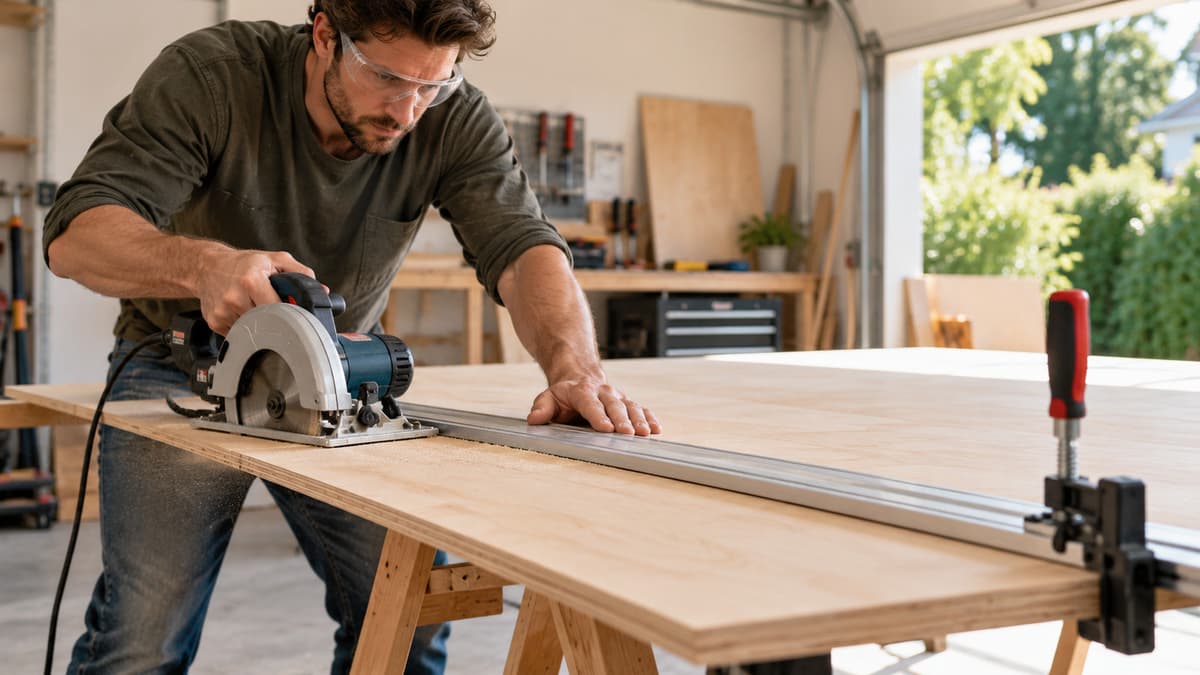
A circular saw is hand-held and moves along the work. Its shoe rests on the face of a supported board or sheet while the blade cuts below it. You can guide it with a marked line, a parallel guide or a compatible rail, depending on the saw and the job. It suits material that is long, broad or awkward to carry to a fixed station.
The dividing line is travel. A mitre saw's blade can only cross the width its mechanism allows. A circular saw can continue along a long worktop or full sheet if the work stays supported. It does not automatically repeat an identical crosscut; that depends on your mark, guide and set-up.
Crosscuts, stops and repeat angles
For skirting, studs and decking ends, the mitre saw has the more natural workflow. The material registers against a fence, and you can set a stop when several pieces need the same finished length. Once the first cut is checked, the stop reduces repeated measuring and helps stop small variations accumulating across a run.
Angle settings suit trim work. A square crosscut is only one case: the head or table can be set for mitres, and suitable machines can bevel too. The board still has to fit the cutting envelope. Sliding means extra crosscut reach across a wider board, not a machine that can run down a sheet.
A circular saw can cut skirting square if you support it and use a mark or a guide that cannot shift. That is reasonable for a few cuts on site. A roomful of matching pieces is quicker at a prepared mitre-saw station.
If repeated trim and crosscuts define the project, use the sliding mitre saw comparison for capacity. No single generic width or blade figure applies to every mitre saw.
Sheets, worktops and long rips
A full plywood or MDF sheet cannot sit against a mitre-saw fence and pass through a limited crosscut path. A circular saw travels over the sheet, so it can break a large panel into manageable parts or make a long straight cut. The same advantage applies to worktops and other broad material.
Support is part of the cut. The shoe needs a stable surface, and the offcut must be managed so the kerf does not close around the blade. If the cut traps the blade, a hand-held circular saw can kick back. Check that the stated cutting depth is enough for the material.
Bevel capability does not erase the distinction. Circular saws in the Bosch set include models that bevel at the shoe; the corded PKS 55 listing states 45 degrees. At a bevel, the available depth can be shallower than for a square cut, so a maximum straight depth is not the full answer for an angled worktop cut.
The Bosch circular saw comparison sets out stated depths, included straight-cut aids and battery requirements. The featured Bosch Professional body is here because its UK listing states a 57 mm cut, a motor brake and a brushless motor, with a 165 mm blade. It is a body-only tool for Bosch Professional 18 V batteries, not a mitre saw, and those blue packs are separate from Bosch's green 18 V system.
Which one fits your first jobs
Start with the largest or most repeated cut, not with a vague aim to buy the more versatile tool. If you are fitting skirting through several rooms, cutting many studs to matching length or squaring numerous decking ends, a mitre saw's fence and stop solve the dominant task, provided each length fits the saw's cutting capacity.
If you are cutting a worktop, reducing sheet goods or making long cuts in boards, start with a circular saw. It can move to material resting on supports, which also helps when there is no permanent bench. You still need room to support the complete cut, control the lead or battery state, and keep either section from pinching the blade.
Some projects contain both. A deck may need repeated crosscuts and long cuts in sheet material. You do not have to buy both on day one. Choose the saw that unblocks the job, and do not force a mitre saw onto a full sheet or treat a circular saw as a repeat-cut station.
Safety depends on the cut
There is no sound basis for calling one of these saw types safer for a first user. A fixed crosscut saw keeps the cut at a station, but it still needs its guards, correct set-up and competent use. Where it is used as work equipment, the HSE context for guarded woodworking machinery is relevant. That does not mean every workplace bench rule can be copied onto a hand-held saw.
A circular saw asks different decisions. You control a moving tool, and support determines whether the kerf stays open. The shoe must stay on the material, the blade path must stay clear below it, and the offcut must not twist into the blade. Kickback remains possible if the blade is trapped.
Match the saw to the cut and follow that model's instructions. Do not hold an oversized sheet at a mitre-saw station, and do not freehand a long circular-saw cut when the result needs a secure guide. A motor brake, guard or guide does not replace correct support.
What this comparison does not price
This decision can be made from the job without inventing a budget. No mitre-saw price or cutting depth was collected for this article, so those figures are absent. Use the linked model comparisons for current product details rather than treating a saw type as if it had one standard specification or shelf price.
A cordless body price can exclude the battery and charger, and a guide system can be described as compatible without being in the box. The featured Bosch Professional saw is listed with an L-BOXX, wood blade, dust adapter and parallel guide, but no batteries. That is useful only if its 57 mm stated depth and blue 18 V platform suit your work and existing kit.
Check the material thickness, the angle of cut, the included straight-cut aid and everything needed to power the saw. Those details decide whether the tool can make the first planned cut when it arrives. A qualifying purchase through the comparison links can earn a commission at no extra cost to you.
Common questions
Can a circular saw cut skirting board square?
Can a mitre saw break down a full sheet?
What does a sliding mitre saw add?
Do I need both a mitre saw and a circular saw?
Which saw is safer for a first-time user?
Can I bevel a worktop with a mitre saw?
Where can I compare circular saw models?

Peter F. is the editor for DIY & tools at productscompared.co.uk. Comparisons in this category are checked against amazon.co.uk listings, review evidence and public UK sources.
Related articles
Which saw for a sheet of timber: choose the right tool
Choose between a circular saw, jigsaw and table saw when sheet size controls the job.

When a circular saw kicks back: what to do
Learn why a hand-held circular saw can jump and how support affects the cut.

18V battery platforms for power saws: choose once
Check battery compatibility before adding a cordless saw to your existing tools.