When a circular saw kicks back: release, then wait

When a circular saw kicks back, release the trigger and let the blade stop. See how support, blade depth and the lower guard differ from bench-saw rules.
On this page

When a circular saw kicks back, the usual hand-held problem is a pinched blade, a wandering cut, or a workpiece that moved as the kerf opened. Bench-saw advice, including a push stick, will not stop a portable saw safely.
Release the trigger, keep the saw still and wait for the blade to stop completely. Do not drag a spinning blade backwards. Isolate the tool, then correct the reason it bound: poor support, too much blade depth, a dull or unsuitable blade, or a lower guard that does not move and return.
HSE’s WIS16 treats kickback as a principal cause of serious accidents on circular saw benches. Electrical Safety First tells hand-held users to let the blade stop and to check that the guard returns. Products Compared read those sources and the Bosch listings on amazon.co.uk. We did not run a lab test. A qualifying purchase can earn us a commission at no extra cost to you.
In short
Release the trigger and wait for a full stop. Do not pull a spinning blade back through the timber. Restart only after the saw is isolated and the bind is fixed: support, depth, blade, or a lower guard that will not return.
Hand-held and bench kickback are not the same
The phrase circular saw kickback covers two related situations. A hand-held circular saw travels across a stationary workpiece. A circular saw bench holds the blade in the table and you feed timber into it. Timber can catch the blade and move violently in either case, but the controls, guards and safe method are not interchangeable.
Much of the strongest UK guidance is written for benches. HSE rip-saw guidance covers a correctly adjusted riving knife and a push stick. Those are bench controls. They are not a reason to improvise a push stick for a hand-held saw, or to set every portable riving knife to the HSE bench measurement.
Start with the manual for the saw in your hands. BS EN 62841-2-5:2014 is the standard identifier for hand-held circular saws. Check the guarding and any riving knife it describes. Some saws have a riving knife and some do not, so one gap for every saw is not a safe claim. A fixed machine needs its own controls; compare that type on our table saw page.
What closes the kerf around the blade
The kerf is the slot removed by the blade. If the board bends or twists as you move forwards, that slot can close around the blade. Continued forward pressure can then turn a bind into a sudden reaction.
Support is part of the cut. Arrange the workpiece and the offcut so neither side drops, sags or levers the closing cut onto the blade. That does not mean clamping both sides so rigidly that the cut cannot settle. It means preventing an uncontrolled fall while the kerf stays open.
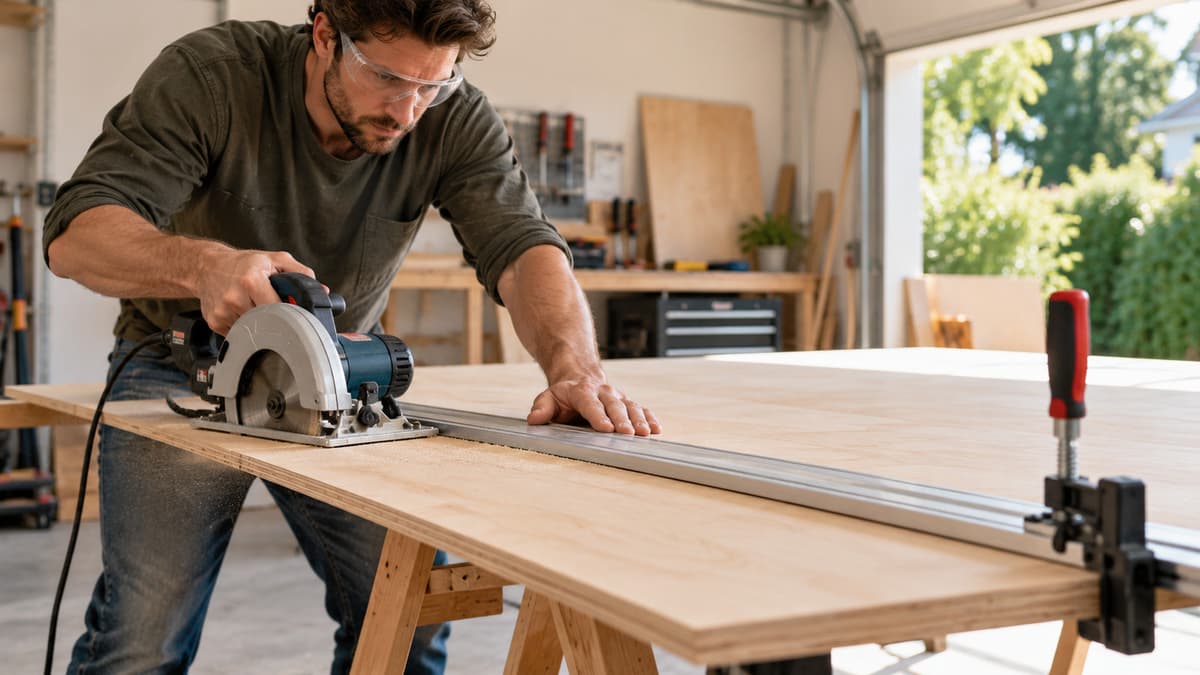
A full sheet makes this easy to miss. Plywood may look flat until a long rip releases stress or an unsupported section sags. Stop if the saw labours or the line shifts, and move a support before the blade is trapped. Choosing a saw for sheet timber sets out when a circular saw, jigsaw or table saw suits the sheet. A rail helps direction. It does not hold up a sagging board.
Set the depth and check the blade
Blade depth changes how much blade is exposed below the timber and how the tool behaves in the cut. The Bosch UniversalCirc manual says to set the depth so that less than one full tooth projects beneath the workpiece. That is a model-specific instruction. Check it against your own manual rather than copying one setting to every saw.
Set the depth before the motor starts and lock the adjustment. Too deep exposes more blade than the work needs. Too shallow may not finish the cut. Either mistake tempts you to alter a live saw, or to force a second pass without planning the support.
HSE bench guidance lists dull blades among kickback factors, and the same sign matters on a portable saw. If you have to force the cut, stop. Burning or repeated binding calls for inspection, not more shoulder pressure. Confirm the blade suits the material and is fitted in the direction the saw and blade manufacturer specify.
Isolate the saw before you touch the blade. Unplug a corded tool, or remove the battery where the manual tells you to. The Bosch circular saw comparison includes both types, so check where the power comes from. The UniversalCirc 18V-53 solo listing names a 160 mm Optiline wood blade and a 53 mm cut, at about £85, with no battery in the box. That does not make its blade or depth right for every material.
The lower guard must move freely
The lower guard covers the blade when the saw is out of the work. As the saw enters the cut, the workpiece moves the guard aside. When the saw leaves the material, the guard should return. Electrical Safety First tells users to make sure it returns and to let the blade stop.
Never wedge or tie the lower guard open. If it is slow, jammed, or failing to return, isolate the saw and stop. There is no safe next cut until that fault is fixed.
Follow the cleaning or service instructions for that model. Do not hold the guard aside and lower a conventional circular saw into the middle of a board unless the manufacturer designed it for that plunge. Choose a method and tool intended for the cut.
Check the guard with the blade, the depth and the support before each session, and again after a knock or contamination. If it does not return, do not make another cut.
What to do when the saw stalls
When the saw slows sharply, sticks or jumps, stop adding energy. Release the trigger while keeping a controlled hold, and keep the saw in place until the blade has stopped completely. Electrical Safety First advises letting the blade spin down, and the Bosch material warns against pulling a spinning blade backwards.
Do not push harder or yank the saw out of the kerf. Pulling backwards while the teeth are still moving drags the blade through a cut that is already pinching it, and twisting it can take the blade off the line. Once stopped, isolate the power, then inspect the setup rather than only resetting the trigger.
- If the workpiece or offcut sagged and closed the kerf, reposition the supports so the slot stays open.
- If the blade left the line, reset the guide rather than bending a trapped path straight.
- Check depth and blade condition against the manual, and replace a damaged blade by the maker’s procedure.
- Confirm the lower guard moves and returns. Do not restart if it sticks.
- If the saw looks damaged, use the manufacturer’s service route or a competent repairer.
Begin again only when you have corrected a cause. If it jumped but seems all right now, the diagnosis is incomplete. A guide or a brake on another model does not replace support and a free kerf. Compare those differences on the DeWalt cordless circular saw and Worx circular saw pages.
When to stop and get help
Some kickback causes are setup errors you can correct with the saw isolated: a misplaced support, the wrong depth, or an offcut allowed to drop. Stop treating the issue as a routine DIY adjustment when a safety component does not work, damage is visible, or you cannot verify the correct blade and how it fits.
A lower guard that will not return needs proper attention. So does a blade, spindle, shoe or depth mechanism that looks bent, loose or damaged after a jump. Do not wedge, remove or work around the part. Follow the manufacturer’s service information or take the saw to a competent repairer.
The work may also be beyond the setup. A sheet you cannot support, an unstable stance, or binding that continues after the obvious fixes calls for a different method or an experienced operator. At work, follow the employer’s controls and training. At home, the manual, intact guards and a controlled workpiece remain the basis for the cut.
Common questions
What does kickback feel like on a hand-held circular saw?
Why does wood close on a circular-saw blade?
Should I pull a circular saw backwards if it sticks?
Does a dull blade make circular-saw kickback more likely?
Does every hand-held circular saw need a riving knife?
What should a circular saw's lower guard do?
When should I stop treating a kickback problem as DIY?

Peter F. is the editor for DIY & tools at productscompared.co.uk. Comparisons in this category are checked against amazon.co.uk listings, review evidence and public UK sources.
Related articles
Which saw for a sheet of timber: choose the right tool
Choose between a circular saw, jigsaw and table saw by the sheet and the cut.

Hearing protection for power saws: UK noise rules
Understand practical hearing protection and where UK workplace duties apply.

When to change a saw blade: signs that matter most
Spot the signs that a worn blade is making you force or burn a cut.