Independent comparisons. We may earn from shop links. More info

Freestanding electric patio heater

Updated: October 2026

You want a UK patio or gazebo seat to stay usable after the sun drops, and a 2 kW indoor halogen looks like the same idea at a lower price. It is not. A freestanding electric patio heater has to match the weather, the lead and the socket you have. Heat levels come after that. This page stays with the Harrier and the SOUTHEATIC in the [freestanding radiant heater comparison](/hub/portable-heaters/freestanding-radiant-heater), as listed on amazon.co.uk on 19 October 2026. Peter F. used those listings and the public UK sources below. There is no lab test. A qualifying purchase can earn a commission at no extra cost to you.

You want a UK patio or gazebo seat to stay usable after the sun drops, and a 2 kW indoor halogen looks like the same idea at a lower price. It is not.

Our top picks

On this page

A patio heater is not an indoor halogen

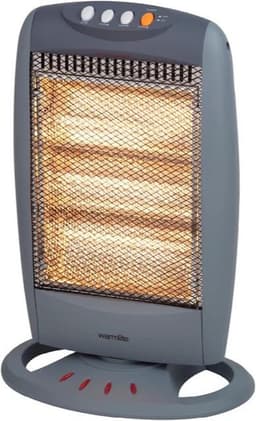
An indoor radiant heater has no weather rating in this set. The Warmlite halogen and the carbon tower are marked indoor. Taking either outside still leaves rain and a lead across wet slabs. Electrical Safety First also says an outdoor patio heater should not be used indoors. The outdoor job is a head aimed at a seat. Harrier reviews praise heat under a gazebo and say it does not cover a whole table. Watts for a room are on the buying guide.

IPX4 and IP65 in plain language

IP ratings here are seller claims. This comparison has no lab spray test. IPX4, which the Harrier bullets call approved, is protection against splashing water. Heat Outdoors describes IPX4 as showerproof and not for heavy rain, and reserves IP65 for a stronger weatherproof claim. IP65 on the SOUTHEATIC, claimed for rain, snow and dust, is the higher seller line: dust-tight and protected against water jets, in the usual reading of the code. The title also says indoor and outdoor, while the usage field says outdoor.

Harrier and SOUTHEATIC

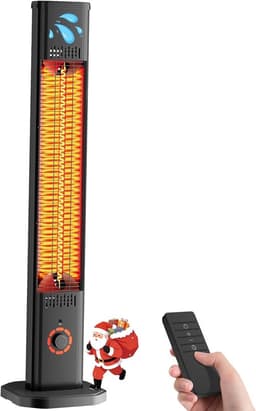
The Harrier is £48.99, 4.4 from 342 reviews, 2,000 W, with a head that tilts and a 9 kg, 211 cm stand. A timer and a tip-over switch are not stated. The SOUTHEATIC T20-GR20 is £139.99, 4.0 from 23 reviews, 2,000 W, eight levels, a remote and an eight-hour timer, at 3.55 kg. A cable length is not stated. On reviews and price, the Harrier is the clearer read. On controls, the SOUTHEATIC is the one with a timer. The skip rules are on the best freestanding infrared heater page.

Socket, lead and wind

The Harrier lead is 1.8 m. Reviews say that once the pole is up, the plug often does not reach past the base. Electrical Safety First advises against an extension lead across the patio. Site the heater at an outdoor socket that is at least IP44 and on a 30 mA RCD, or have one fitted. A new point is an electrician’s job. Anchor or weight the stand so it cannot blow over. Clearance once you are indoors is the how to use page.

What it costs to run

Both outdoor heaters are 2,000 W at the top of the dial. At Ofgem’s 26.32 pence per kWh for 1 October to 31 December 2026 in England, Scotland and Wales, a full hour is about 53p and two hours about £1.06. Lower settings exist, and their watts are not stated, so do not invent a cheaper hour. A timer changes the habit, not the unit price. The Harrier has no timer stated.

Common questions

Is IPX4 enough for a British patio?
It can be enough under a cover, as a splash rating, if you bring the heater in for heavy rain. The Harrier claims IPX4 and reviewers use it under a gazebo. Heat Outdoors describes IPX4 as showerproof and not for leaving out in heavy rain. That is a seller’s reading of the code, not a test of this ASIN.
What does the IP65 claim add?
On the SOUTHEATIC listing it is a seller claim of protection against rain, snow and dust, which is a higher bar than the Harrier’s IPX4 splash wording. This page has no lab spray test of that heater. The review file is 4.0 from 23 reviews, so the claim is thinly witnessed. The title also says the heater is for indoor and outdoor use. Follow Electrical Safety First and keep an outdoor patio heater outdoors.
Why is the lead a problem?
Because 1.8 m often does not reach past the base once the Harrier pole is extended. Reviews say this directly. The safe response is to place the heater beside an outdoor socket, or to have a socket fitted in the right place. An extension lead across the patio is the fix Electrical Safety First advises against. The SOUTHEATIC does not state a cable length at all, so you cannot plan the socket from the listing.
Do I need an outdoor socket?
Yes. Use a UK three-pin connection to an outdoor socket that is at least IP44 and protected by a 30 mA RCD, which is Electrical Safety First’s patio guidance. A lead through a doorway from the kitchen is a trip and a water path. If you need a new socket, that is an electrician. Do not add a spur because the heater arrived before the socket did. The heater can wait.
Can I take a patio heater indoors?
No. Electrical Safety First says not to use an outdoor patio heater indoors. The SOUTHEATIC title mentions indoor and outdoor, and the usage field says outdoor. When a listing disagrees, keep the outdoor heater outside. Indoor radiant heaters in this comparison are the wrong object for the garden as well. A dry gazebo is still an outdoor sit, not a living room.
How much does 2 kW cost per hour?
About 53p at Ofgem’s direct-debit average of 26.32 pence per kWh for 1 October to 31 December 2026 in England, Scotland and Wales. That is full output for a full hour. Two such hours are about £1.06. Northern Ireland is outside that average.

Related pages

Sources

Public UK sources for plugs, efficiency rules, running cost and heater safety. Listing prices, stars and review counts are from amazon.co.uk on 19 October 2026.

  1. Electrical Equipment (Safety) Regulations 2016, regulation 35 (retrieved 19 October 2026)
  2. Regulation (EU) 2015/1188 on legislation.gov.uk (retrieved 19 October 2026)
  3. GOV.UK — Placing energy-related products on the UK market (retrieved 19 October 2026)
  4. Ofgem — Energy price cap, 1 October to 31 December 2026 (retrieved 19 October 2026)
  5. Electrical Safety First — Portable heaters (retrieved 19 October 2026)
  6. Electrical Safety First — Patio heaters (retrieved 19 October 2026)
  7. Centre for Sustainable Energy — Room heaters (retrieved 19 October 2026)
  8. Devon and Somerset Fire and Rescue — Heaters (retrieved 19 October 2026)