Independent comparisons. We may earn from shop links. More info

Freestanding radiant heater buying guide

Updated: October 2026

You want heat on a chair, a desk, or a covered patio, and amazon.co.uk calls all of it a freestanding radiant heater. A halogen dish, a carbon tower, a bar fire, a mica panel and a patio head are not the same buy. Choose by the hour you will sit there, the watts you will leave on, and whether the listing is indoor or outdoor. The [freestanding radiant heater comparison](/hub/portable-heaters/freestanding-radiant-heater) scores eight listings from 19 October 2026. Peter F. used those listings and the public UK sources below. There is no lab test. A qualifying purchase can earn a commission at no extra cost to you.

You want heat on a chair, a desk, or a covered patio, and amazon.co.uk calls all of it a freestanding radiant heater. A halogen dish, a carbon tower, a bar fire, a mica panel and a patio head are not the same buy.

Our top picks

On this page

What freestanding radiant includes

Radiant heat warms you and the surfaces in front of the element, not the air behind you. The Centre for Sustainable Energy treats a short directional blast as a different job from holding a room for hours. In this set that is a halogen dish, a quartz-halogen tube, a carbon tower, a bar fire, an oil-free column, a mica panel, and two 2,000 W outdoor towers.

Match the heater to the hour of use

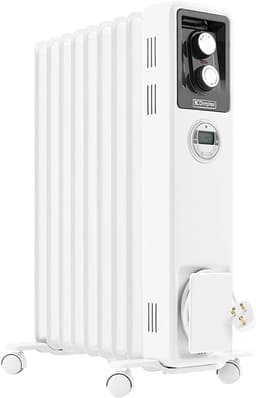
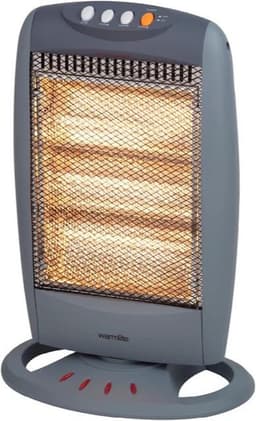
A 400 W bar on the WL42005 or 500 W on the WL42013 is the honest cost of heat for one chair. The SONBION stops at 800 W. For an evening, the ECR20TIE has a thermostat and a 24-hour timer. Listing areas of 12–25 m² and 18 m² are seller text. Adax’s figure of about 80 W per square metre is a rule of thumb for insulated room air, not a British Standard and not a halogen beam. The indoor choice stays on the halogen versus carbon page.

Wattage and what an hour costs

Ofgem’s direct-debit average for 1 October to 31 December 2026 is 26.32 pence per kWh in England, Scotland and Wales. Northern Ireland is outside it, and VAT is off electricity in that window. A full hour is about 11p at 400 W, about 13p at 500 W, about 21p at 800 W, about 32p at 1.2 kW and about 53p at 2 kW. A thermostat spends less than a bar left on high. The WL42005 has no thermostat, so you switch a bar off yourself. The ECR20TIE line of up to 9% less energy does not name a comparison heater.

Controls, plug and weather

The dish, the carbon tower, the SONBION and the Yeominster do not state a thermostat or a timer. The ECR20TIE states both. The SOUTHEATIC states an eight-hour timer and a remote. The Harrier states neither. A UK heater should have a BS 1363 plug. Electrical Safety First wants it straight in the wall, about one metre from fabric, and off overnight. A tip-over switch is stated on the WL42005 and the SONBION only. Placement is on the how to use page. IPX4 on the Harrier is splash resistance, not heavy rain, on the patio heater page.

What to ignore on the listing

A coverage line is not even air temperature: 200 with no unit on the halogen, 270 with no unit on the carbon tower, 250 square feet on the Yeominster and 200 square feet on the Harrier. The SONBION title mixes quartz and halogen. Treat it as one tube. A noiseless line means there is no fan, not that the element is silent when it ticks. Stars are not a safety test.

Common questions

Will a freestanding radiant heater heat the whole room?
A halogen dish, a quartz bar or a carbon tower heats what sits in the beam. Reviews of the Warmlite WL42013 say the person in front feels it, and the air in the room does not. A thermostatic panel or the oil-free Dimplex ECR20TIE is sold as room heat, with listing areas of 18 m² and 12–25 m². Those areas are seller text.
How many watts do I need if I only sit in one chair?
Use the lowest setting that warms you, not the highest number on the box. In this set that is 400 W on the Warmlite WL42005 or 500 W on the WL42013. At the October to December 2026 Ofgem average, those hours are about 11p and about 13p if the element stays on. An 800 W SONBION hour is about 21p.
Is a mica panel the same as a halogen heater?
No. The Mylek is a flat 2,000 W mica panel with a thermostat, a timer and Wi-Fi, for wall or floor. A halogen heater in this set is a bright dish or bar with no thermostat stated. Both can be called radiant on a listing. The panel behaves more like a room heater that cycles. The dish is instant light and heat on whatever it faces, and it stops when you switch it off.
Why do two figures appear for the Yeominster output?
The bullets say 600 W or 1.2 kW. One table cell says 2 kW, and the power-consumption cell says 1.2 kW. Both lines are on the same amazon.co.uk listing. Reviews describe two bars, and several owners run one 600 W bar in a living room. Treat 1.2 kW as the stated maximum until the listing agrees with itself. Do not quote 2 kW as settled.
Can I use an indoor tower on the patio?
No. Indoor listings in this set have no weather rating. The carbon tower and the halogen dish are marked indoor. Rain, a short outdoor lead and an RCD socket are a different buy. The Harrier and the SOUTHEATIC are the outdoor heads here, and even those depend on the IP claim and where you can plug them in.
What does Lot 20 change about the bill?
Almost nothing you can see on a single evening. The assimilated ecodesign rule sets seasonal-efficiency floors for many indoor electric radiant heaters sold in Great Britain, and outdoor-only heaters are excluded. Northern Ireland follows a later EU regulation for CE-marked heaters placed there from 1 July 2025. Your meter still charges the kilowatt-hours the element draws. A Lot 20 line on the Mylek listing is a compliance claim, not a cheaper unit rate.

Related pages

Sources

Public UK sources for plugs, efficiency rules, running cost and heater safety. Listing prices, stars and review counts are from amazon.co.uk on 19 October 2026.

  1. Electrical Equipment (Safety) Regulations 2016, regulation 35 (retrieved 19 October 2026)
  2. Regulation (EU) 2015/1188 on legislation.gov.uk (retrieved 19 October 2026)
  3. GOV.UK — Placing energy-related products on the UK market (retrieved 19 October 2026)
  4. Ofgem — Energy price cap, 1 October to 31 December 2026 (retrieved 19 October 2026)
  5. Electrical Safety First — Portable heaters (retrieved 19 October 2026)
  6. Electrical Safety First — Patio heaters (retrieved 19 October 2026)
  7. Centre for Sustainable Energy — Room heaters (retrieved 19 October 2026)
  8. Devon and Somerset Fire and Rescue — Heaters (retrieved 19 October 2026)