Independent comparisons. We may earn from shop links. More info

How to use a halogen heater safely

Updated: October 2026

You have just unpacked a halogen dish, a quartz bar or a carbon tower, and the heat is there the moment the element glows. This page is how to use a halogen heater safely in a UK room: where it stands, what the first hour looks like, and when you switch it off. The [freestanding radiant heater comparison](/hub/portable-heaters/freestanding-radiant-heater) is the product table. A tip-over switch does not make a one-metre gap optional. Peter F. used the listings from 19 October 2026 and the public UK sources below. There is no lab test. A qualifying purchase can earn a commission at no extra cost to you.

You have just unpacked a halogen dish, a quartz bar or a carbon tower, and the heat is there the moment the element glows.

Our top picks

On this page

Set the gap before you plug in

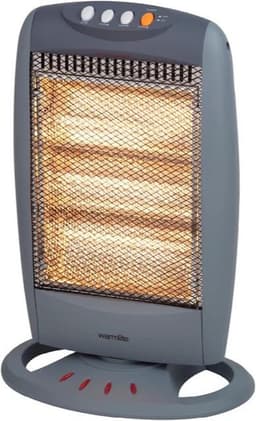
Put the heater on a level, firm floor. Electrical Safety First asks for about one metre from curtains, sofas, bedding and other combustibles. The WL42005 weighs 1.5 kg and the carbon tower 2.2 kg, with a base reviews call floppy. Use a BS 1363 plug straight in the wall. On thick carpet, the WL42005 tip switch may not press in. That switch is stated on the halogen and the SONBION, and not on the carbon tower. Plug-in glowing heaters do not belong in a bathroom zone.

First time on

Take packing off the guard before the element sees power, and click the base fully home. Start on the lowest setting and stay in the room: 400 W on the WL42005, 500 W on the WL42013, one bar on the SONBION. Aim at the seat, not at a curtain or a television in the dark. If the glow fights the screen, that choice is on the halogen versus carbon page. A light plastic smell on a first run of the oil-free column or the Mylek faded for those owners. Stop for smoke, a smell that gets worse, or scorch marks. Do not leave it alone to burn a smell off, and do not open the guard to poke a tube.

While it is running

Use the fewest bars that warm you. A 1,200 W halogen left on high is about 32p an hour at Ofgem’s 26.32 pence per kWh for 1 October to 31 December 2026 in England, Scotland and Wales. A 400 W bar is about 11p. None of these three states a thermostat, so you switch a bar off yourself. If oscillation rocks the tower, aim it by hand. Do not dry a towel or cover the top. Elements stay hot after switch-off, so do not move the heater while it is on. If you leave the room, switch it off. Rain and RCD sockets are on the patio page.

Night, pets and a blown tube

Switch the heater off and unplug it before you sleep. The one-metre gap has to survive a cat, and aerosols do not belong on the same sideboard. If a tube has blown, stop. If this was the wrong type, use the buying guide.

Common questions

How far should a halogen heater sit from a sofa?
About one metre from the sofa, curtains, bedding and anything else that can burn. That is the clearance Electrical Safety First and Devon and Somerset Fire and Rescue both give for portable heaters. The guard still gets hot inside that metre. A SONBION review describes fabric scorched when it touched the grille. Closer is not safer because the heat feels nicer on your legs.
Can I leave it on overnight?
No. Switch a glowing halogen, quartz or carbon heater off and unplug it before you sleep. Electrical Safety First and UK fire services treat overnight portable heaters as a fire risk, especially when nobody is awake to move a curtain or a pet. A low bar is still a glowing element. If the room needs heat all night, that is a question for a thermostatic room heater and the manual, not for leaving this dish on.
What if the tip switch will not click on carpet?
Move the heater to a firm, level surface where the switch can press in, or use a different spot in the room. Warmlite WL42005 reviews say the tip switch may not seat on soft carpet. Forcing it with a book, or defeating the switch, removes the cut-out the listing is selling. A tip switch that works on a hard floor still does not replace the one-metre gap. The carbon tower does not state a tip-over switch at all.
Can I dry a towel on the guard?
No. Do not hang a towel, clothes or washing on the heater, and do not drape anything over the top. Fire services say this directly. The grille on a small quartz heater can scorch fabric that touches it, which is what one SONBION owner reported with a blanket and cat fur. If something is damp, use a tumble dryer or an airer well away from the glow.
Should I use an extension lead?
No. Plug the heater straight into a wall socket. Electrical Safety First advises against an extension lead for portable heaters, because reels and multi-way blocks are a common way these fires start when a high load is coiled or shared. If the lead does not reach, move the heater. Do not tape a joint or run the lead under a rug. A warm plug or a scorched socket means stop and get an electrician.
What do I do if a tube has blown?
Stop using the heater. Do not keep it on with one bar dead, and do not try a home replacement unless the manufacturer sells a stated spare and the manual tells you the steps. Owners of the cheap halogen and the SONBION often cannot find a tube. Contact the seller under the warranty or the Consumer Rights Act if it failed early. If the plug, the socket or the consumer unit is involved, that is an electrician, not a new tube.

Related pages

Sources

Public UK sources for plugs, efficiency rules, running cost and heater safety. Listing prices, stars and review counts are from amazon.co.uk on 19 October 2026.

  1. Electrical Equipment (Safety) Regulations 2016, regulation 35 (retrieved 19 October 2026)
  2. Regulation (EU) 2015/1188 on legislation.gov.uk (retrieved 19 October 2026)
  3. GOV.UK — Placing energy-related products on the UK market (retrieved 19 October 2026)
  4. Ofgem — Energy price cap, 1 October to 31 December 2026 (retrieved 19 October 2026)
  5. Electrical Safety First — Portable heaters (retrieved 19 October 2026)
  6. Electrical Safety First — Patio heaters (retrieved 19 October 2026)
  7. Centre for Sustainable Energy — Room heaters (retrieved 19 October 2026)
  8. Devon and Somerset Fire and Rescue — Heaters (retrieved 19 October 2026)