Independent comparisons. We may earn from shop links. More info

Halogen heater vs carbon infrared heater

Updated: October 2026

You are choosing a heater for a UK living room or a desk, and the titles say halogen, quartz and carbon as if they were three kinds of heat. They are not. A halogen heater vs carbon infrared heater is a choice about glare, shape and the watts you leave on. Both warm what they face. This page uses the Warmlite dish, the Warmlite tower and the SONBION from the [freestanding radiant heater comparison](/hub/portable-heaters/freestanding-radiant-heater), checked on 19 October 2026. Peter F. used those listings and the public UK sources below. There is no lab test. A qualifying purchase can earn a commission at no extra cost to you.

You are choosing a heater for a UK living room or a desk, and the titles say halogen, quartz and carbon as if they were three kinds of heat. They are not.

Our top picks

On this page

Both heat what they face

Halogen tubes, quartz tubes and carbon fibre in these listings are directional infrared. They glow and heat what they face, and they do little to stir the air. Broughton EAP describes quartz heating as short-wave infrared that heats surfaces. The Centre for Sustainable Energy treats this as a short blast at a person, not a convector left to hold a room. Running cost follows the watts, not the word on the box. That trade-off is on the buying guide.

Bright bar or narrower tower

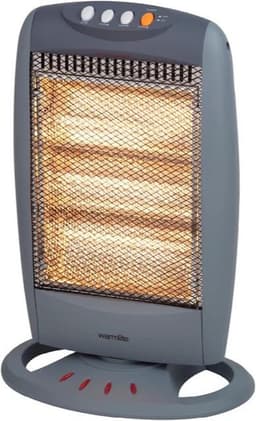
The Warmlite WL42005 is the bright bar: 1.5 kg, £21.45, 4.1 from 2,153 reviews, 400 W, 800 W or 1,200 W, and 120° oscillation. The tip switch may not press in on soft carpet. The WL42013 is the narrower tower: 2.2 kg, £56.46, 4.4 from 1,197 reviews, 500 W or 1,000 W. The base is the weak point, floppy or not standing straight, and a tip-over switch is not stated. The SONBION at £39.95 is 800 W, 4.2 from 511 reviews. The listing says quartz and halogen, so do not treat those words as a third technology.

What an hour costs

Ofgem’s direct-debit average for 1 October to 31 December 2026 is 26.32 pence per kWh in England, Scotland and Wales, with VAT off electricity in that window. None of these three states a thermostat. The tower beats the dish on cost only when you use 500 W instead of 1,200 W. The SONBION cannot go below 800 W. The dish is about £35 cheaper to buy.

What owners say fails

On the halogen dish the recurring fault is the tube, often within days or weeks, and spares are hard to find. On the carbon tower the recurring fault is the base: floppy and top-heavy. One shed reviewer was marked by standing too close. That is a clearance failure, not proof that carbon is gentler. Fabric against the SONBION grille scorches. A guard, a metre of clearance and switching off when you leave still apply. That is the how to use page.

When to choose which

Choose the halogen dish when about £21 is the budget, 400 W is a real setting, and a short burst of glare is acceptable on a hard floor. Choose the carbon tower when 500 W and a narrower cabinet matter more, and you will seat the base. It is the best value because 4.4 from 1,197 reviews at £56.46 is a stronger file than the halogen’s cheaper 4.1, not because carbon is better physics. Who should skip it is on the best freestanding infrared heater page.

Common questions

Is carbon the same kind of heat as halogen?
Yes, in the way that matters at home. Both are directional infrared. They warm you and the surfaces they face, and they do not blow hot air around the room the way a fan heater does. Carbon, halogen and the SONBION’s quartz wording are different elements and different amounts of visible light. They are not different fuels, and they do not change the price of a kilowatt-hour. A 1,000 W hour costs the same whichever word is on the box.
Which is brighter in a dark room?
The three-bar halogen dish. Warmlite WL42005 reviews call it very bright in a dark living room, which is a problem if you are watching television. The carbon tower is a narrower glow. Some SONBION owners bought that 800 W unit because they wanted less glare than a three-bar halogen, and some of them got it. Less glare is not no light. All three glow. If you need the room dim, a thermostatic panel with no exposed bar is a different product.
Which is cheaper to run?
The one on the lower watt setting, for the hours it stays on. At 26.32 pence per kWh, about 11p an hour at 400 W, about 13p at 500 W, about 21p at 800 W, about 26p at 1 kW, and about 32p at 1.2 kW. The halogen dish can be the cheapest hour if you use one bar. The carbon tower can be cheaper if you stay on 500 W instead of 1,200 W. The element name does not change the tariff.
Do carbon tubes last longer?
These listings do not state a life you can compare, so this page does not claim that they do. Halogen reviews often describe a dead tube and no spare. Carbon reviews in this set complain more about a wobbly base than about a published hour count. The SONBION’s up to 7,000 hours line is a seller claim. One owner’s guess of under 100 hours is not a lab result either. Buy on the watts and the glare, and treat a spare tube as unlikely.
Is the SONBION quartz or halogen?
Both words are on the amazon.co.uk listing. Bullets say quartz and also halogen, the model is LSG13, and the included line says halogen heater. Treat it as one 800 W directional tube heater with two settings, not as a third science. It is £39.95, 4.2 from 511 reviews, with tip-over protection stated. It does not oscillate, and it has no thermostat stated. Expect a glow, a hot grille, and the same spare-tube problem as the dish.

Related pages

Sources

Public UK sources for plugs, efficiency rules, running cost and heater safety. Listing prices, stars and review counts are from amazon.co.uk on 19 October 2026.

  1. Electrical Equipment (Safety) Regulations 2016, regulation 35 (retrieved 19 October 2026)
  2. Regulation (EU) 2015/1188 on legislation.gov.uk (retrieved 19 October 2026)
  3. GOV.UK — Placing energy-related products on the UK market (retrieved 19 October 2026)
  4. Ofgem — Energy price cap, 1 October to 31 December 2026 (retrieved 19 October 2026)
  5. Electrical Safety First — Portable heaters (retrieved 19 October 2026)
  6. Electrical Safety First — Patio heaters (retrieved 19 October 2026)
  7. Centre for Sustainable Energy — Room heaters (retrieved 19 October 2026)
  8. Devon and Somerset Fire and Rescue — Heaters (retrieved 19 October 2026)