Independent comparisons. We may earn from shop links. More info

Fan heater vs oil-filled radiator

Updated: October 2026

You are choosing between two portable heaters and trying to spot the efficient one. On a fan heater vs oil-filled radiator decision, the same wattage costs the same. The split is how fast you feel the heat, how loud the hour is, and whether any warmth remains after you switch off. Ceramic, PTC and oil are not three prices of power. Products Compared used the fan heaters in this amazon.co.uk batch and public UK guidance. No oil-filled model was in the batch, so this page names none. The fan side is on the [fan heater comparison](/hub/portable-heaters/fan-heater).

You are choosing between two portable heaters and trying to spot the efficient one. On a fan heater vs oil-filled radiator decision, the same wattage costs the same.

Our top picks

On this page

The cost is the watts

An electric room heater turns the power it draws into heat at the point of use, and the Centre for Sustainable Energy ties the cost to the kilowatts. Ofgem’s Direct Debit average for England, Scotland and Wales, from 1 October to 31 December 2026, is 26.32 pence per kWh. The cap does not set Northern Ireland’s rate. At that rate, a full-power hour is about 39p at 1,500 W and about 53p at 2,000 W. A cheaper oil-filled hour usually means fewer watts, not a cheaper kind of electricity.

Speed and noise

A fan heater pushes hot air, so you feel it quickly and you hear the fan. An oil-filled radiator is slower and usually quieter. Ideal Home puts it that way: quiet and slow against fast and audible. A desk hour favours the fan. In this batch, Dreo Atom reviews often call that ceramic fan acceptable in a bedroom. Wire-element fan heaters here are more often called noisy.
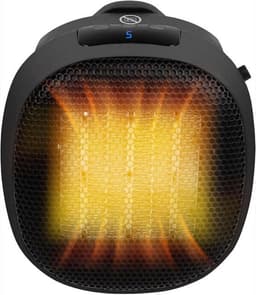
DREO Dreo Atom 316 1500 W white

Testsieger

DREO Dreo Atom 316 1500 W white
8.5/10about £42.49

Heat after you switch off

When a fan heater stops, the blast stops with it. An oil-filled radiator keeps releasing heat after the power is off. In Which? tests of oil-filled radiators as a class, that residual output lasted about half an hour. That is a class finding, not a measurement of a model this page stocks. Hertfordshire’s line is still to switch off when you leave or go to bed, unless the manufacturer designed that heater for overnight use. The steps are on the how to use a fan heater safely page.

When to pick which

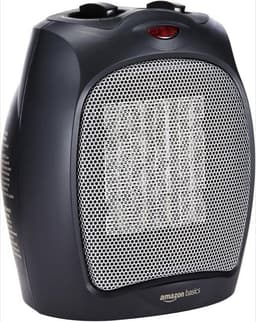
Choose a fan heater for heat in minutes, if you can accept that model’s noise. On this batch, the Dreo Atom at 1,500 W is the fan when you want a stated tip-over switch, a 5–35°C thermostat and a large review count. The Amazon Basics at 1,800 W fits a louder fan with tip-over stated. The best fan heater page says who should skip the £9 Warmlite. Choose an oil-filled radiator when you can wait and you want warmth after switch-off. Neither type replaces central heating.

Common questions

Which is cheaper to run, a fan heater or an oil-filled radiator?
At the same wattage, a full-power hour costs the same. On Ofgem’s 26.32p per kWh for England, Scotland and Wales from 1 October to 31 December 2026, 2,000 W is about 53p an hour and 1,500 W about 39p. A cheaper oil figure usually means fewer watts or fewer minutes on. Northern Ireland is outside that cap. A thermostat shortens the time on high. It does not create an oil rate.
Which heats a room faster?
A fan heater warms the air you feel sooner, because it blows across a hot element. An oil-filled radiator is slower while the oil and the casing warm up. Which? found fan heaters ahead on speed, with oil-filled models still releasing heat after switch-off. A 700 W fan in a large room will not beat a higher-wattage radiator just because it has a fan.
Which is quieter in a bedroom?
The oil-filled radiator is the quieter type, because there is no fan to listen to. Ideal Home describes that as quiet and slow against fast and audible. Some Dreo Atom reviews call that one fan acceptable in a bedroom. Wire-element heaters in this batch are more often called noisy. Switch either heater off at bedtime unless the maker designed it for overnight use.
Does an oil-filled radiator stay warm after I turn it off?
It keeps giving off heat after the power stops. In Which? tests that residual output lasted about half an hour for the class they tested, which is not a promise for a model this page does not stock. A fan heater stops when the fan stops. Use the leftover warmth as a reason to pick oil if you will stay in the room.
Is a ceramic fan heater a third category?
A ceramic or PTC model is still a fan heater. At the same wattage, a full-power hour costs the same as a wire-element fan heater and the same as an oil-filled radiator. In this batch the Atom, Amazon Basics and Pro Breeze are the ceramic or PTC listings, and the Warmlite models use a wire element. Choose ceramic for the controls, not for a lower unit rate.
Can I leave either on overnight?
Only if the manufacturer says that heater is designed for overnight use. Hertfordshire Fire and Rescue states the exception that way. A 12-hour timer is not that approval, and a warm oil-filled casing is not one either. Keep about one metre from combustibles. Whole-home overnight heat belongs with the central heating.
What if I only need heat for an hour at a desk?
Use a fan heater at the lowest wattage that warms your seat, and switch it off when you get up. On the 26.32p rate, 700 W is about 18p an hour at full power, 1,500 W about 39p and 2,000 W about 53p. An oil-filled radiator can still be warming up as the hour ends. Check the tip-over line if a chair can knock the heater.

Related pages

Sources

Public UK sources for the plug, clearance, the seasonal-efficiency rule, and the unit rate. Listing prices, stars, and review counts are the amazon.co.uk figures in this set. Retrieved 16 October 2026.

  1. Electrical Safety First — Portable heaters (retrieved 16 October 2026)
  2. Regulation (EU) 2015/1188 — local space heaters (retrieved 16 October 2026)
  3. GOV.UK — Placing energy-related products on the UK market (retrieved 16 October 2026)
  4. Ofgem — Energy price cap unit rates and standing charges (retrieved 16 October 2026)
  5. London Fire Brigade — Portable heaters, gas fires and open fires (retrieved 16 October 2026)
  6. Centre for Sustainable Energy — Room heaters (retrieved 16 October 2026)
  7. BS EN 60335-2-30:2009+A13:2022 — room heaters (retrieved 16 October 2026)
  8. IET Wiring Matters, September 2025 — 13 A continuous load (retrieved 16 October 2026)
  9. North Yorkshire Fire and Rescue — Heating your home (retrieved 16 October 2026)