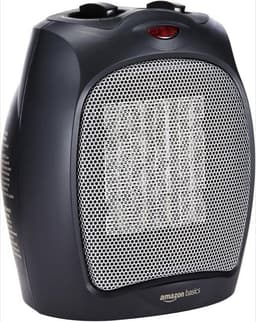
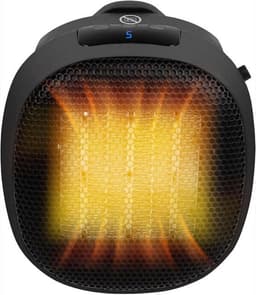
Independent comparisons. We may earn from shop links. More info

How to use a fan heater safely

Updated: October 2026

The heater is in the hall, or it has just come out of the box, and you want the room warm tonight. How to use a fan heater safely is three habits: plug it into the wall, keep about a metre clear, and switch it off when you leave or go to bed. A 12-hour timer on a Dreo, a Pro Breeze or a Russell Hobbs limits a session you are awake for. It is not a line that the heater is designed to run overnight. The [fan heater comparison](/hub/portable-heaters/fan-heater) ranks the 12 listings. This page is what you do with the one you have.

The heater is in the hall, or it has just come out of the box, and you want the room warm tonight.

Our top picks

On this page

Before you switch it on

Stand the heater level and check the cable before the thermostat. You want an intact UK 3-pin plug and a free wall socket. Electrical Safety First says to plug portable heaters straight into the wall. An extension lead or a coiled cable drum stays out. If the socket is behind the sofa, move the sofa. Keep about one metre from curtains, bedding and furniture, and let the heater cool before you move it.

Running it

Point the outlet into the room and leave the vents clear. London Fire Brigade says never to dry clothes on a heater. Set a degree scale and let it cycle, or drop a warm/hot dial and stay long enough to hear whether it clicks off. On a WL44002, a knock does not cut the power if there is no tilt switch. Check for a stated tip-over switch on the fan heater buying guide before you buy the next one.
DREO Dreo Atom 316 1500 W white

Testsieger

DREO Dreo Atom 316 1500 W white
8.5/10about £42.49

Smell, noise and when to stop

A new heater often smells of hot dust the first time the element comes up. Dreo Atom and Warmlite reviews describe that smell fading, so run the first session while you are in the room. Unplug if it thickens, if you see smoke, or if the plug becomes hot. Fan noise is a comfort problem. Smoke and a hot plug are the stop.

Night, children, pets and the bathroom

Switch the heater off when you leave or go to bed, unless the instructions say that model is designed for overnight use. A 12-hour timer is not that exception. Keep it where a child or a pet cannot push it into a curtain. North Yorkshire Fire and Rescue says a standard portable heater does not belong in a bathroom. The gold Dreo listing names a bathroom and states no IP rating, so follow the fire service. A box room belongs on the small-room fan heater page.

Common questions

Where should a fan heater sit?
Put it on a stable surface, about one metre from curtains, bedding and furniture, with the plug in a wall socket. Electrical Safety First and London Fire Brigade both use that clearance. Let it cool before you move it. If the only convenient socket is too low, too close to a worktop, or behind soft furnishings, that socket is the wrong place. An extension lead does not repair the layout.
Can I leave it on overnight if it has a timer?
Leave it on overnight only when the manufacturer says that heater is designed for overnight use. Hertfordshire Fire and Rescue says to turn it off when you leave or go to bed, with that exception. A 12-hour timer on an Atom, a tower, a Pro Breeze or a Russell Hobbs limits a session while you are there. It does not add an overnight approval. Switch the heater off at bedtime.
Why does it smell of hot plastic the first time?
A new element often smells while dust and factory residues heat up. Dreo and Warmlite reviews in this batch describe that on first use, and some say it passed. Run the first session while you are there, with the vents clear. If the smell fades across a short run, that matches the ordinary notes. If it builds, or you see smoke, unplug it. That is a different event from a fading first-run smell.
When is a smell a reason to unplug it?
Unplug when the smell is of burning at the plug or cable, when you see smoke, or when a heat setting is on and the fan is not turning. Those appear as separate UK reviews here: a hot plug on a DREO tower, smoke on a CUQOO account, smoke on a Status unit, and a burning lead on a 2,800 W DAHTEC. Pull the plug at the wall, leave the case shut, and ask an electrician about a hot or discoloured socket.
Can I use an extension lead if the socket is in the wrong place?
Use the wall socket, or move the heater to a socket that gives you a metre of clearance. Electrical Safety First says not to run a portable heater from an extension lead, and Hertfordshire includes cable drums. A lead adds a connector that can heat up, which is already the failure described at plugs in these reviews. One campervan reviewer used a lead with a plug-in heater. That is an example to avoid. If no socket is safe, the room needs a different plan.
What if it trips the electrics?
Unplug the heater and leave it unplugged. One trip can be the circuit doing its job on a shared 2 kW load. If it trips the house more than once, ask an electrician to check the socket. A CUQOO review that describes smoke and a trip is a stop. Leave the case closed.
Is a fan heater safe in a bedroom with a child or a pet?
Use it while you are awake in the room, a metre clear of bedding, where a child or pet cannot push it into a curtain. Prefer a stated tip-over switch. Reviewers say the WL44002 has none, so a knock does not cut the power. Switch it off at bedtime unless the maker says that model is for overnight use. No fuel flame means no carbon monoxide, and a covered heater can still start a fire.

Related pages

Sources

Public UK sources for the plug, clearance, the seasonal-efficiency rule, and the unit rate. Listing prices, stars, and review counts are the amazon.co.uk figures in this set. Retrieved 16 October 2026.

  1. Electrical Safety First — Portable heaters (retrieved 16 October 2026)
  2. Regulation (EU) 2015/1188 — local space heaters (retrieved 16 October 2026)
  3. GOV.UK — Placing energy-related products on the UK market (retrieved 16 October 2026)
  4. Ofgem — Energy price cap unit rates and standing charges (retrieved 16 October 2026)
  5. London Fire Brigade — Portable heaters, gas fires and open fires (retrieved 16 October 2026)
  6. Centre for Sustainable Energy — Room heaters (retrieved 16 October 2026)
  7. BS EN 60335-2-30:2009+A13:2022 — room heaters (retrieved 16 October 2026)
  8. IET Wiring Matters, September 2025 — 13 A continuous load (retrieved 16 October 2026)
  9. North Yorkshire Fire and Rescue — Heating your home (retrieved 16 October 2026)