Independent comparisons. We may earn from shop links. More info

Revolving punch vs drive punch

Updated: 21 October 2026

You need a hole in leather, and the two tools in the results do not work the same way. A revolving punch vs drive punch choice is about where the hole sits, how thick the leather is, and whether the hole is a small circle. The revolving punch is a plier with a wheel of tubes and one pad. The drive punch is one tube you strike with a mallet. This page is that split. It does not rank the ten pliers. Those rows are on the [revolving punch pliers comparison](/hub/pliers/revolving-punch-pliers). Listings were read on 19 October 2026. We did not strike either tool in a lab. A qualifying purchase can earn a commission at no extra cost to you.

You need a hole in leather, and the two tools in the results do not work the same way.

Our top picks

On this page

What each tool is

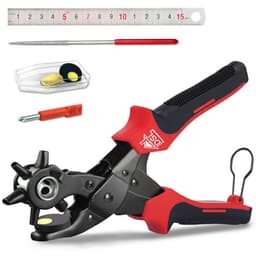
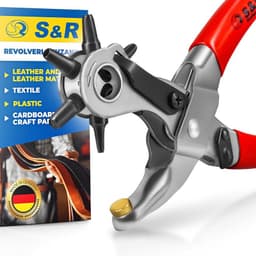
A revolving punch carries several hollow tubes on a rotating head. You click one over a small anvil and squeeze. Most kept kits list 2 mm to 4.5 mm. Knipex 90 70 220 and S&R 274.100.240 list 2 mm to 5 mm. DSL adds flats and an oval and drops the 2 mm tube. You change size with your fingers. A drive punch is one tube. You stand it on the leather and hit it with a mallet, on a board or a thick mat. Le Prevo lists drive punches from 5 mm upward, including oblongs. One punch makes one size. British Leather Supplies uses the same split: a rotary punch for straps, a drive punch for larger holes and thick leather. An eyelet plier sets a grommet. Those kits sit with punch pliers.

Reach and hole size

The tube only reaches leather that fits between the head and the pad. A belt edge fits. The middle of a bag panel usually does not. Klum House says a rotary punch cannot reach the centre of a panel and a drive punch can. Their inch sizes are a US kit. Use the picture, not the inches. These amazon.co.uk bullets do not print a jaw depth. Maun’s 35 mm belongs to its 2230, which is not in this set. A US craft site’s rule of thumb is about 2 mm of thickness. That is not a measurement of the blue Diyife or the BGS 75835. Knipex and S&R stop at 5 mm. An 8 mm hole, a 10 mm hole or a clean oblong is past every wheel here. Overlapping a 4 mm tube tears the strap. Spacing sits on the belt holes page.

When to pick which

Use a revolving punch when the hole is small, round and near an edge, and the leather yields on one squeeze. Use a drive punch when the hole is far from an edge, larger than your biggest tube, oblong, or the first squeeze only scars the surface. The condition is the hole, not the brand. A £17.52 Knipex does not reach the centre of a hide. A steel hammer can mushroom the struck end of a drive punch. Use a mallet, and keep your other hand off the tube. The plier’s matching mistake is a harder squeeze when the hole will not appear. A German-language note on the BGS listing describes a bent frame. That is not UK opinion. Stop, and change tool. The click and the card are on the how to use revolving punch pliers page. Diameters are in the buying guide.

Tools that are not either of these

An eyelet plier sets a metal ring. The hole exists to hold the fitting. A grommet in a tarp needs its own die. A cobbler is the person to call when the leather is costly, the hole is a slot, or the belt must be shortened. Shortening is cutting and stitching, which neither punch does. If you only buy one tool, buy the revolving punch for small round holes near an edge, and add a drive punch on the day you need the middle of a panel or a size above 5 mm.

Common questions

Can a revolving punch reach the middle of a bag panel?
Not if the panel is wider than the jaw. The tube has to sit over the pad, so the leather has to fit inside the throat. Belt edges do. The centre of a bag side usually does not. Maun’s 35 mm depth belongs to the 2230, which is not in this set, and it would still not cross a wide panel. A drive punch reaches that centre because you place the tube anywhere.
Do I need a mallet as well?
You need a mallet for a drive punch, plus a board or mat. You do not need one for a revolving punch. Craft guides say a steel hammer can mushroom the end you strike. The revolving punch’s matching mistake is a harder squeeze when the hole is not appearing. That bends the frame. It does not turn the plier into a mallet tool.
Which tool makes a hole bigger than 5 mm?
A drive punch. In this revolving set the ceiling is 5 mm on Knipex and S&R, and 4.5 mm on the other round heads. Le Prevo lists drive punches from 5 mm upward. DSL’s oval is 7×4 mm, which is a shape, not an 8 mm circle. A 10 mm hole is outside every wheel here.
Which tool makes the buckle slot?
A drive punch in an oblong size, or a repairer. Overlapping circles tear the edge. DSL lists flat and oval heads, and a reviewer found those heads can foul a wide belt. A slot is a different cutter from a 4 mm round hole. The belt page puts that limit next to spacing.
Is an eyelet plier the same thing?
No. An eyelet plier or a press-stud tool sets a metal fitting. A revolving punch only cuts a hole. A drive punch only cuts a hole. The eyelet kits that appeared beside these ASINs were removed. A grommet needs the die that matches it, not a 3 mm leather tube.
Why do cheap revolving punches bend?
They are asked to punch leather that will not yield, or the head is not clicked home and someone squeezes harder. A non-UK review on the BGS listing described a bend after a few belt holes. That is not a British rate, and it matches forcing any of these pliers. Stop at a scar. Change to a drive punch or a shop. Do not straighten the frame and continue.

Related pages

Sources

Public UK sources from the research digest, last checked on 19 October 2026. Shelf prices and star lines are the amazon.co.uk figures in the display file.

  1. Knipex: revolving punch pliers 90 70 220 (retrieved 19 October 2026)
  2. BGS: revolving punch pliers 2–4.5 mm (retrieved 19 October 2026)
  3. Maun: revolving leather hole punch plier 2230 (retrieved 19 October 2026)
  4. Le Prevo: hole punches (retrieved 19 October 2026)
  5. HSE: PUWER overview (retrieved 19 October 2026)
  6. legislation.gov.uk: Consumer Rights Act 2015, satisfactory quality (retrieved 19 October 2026)
  7. S&R: English manual for 274.100.240 (retrieved 19 October 2026)
  8. British Leather Supplies: a beginner’s guide to punching holes in leather (retrieved 19 October 2026)