Independent comparisons. We may earn from shop links. More info

How to use revolving punch pliers

Updated: 21 October 2026

The plier is in your hand, the belt is on the table, and the wheel of tubes looks as if any of them will do. How to use revolving punch pliers comes down to five moves: click the size home, put something under the leather, squeeze once, clear the plug, and shut the tool. This page is that sequence. It does not rank the listings, and it does not set belt spacing. The rows are on the [revolving punch pliers comparison](/hub/pliers/revolving-punch-pliers). We did not run a lab punch. A qualifying purchase can earn a commission at no extra cost to you.

The plier is in your hand, the belt is on the table, and the wheel of tubes looks as if any of them will do.

Our top picks

On this page

Set the head before you squeeze

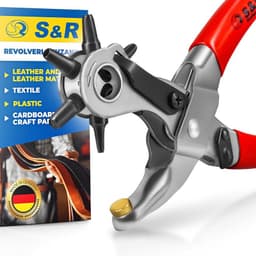
Turn the wheel until the tube sits over the pad and the head clicks. A tube that is only halfway there cuts a crescent, and a second squeeze usually makes the tear worse. Look from the side. The cutting edge should meet the anvil in a full circle. Most kits here are 2 mm to 4.5 mm. Knipex 90 70 220 and S&R 274.100.240 replace 4.5 mm with 5 mm. Match the hole you are copying. The blue Diyife, the orange Diyife and the DSL include a ruler. Knipex, S&R, BGS and Baysihin do not. If the head will not turn, stop. Do not grip the tube with another pair of pliers. That is how a hollow punch bends.

Back the material and squeeze once

Put carton or a leather offcut under the strap. A Diyife line says carton paper. A DSL review said that punching with nothing underneath marked the far side. The pad meets the tube. It does not save the table, or the facing of the belt. Keep the plier level and close it once. British Leather Supplies says not to twist, because twisting ovals the hole. A Knipex-focused note suggests rotating while you press. Use the UK supplier’s line: do not rock the tool in the cut. If the hole is incomplete, check the detent and try one square squeeze on a scrap. If the leather has only a scar, stop. Maun’s 1.5 mm note belongs to its own 2230 family, not these ASINs. Forcing is how a light frame bends.

Clear the tube and lock the pliers

The disc has to leave the tube. If it stays inside, the next hole is a bruise. Push it out with a blunt pin from the back, away from your fingers. A grinding rod dresses an edge. It is a poor pick for digging at a sharp rim, and a file does not fix a bent tube. Knipex, S&R, XOOL, the orange Diyife and Baysihin state a lock or a buckle. Use it. The blue Diyife, Gunpla, DSL and BGS do not, so do not invent a click. One XOOL reviewer could not close the hook again. BGS asks for gloves and goggles. The S&R manual asks for safety glasses and no children at the bench. That sheet is one maker’s instruction, not a UK statute.

When the hole will not appear

A crescent means the head was between clicks, or the tube is no longer square to the pad. A faint ring means the leather is too thick, or the edge is blunt. Card will not fix a bent tube. Spare plates replace it only on the kits that include them. On Knipex they are a separate purchase. On Baysihin the included-components field says NO. Stop if the frame flexes. Do not straighten a bent punch and carry on. A hole far from an edge, larger than 5 mm, or a buckle slot needs a drive punch and a mallet. That split is on the revolving punch versus drive punch page. Placement is on the belt holes page. The wrong size set is the buying guide.

Common questions

How do I know the size has locked in?
The wheel should click and then sit still, with the tube square on the pad. If you can still rock the head with a fingertip, it is between detents and it will cut a crescent. Turn to the next click and look again before you squeeze the belt. Do not use another tool as a lever on the tube if the wheel is stiff.
Why is the hole a crescent?
The cutting edge only met the pad on part of the circle. The usual cause is a head that did not click home. A mushroomed tube, or one that a non-UK orange-Diyife review said missed the base plate, does the same thing. Check the detent first. If the tube is bent or short of the pad, fit a spare where the box has one, or stop.
What do I put under the belt?
Carton or scrap leather, under the strap. The Diyife guidance says carton paper. A DSL review marked the far side when that layer was missing. The worktop is not the anvil. The scrap also shows you whether this tube cuts a full circle before you commit to the strap you wear.
How do I get the leather plug out?
Push the disc out of the hollow tube with a blunt pin, working so the sharp rim points away from your hand. If the plug stays in, the next squeeze bruises the leather. A grinding rod dresses an edge. It is a poor tool for fishing a plug out with your fingers on the rim.
Should I twist the pliers?
No, not as the default. British Leather Supplies says twisting ovals the hole. A separate Knipex-focused note suggests rotating while you press. Those guides disagree. Keep the tool level and close it once. If the cut is incomplete, reset the detent and try a scrap, rather than sawing the strap.
What if I cannot close the squeeze?
Stop. The material is too thick, the tube is blunt, or the head is not seated. A harder squeeze is how a light frame bends. The BGS file has a non-UK report of that bend. It is not a British failure rate, and it is still the wrong direction. Use a drive punch and a mallet, or a repair shop, when a scar is all you can make.
How do I store it so the points are covered?
Close the handles and use the lock if the listing states one. Knipex, S&R, XOOL, the orange Diyife and Baysihin do. The other kept listings do not, so a band or a pouch is the cover. Keep it in a drawer, away from children. The S&R manual and the BGS page both want glasses and gloves while you work, and the points are still sharp afterwards.

Related pages

Sources

Public UK sources from the research digest, last checked on 19 October 2026. Shelf prices and star lines are the amazon.co.uk figures in the display file.

  1. Knipex: revolving punch pliers 90 70 220 (retrieved 19 October 2026)
  2. BGS: revolving punch pliers 2–4.5 mm (retrieved 19 October 2026)
  3. Maun: revolving leather hole punch plier 2230 (retrieved 19 October 2026)
  4. Le Prevo: hole punches (retrieved 19 October 2026)
  5. HSE: PUWER overview (retrieved 19 October 2026)
  6. legislation.gov.uk: Consumer Rights Act 2015, satisfactory quality (retrieved 19 October 2026)
  7. S&R: English manual for 274.100.240 (retrieved 19 October 2026)
  8. British Leather Supplies: a beginner’s guide to punching holes in leather (retrieved 19 October 2026)