Independent comparisons. We may earn from shop links. More info

Punch holes in a leather belt

Updated: 21 October 2026

The belt fits everywhere except the hole you need, and the tongue is sitting on leather. Punch holes in a leather belt only after you have copied the holes that are already there: the distance between them, the diameter, and the shape. A hole in the wrong place, or a round hole where the old one is a slot, shows every time you dress. This page is that geometry. The ten pliers are on the [revolving punch pliers comparison](/hub/pliers/revolving-punch-pliers). Listings were read on amazon.co.uk on 19 October 2026. Products Compared did not punch a belt in a lab. A qualifying purchase can earn a commission at no extra cost to you.

The belt fits everywhere except the hole you need, and the tongue is sitting on leather.

Our top picks

On this page

Match the hole you already have

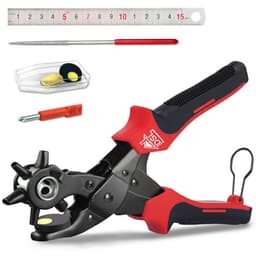
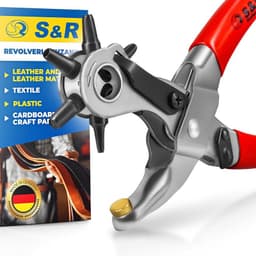
Measure from the centre of the last hole the tongue uses to the centre of the one before it. Copy that distance on the midline. British Leather Supplies says belt holes are often about 25 mm apart and often 4–5 mm across. That is supplier guidance, not a British Standard. Your ruler beats the average. Mark the new centre with a pencil. A hole that drifts makes the buckle sit crooked. The blue Diyife, the orange Diyife and the DSL list a ruler. Knipex and S&R do not. Fit the tongue into an old hole for the diameter. Diyife, Gunpla, XOOL and BGS stop at 4.5 mm. Knipex and S&R state 5 mm. The size list without a winner is the buying guide.

Round holes and shaped holes

A round tube copies a round hole. It does not copy a slot. Overlapping circles chew the edge. Le Prevo sells oblong drive punches from 5 mm upward. In this set, the DSL is the only mixed-shape plier: round holes at 3, 3.5 and 4 mm, flats at 6×4 mm and 7×3 mm, and an oval at 7×4 mm. It does not list 2 mm or 5 mm. A reviewer said the slotted heads sit along the belt and catch the strap. Try the shape on a scrap first. Every other kept plier is a round head. If the buckle needs a slot, use an oblong drive punch or a repair shop. That split is on the revolving punch versus drive punch page. Shortening the strap needs a cut, a skive and a stitch or a rivet. A row of holes is not a shortened belt.

Belts that should not meet a new plier

Suede and a costly fashion belt are the first stop. A UK reviewer on the XOOL notes marked expensive suede. The nap shows every miss. Smooth leather forgives a slightly off centre more than suede does. Neither forgives a hole in the wrong place. If the first squeeze only scars the surface, stop. One UK S&R note of leather called 4 mm is that strap, not a rating. Maun’s 1.5 mm note and a craft guide’s rough 2 mm ceiling are other tools’ rules of thumb. Your test is the scar. Forcing a light plier is how a frame bends.

Cobbler, nail, or the plier you already have

UK forum threads, including an AskUK question about a belt hole, send people to a cobbler or a counter such as Timpson. Some replies mention no charge. That is anecdote, not a tariff. Do not heat a nail. The edge chars and the hole is the wrong size. A drill walks and leaves a fuzzy bore. If you continue at home, use the sequence on the how to use revolving punch pliers page: detent, card, one squeeze, clear the plug, and lock the tool if it has a lock. One extra hole, in line and the same shape, is the whole job.

Common questions

How far from the last hole should the new one sit?
Use the centre-to-centre distance of the holes already in that belt, on the midline. About 25 mm is a common spacing in the British Leather Supplies note, not a rule for yours. If your holes are 20 mm apart, a new hole at 25 mm sits in the wrong place for the buckle. Measure the strap, then mark, then punch.
What diameter fits a buckle tongue?
The diameter of the hole the tongue already uses. Measure it, then pick the listed tube, in millimetres. Supplier guidance often mentions 4–5 mm. In this set, 4.5 mm is the top of the Diyife, Gunpla, XOOL and BGS heads. 5 mm is stated on Knipex and S&R. A slightly tight clean hole is a better result than a scar from a blunt undersized tube.
Can I copy a slotted hole with a round punch?
No. Overlapping circles tear the edge and do not leave a clean slot. DSL lists flat and oval punches, and those can still foul a wide belt. A buckle slot is a drive-punch shape or a job for a repairer. Do not nibble it with the 4 mm round tube because that tube feels sharp.
Will this mark a suede belt?
It can. A UK XOOL reviewer marked expensive suede and was disappointed. Card underneath stops the pad side marking, which a DSL review also ran into, and it does not restore a crushed nap. For a costly or suede belt, a shoe-repair counter is the calmer option. If you punch at home, use a scrap of the same material first.
Should I go to a shoe-repair shop instead?
Yes, when the belt is costly, suede, too thick to squeeze, or the hole is a slot. Forum replies point at cobblers and at counters such as Timpson, sometimes mentioning no fee. Treat that as anecdote, not a price list. The shop can also say when the strap should be shortened instead. That alteration is outside a revolving punch.
Can the same plier shorten the belt and move the buckle?
No. Shortening means cutting the strap, thinning the end and fixing the buckle with stitching or a rivet. A revolving punch only makes a hole. Adding holes until the tail looks shorter leaves a row of unused holes. Take a shorten-and-restitch job to someone who repairs leather.
What if the belt is too thick to squeeze?
Stop at the first scar. A UK S&R reviewer punched leather they called 4 mm, which shows some thick belts yield, and it does not rate your belt. If the tube will not go through, use a drive punch and a mallet on a board, or a repair shop. Straightening a bent plier and trying again is how the frame fails twice.

Related pages

Sources

Public UK sources from the research digest, last checked on 19 October 2026. Shelf prices and star lines are the amazon.co.uk figures in the display file.

  1. Knipex: revolving punch pliers 90 70 220 (retrieved 19 October 2026)
  2. BGS: revolving punch pliers 2–4.5 mm (retrieved 19 October 2026)
  3. Maun: revolving leather hole punch plier 2230 (retrieved 19 October 2026)
  4. Le Prevo: hole punches (retrieved 19 October 2026)
  5. HSE: PUWER overview (retrieved 19 October 2026)
  6. legislation.gov.uk: Consumer Rights Act 2015, satisfactory quality (retrieved 19 October 2026)
  7. S&R: English manual for 274.100.240 (retrieved 19 October 2026)
  8. British Leather Supplies: a beginner’s guide to punching holes in leather (retrieved 19 October 2026)