USB grow light UK plug: check power before buying

Learn how to match a USB grow light to a safe UK plug, check 5 V wattage claims, estimate running costs and decide whether a power bank will work.
On this page
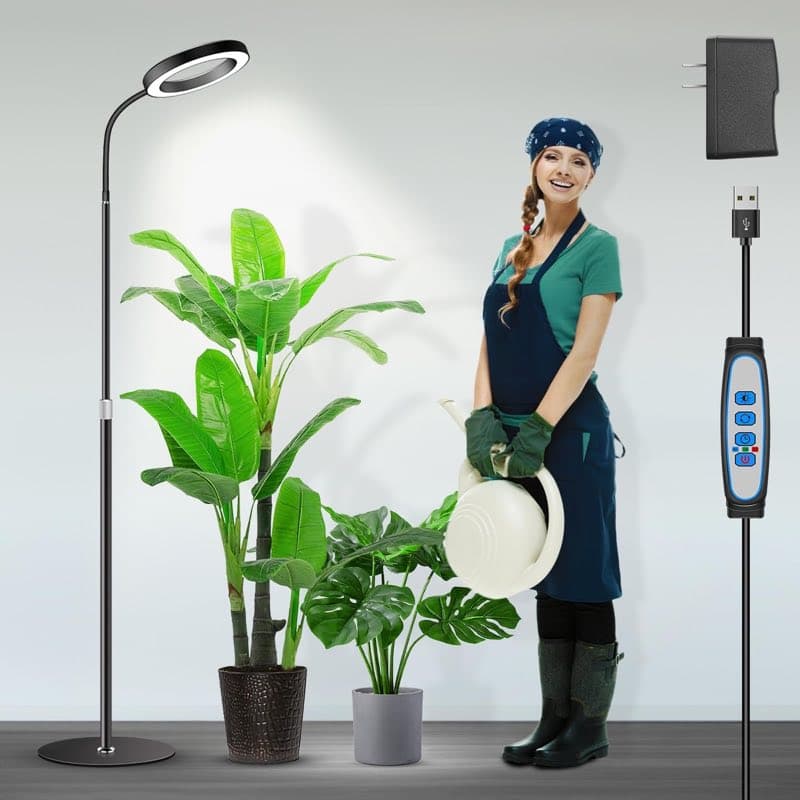
A USB grow light UK plug setup can look straightforward until the parcel contains only a USB lead, the listing claims an implausible wattage, or the timer turns out to offer the wrong cycle. The lamp may run at just 5 V, but the adaptor feeding it still connects to 230 V UK mains. Checking the output label and doing one simple calculation can prevent a weak lamp, an overloaded power supply or an inconvenient return.
In short
A USB plant lamp needs a suitable UK mains adaptor unless you intend to use a computer port or power bank. Match the stated voltage, make sure the supply can provide enough current, and use watts equals volts multiplied by amps to challenge contradictory claims. Treat the plug, timer and lamp as one system rather than buying on a headline wattage alone.
USB is not the wall socket
The rectangular USB connector on a grow light is a low-voltage power connection, not a substitute for a UK mains plug. If the box contains only a cable, you need another source of 5 V power. That might be a USB mains adaptor, a power bank or, for a very modest lamp, a suitable USB port on another device. The practical choice for daily plant lighting is usually a dedicated adaptor because a grow light may run for 8 to 16 hours at a time.
For a UK wall socket, look for an adaptor with a proper three-pin BS 1363 plug and a clearly marked USB output. The output must match the lamp's required voltage; most products in this class state 5 V, but you should check rather than assume. Its available current must equal or exceed the lamp's requirement. A lamp marked 5 V and 2 A can use a 5 V, 2 A or higher-current USB supply, because the lamp draws what it needs; it should not be connected to a supply with the wrong output voltage.
A product described as “USB powered” may or may not include the wall adaptor. One UK clip-light listing, for example, specifies a 5 V lamp and includes a wall-socket adaptor, while other listings show a plug in staged photographs but supply only the lead. Read the “what is in the box” section and inspect the specification, not just the lead image. If a seller ships a two-pin continental plug, a travel adaptor is not a good permanent answer for a lamp that will operate unattended for long periods. Ask for the correct UK version or choose another product.
Check 5 V grow light wattage
Online descriptions sometimes combine a large wattage with a USB input that cannot deliver it. You can test the figures with one equation: watts = volts × amps. A lamp claiming 5 V at 2 A has a maximum stated electrical input of 10 W. At 5 V and 3 A, the corresponding figure is 15 W. If the same listing calls either product a 24 W lamp without explaining a different measurement, its specifications disagree.
That discrepancy does not prove that the lamp is dangerous, and it does not reveal its actual light output. The larger number could be a mistake, the sum of nominal LED chip ratings, or a marketing figure that is not wall power. What it cannot be is the electrical input from one 5 V, 2 A connection at the same moment. Treat it as a reason to ask the seller for the measured input power and required supply, not as evidence that you have found a brighter bargain.
This matters when choosing an adaptor. Suppose a four-head lamp says “27 W maximum” but also specifies 5 V and 2 A. The USB figures describe 10 W, so you cannot sensibly select a power supply using the 27 W headline. Nor should you assume that any old 1 A phone charger is adequate: at 5 V it can nominally provide only 5 W. An under-specified supply may fail to start the lamp, dim at the highest setting or become warmer than expected.
Timers and power banks
Built-in timers are convenient only if their cycles fit your routine. USB plant lamps commonly offer a small set of repeating periods, such as 3, 9 and 12 hours. Check whether “12 hours” means 12 hours on followed by 12 hours off, whether the cycle repeats automatically, and whether settings survive a power cut. A controller that forgets its state whenever a switched socket turns off defeats much of the point.
A power bank is attractive when the shelf has no nearby socket, but runtime claims need another calculation. Energy capacity is best compared in watt-hours, not by looking only at milliamp-hours. A 10 W lamp used for 12 hours requires about 120 Wh at the lamp before allowing for conversion losses. Many everyday power banks store much less usable energy than that, so a full “day” can empty even a fairly large unit.
For a rough mains-cost example, a 10 W light used 12 hours a day consumes 0.12 kWh daily, or 3.6 kWh over 30 days. At an illustrative unit rate of £0.25 per kWh, that would cost £0.90 per month. This is the assumption used in one seller's example, not a universal UK tariff. Substitute your actual unit rate, and remember that the adaptor adds a small conversion loss, so a wall meter may show slightly more than the lamp-side estimate.
Mains grow lights are different
A bulb that screws directly into a lampholder is not interchangeable with a 5 V USB lamp. UK homes commonly have B22 bayonet fittings, and E27 Edison screw fittings are also sold, but the physical base is only one check. You must confirm the rated voltage, the fitting, the fixture's maximum load and whether the shade or enclosure is suitable for the bulb. An E26 product intended for another market is not automatically suitable because it appears to screw into an E27 holder.
Confusion grows when sellers use familiar bulb terms for low-voltage kits. A 5 V USB-C E27 kit, for example, can use an Edison-screw-shaped connection while relying on a dedicated 5 V bulb and cable. That does not turn it into a normal 230 V E27 lamp. Mixing the special low-voltage bulb with a mains holder, or using a mains bulb with its USB kit, could damage equipment and create a serious hazard. Keep every component within the named system.
Moisture claims deserve particular caution. Do not interpret “USB” as permission to use a lamp beside a bath, over a sink or where mist reaches the connector. Unless the listing gives a specific ingress-protection rating for the relevant parts and the installation follows the maker's limits, keep the lamp, inline controller and adaptor dry. Even where a lamp head has some protection, its USB joint and mains supply may not share it. A broad “waterproof” line without a rating is not enough evidence.
What to check before you pay
Start with the product's input line and work out what it commits the seller to. You want a stated voltage and current, such as 5 V 2 A, plus a clear answer about whether the UK adaptor is included. Multiply the two figures and compare the result with the claimed input wattage. If they do not agree, ask for clarification in writing or choose a listing with coherent specifications.
Use this short pre-purchase sequence:
- Confirm the contents. Establish whether you receive the lamp, USB cable, controller and a UK mains adaptor.
- Match the supply. Use the specified output voltage and at least the required current; do not guess from the connector shape.
- Check the arithmetic. Multiply volts by amps and query any incompatible wattage headline.
- Plan the schedule. Make sure the timer repeats as needed and retains settings after an interruption.
- Measure the position. Check cable reach, clip opening, head clearance and distance to the leaves.
- Keep it dry. Do not rely on a general waterproof claim or place the mains adaptor near watering.
That process will not tell you whether a particular spectrum or beam is best for your plant, but it removes several avoidable buying mistakes. Once the electrical details are credible, compare coverage, adjustability and intended plant area in the plant lamps comparison.
Common questions
Can I plug a USB grow light into a UK socket?
Why does a grow light say 24 W and 5 V 2 A?
Is a USB grow light safe in a bathroom?
Will a power bank run a grow light overnight?
Is E26 the same as a UK bulb fitting?
Does a 12-hour timer cover a long seedling day?
How do I estimate the monthly running cost?
Does a USB grow light need an earth?

Products Compared publishes British-English buying guides based on amazon.co.uk listings and public UK sources. We do not run a lab and we do not invent test scores.
Related articles

Seedling heat mat UK: start tomatoes before the last frost
Use a seedling heat mat safely on a British windowsill, choose the right compost temperature, avoid overheating and know when tomatoes can go outside.

ZZ plant low light care: keep it healthy in a dim room
Learn how to keep a ZZ plant healthy in a dim British room, including sensible watering, winter temperatures, lamp use and signs of excess water.

Tomatoes in pots UK: better patio growing
Choose the right tomato pot size, watering routine and cold-night cover for healthier patio plants in changeable UK summer weather.