Independent comparisons. We may earn from shop links. More info

Spider repellent vs spider killer spray

Updated: 23 October 2026

A house spider on the plaster, or uPVC frames wiped in September, and spider spray on amazon.co.uk still hides two products. Spider repellent vs spider killer spray is whether you want to deter spiders at entry points or knock down a spider you can see now. Choose a peppermint barrier if you will mist thresholds every two to three weeks and you do not want dead spiders on the carpet. Choose a contact aerosol only when a glass and card will not reach. Our [spider spray comparison](/hub/pest-control/spider-spray) sets out the five UK listings. A purchase through a link can earn a commission at no extra cost to you.

A house spider on the plaster, or uPVC frames wiped in September, and spider spray on amazon.co.uk still hides two products.

Our top picks

On this page

Two jobs: deter at the frame, or kill on contact

A spider repellent is a scent barrier on frames and skirting before spiders enter. A spider killer is a knockdown aimed at the arachnid in front of you. Neither does the other job well, even when the marketplace groups them under one heading. If you only want one visible spider off a living-room wall, without residue or a body to sweep up, the British Pest Control Association still starts with a tumbler and a piece of stiff card. Buyers get stuck when they expect both effects from one bottle. A pump of peppermint at a running house spider leaves a damp mint patch while the spider goes under the wardrobe. A 200 ml contact aerosol across a conservatory sill on Sunday will not stop a fresh spider on Tuesday. Once you follow a routine for frames and vents in how to use spider spray, the split is easier to see.

What mint repellents do

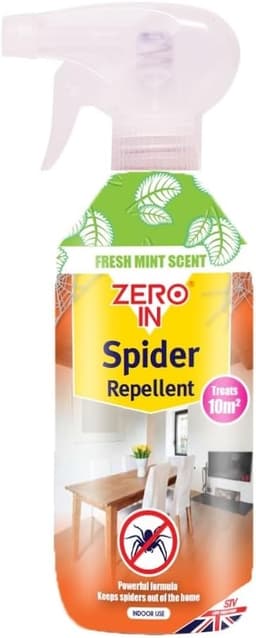
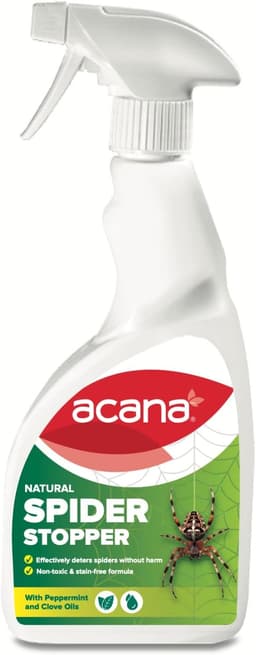
Mint and plant-oil sprays lay a film along window edges, thresholds and air bricks that spiders prefer not to cross. They leave no dead spiders on the sills. Four of the five listings follow that pattern. Acana (B0DFMLDNPT, about £7.99) names peppermint and clove. Zero In STV981 (B0DBZYCM31, about £17.25) names a mint oil extract. The twin title (B074PN6H85, about £12.90) is the same humane mint idea. WildGuard (B0HLGBR2VS, about £12.95) names peppermint, lavender and eucalyptus with castile soap. The STV981 safety data sheet lists peppermint oil under 1% and an EUH208 line: it may produce an allergic reaction. Acana's title says up to 12 weeks. WildGuard states no week count. Directions and reviews point to every two to three weeks indoors, and sooner after rain. Bottle sizes are on best spider spray.

What contact killers do

A contact killer is a pressurised aerosol built to immobilise a visible spider within minutes of a direct hit. It is removal, not a perimeter shield. In this set the contact killer is Pestshield (B01CR88VCG), six 200 ml cans at about £12.10, 4.4 from 122 amazon.co.uk reviews. It sprays as an unscented mist, with no lingering menthol, and it depends on hitting the spider. Reviews say small spiders stop within minutes. Large autumn house spiders sometimes walk away after a brief burst, and holding the nozzle down can empty a 200 ml tin in about 20 seconds. Spiders walk on the tips of their legs rather than dragging their bodies across skirting, so a dried contact film rarely stops the next spider tomorrow.

Product types 18 and 19, and conflicted listings

Under the GB Biocidal Products Regulation, killers and deterrents are separate. Product Type 18 covers control of arthropods, including arachnids, by means other than repulsion. Product Type 19 covers repellents and attractants. Northern Ireland follows EU BPR. Adverts must say: use biocides safely, and always read the label and product information before use. They must not say non-toxic, natural or animal friendly. None of the five pages prints an HSE number. The Zero In twin (B074PN6H85) shows a humane mint title, yet the bullets describe a KARRMA spray that kills within minutes. Pestshield (B01CR88VCG) is titled an insect killer, yet one bullet prints insect repellent. Choose Acana or the Zero In triple for a mint barrier. Choose Pestshield only for an unscented direct hit. Mismatched bullets are covered in the spider spray buying guide.

Common questions

What is the difference between a spider repellent and a spider killer spray?
A spider repellent uses oils such as peppermint, clove or eucalyptus to lay a scent barrier along window frames, doors and skirting so spiders take another route. A spider killer spray is a pressurised aerosol meant to knock down and kill a visible spider on direct contact. It offers little protection against new spiders later.
Does peppermint spider spray harm or kill spiders?
Peppermint sprays in this set, including Acana Natural Spider Stopper at about £7.99 and Zero In STV981 at about £17.25 for three bottles, are sold as deterrents that do not harm spiders. They are a sensory film at thresholds. Peppermint oil still carries an EUH208 skin-sensitiser warning, so keep the spray off skin and follow the bottle around pets.
Does a contact spider killer keep new spiders out of the room?
Pestshield (about £12.10 for 6 × 200 ml) is built to kill a spider you spray directly, not to seal a room over time. Spiders walk on the tips of their legs rather than grooming a dried film, so new spiders can cross treated skirting days later. A high star line does not add a barrier.
Why does the Zero In twin say humane in the title and kills within minutes in the bullets?
On amazon.co.uk the Zero In twin (B074PN6H85, about £12.90) has a catalogue mismatch. The title and the bottle are Zero In's mint-oil repellent. The bullets print copy for a KARRMA insect killer. Rely on the physical bottle, or pick the Zero In triple (B0DBZYCM31), where the page text matches the mint barrier.
Why is a cheaper per-litre killer not a substitute for a barrier spray?
Six 200 ml cans of Pestshield are about £10.08 a litre (about £12.10 for 1.2 litres), against about £15.98 a litre for Acana at about £7.99. The aerosol can empty in around 20 seconds of continuous spraying and it has no lasting scent barrier. Spraying it along window frames wastes propellant and does not deter the next spider.

Related pages

Sources

Public UK sources used for this comparison. Shelf prices, stars and review counts are the amazon.co.uk figures captured for these five listings. Last checked 22 October 2026.

  1. HSE biocidal product types (retrieved 22 October 2026)
  2. HSE biocidal advertising (retrieved 22 October 2026)
  3. Acana Spider Stopper directions (retrieved 22 October 2026)
  4. HSE packaging and labelling (retrieved 22 October 2026)
  5. BPCA spider control (retrieved 22 October 2026)
  6. BPCA false widow sightings (retrieved 22 October 2026)
  7. NHS insect bites and stings (retrieved 22 October 2026)
  8. STV981 safety data sheet (retrieved 22 October 2026)