Independent comparisons. We may earn from shop links. More info

Spider spray buying guide

Updated: 23 October 2026

When large house spiders cross the carpet in September, a search for spider spray on amazon.co.uk returns peppermint mists beside heavy aerosols. The British Pest Control Association still starts with a glass and a piece of card, fewer webs, and fewer flies. This spider spray buying guide is five checks in order, so you do not buy a contact killer when you wanted a mint barrier. Compare the current UK bottles in our [spider spray comparison](/hub/pest-control/spider-spray). A purchase through a link can earn a commission at no extra cost to you.

When large house spiders cross the carpet in September, a search for spider spray on amazon.co.uk returns peppermint mists beside heavy aerosols.

Our top picks

On this page

Start with the job: barrier or contact killer

Your first decision is whether you want spiders to turn back at a threshold or a spider knocked down on contact. amazon.co.uk mixes both. In Great Britain the Health and Safety Executive splits them under the GB Biocidal Products Regulation: Product Type 19 for repellents, and Product Type 18 for insecticides that work by means other than repulsion. Northern Ireland follows EU BPR. A type 19 mint spray scents uPVC frames, thresholds and skirting. It will not reliably kill a spider already on the ceiling. A type 18 aerosol is a direct hit. It leaves a dead spider and little lasting scent. Decide which outcome you will tolerate before the price. If you are torn, read spider repellent vs spider killer spray.

Check what is named on the listing

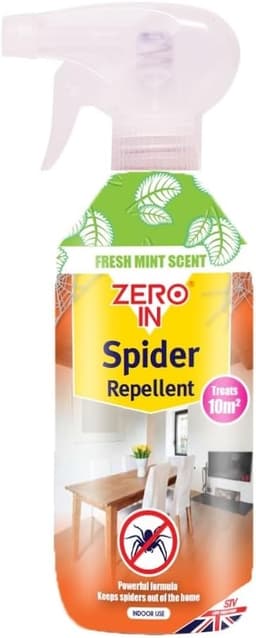
A trustworthy page says whether the bottle uses a named plant oil, such as peppermint, clove, lavender or eucalyptus, or a regulated insecticide. Titles and bullets often describe different formulas. Do not rely on the headline. Two listings in this set show the trap. The Zero In twin (B074PN6H85, 2 × 500 ml, about £12.90) carries a humane mint title, yet the bullets open with copy for a KARRMA spray that claims to kill insects within minutes. Pestshield (B01CR88VCG, six 200 ml cans, about £12.10) holds 4.4 from 122 reviews and names no active, no HSE number and no repeat interval. A size field prints 33.33 ml beside 200 ml. If the title and the bullets disagree, use the bottle label.

Trust the repeat interval on the bottle

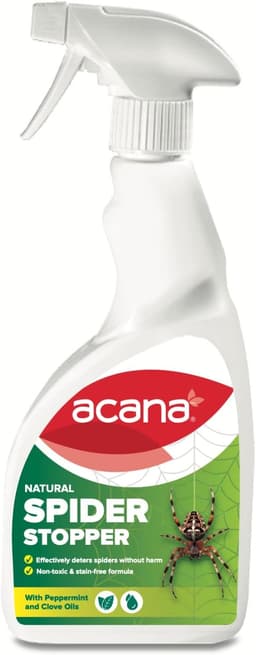
Even a verified oil barrier does not keep every spider out. Oils leave the frame as they dry. As a rule of thumb, re-apply peppermint barriers every two to three weeks in autumn, and sooner if you wipe PVC sills or rain washes a threshold. Headlines stretch that window. Acana Natural Spider Stopper (B0DFMLDNPT, 500 ml, about £7.99) says up to 12 weeks in the title. The bullets give no week count. A retailer directions page for the same bottle says every two to three weeks, so the bottle wins. Five windows and two doors every fortnight from September to November empty a 500 ml bottle faster than a 12-week headline implies. Preparation is in how to use spider spray.

Surfaces, biocide rules, and price per litre

Most 500 ml mint triggers are for indoor frames, skirting and thresholds. Sheds and rough brick need a label that allows outdoors, and rain still rinses an exposed film. The 2023 safety data sheet for Zero In STV981 lists peppermint oil under 1%, an EUH208 line that it may produce an allergic reaction, and says to keep it away from children. None of the five pages prints an HSE number. Article 72 forbids biocidal advertisements from saying non-toxic, natural, harmless, animal friendly or HSE approved. Compare price per litre. Acana at about £7.99 for 500 ml is about £15.98 a litre. The Zero In twin at about £12.90, and WildGuard at about £12.95 for 1 litre, sit near £13 a litre. The triple at about £17.25 for 1.5 litres is £11.50 a litre.

Common questions

What is the first thing I should check on a spider spray listing?
Start by checking whether the bottle is a barrier repellent, GB BPR Product Type 19, meant to deter spiders at window frames and doors, or a contact killer aerosol, Product Type 18, made to spray at a visible spider. Amazon results mix both. A peppermint barrier will not give instant knockdown. An insecticide aerosol leaves a dead spider and little lasting scent.
Why does one spider spray claim 12 weeks while directions say two to three weeks?
Peppermint evaporates from hard frames and is wiped off in ordinary cleaning. The amazon.co.uk title for Acana Natural Spider Stopper (B0DFMLDNPT) says up to 12 weeks. A UK retailer directions page for the same 500 ml bottle says every two to three weeks. Treat two to three weeks, or straight after you wash the frames, as the working interval for a mint barrier.
Should I trust pet safe, non-toxic, or HSE approved on an Amazon title?
Treat those phrases with caution. Article 72 of the Biocidal Products Regulation, enforced by the Health and Safety Executive, says biocidal advertisements must not use non-toxic, natural, harmless, animal friendly or HSE approved. Plant-oil sprays can still affect skin. The Zero In STV981 safety data sheet lists peppermint oil under 1% with an EUH208 skin-sensitiser warning.
How do I know if a spray kills spiders or only deters them?
Read the title and the bullets. Essential oils such as peppermint, clove, lavender or eucalyptus point to a threshold deterrent. Direct-contact knockdown points to a killer. Watch catalogue errors. The Zero In twin (B074PN6H85) has a humane mint title, but the bullets paste copy from a KARRMA contact-killer spray. Follow the bottle in your hand.
Why does a high star rating or a 13,000 review count not guarantee a barrier works?
Amazon often rolls review counts across a parent listing that includes several pack sizes. The Zero In 3 × 500 ml bundle (B0DBZYCM31) shows 3.9 from 13,064 ratings pooled across that family, not 13,064 sales of this triple pack. Pestshield (B01CR88VCG) holds 4.4 from 122 reviews and still does not name an active on the page. Stars do not replace a named oil and a repeat interval.
How much does spider spray cost per litre on amazon.co.uk?
In this set the range is about £11.50 to £15.98 a litre. Acana at about £7.99 for 500 ml is about £15.98 a litre. WildGuard at about £12.95 for 1 litre, and the Zero In twin at about £12.90 for 1 litre, sit near £13 a litre. The 3 × 500 ml triple at about £17.25 is £11.50 a litre. The pack price is not the same comparison.

Related pages

Sources

Public UK sources used for this comparison. Shelf prices, stars and review counts are the amazon.co.uk figures captured for these five listings. Last checked 22 October 2026.

  1. HSE biocidal product types (retrieved 22 October 2026)
  2. HSE biocidal advertising (retrieved 22 October 2026)
  3. Acana Spider Stopper directions (retrieved 22 October 2026)
  4. HSE packaging and labelling (retrieved 22 October 2026)
  5. BPCA spider control (retrieved 22 October 2026)
  6. BPCA false widow sightings (retrieved 22 October 2026)
  7. NHS insect bites and stings (retrieved 22 October 2026)
  8. STV981 safety data sheet (retrieved 22 October 2026)