Independent comparisons. We may earn from shop links. More info

How to use neem oil when the bottle has set

Updated: 23 October 2026

You have a bottle of neem oil that looks cloudy, feels solid, or will not disappear into water, and you want to know whether it has spoiled. This page is about handling a fixed seed oil: warming it, storing it, judging the smell, and patch-testing before it goes on skin. It stops before any garden dose. The [neem oil comparison](/hub/pest-control/neem-oil) lists the nine amazon.co.uk bottles behind that advice, with prices from 21 October 2026. Products Compared used the listings and public UK seller guidance, and did not run a lab test. A qualifying purchase through our links can earn a commission at no extra cost to you.

You have a bottle of neem oil that looks cloudy, feels solid, or will not disappear into water, and you want to know whether it has spoiled.

Our top picks

On this page

When the oil is solid or cloudy

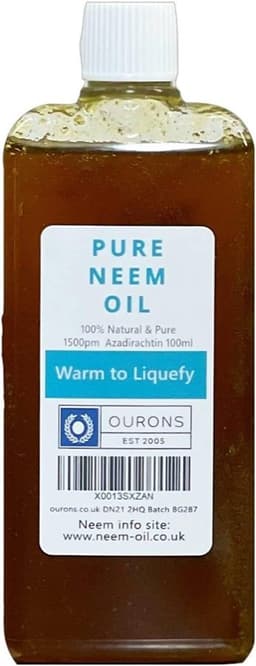
Cold-pressed neem seed oil sets when the room is cool. Seller guidance, including neem-oil.co.uk, puts that change at about 20°C. Ourons prints the same behaviour on the 100 ml and 500 ml listings. A UK review of Fushi describes a solid that melted in the palm. Cloudiness in a British kitchen in October is not, on its own, a failed bottle. Warm the sealed bottle in hot tap water. Keep the cap on. A 100 ml bottle loosens faster than the 500 ml Ourons. Do not microwave it. A microwave heats unevenly, can melt a plastic cap, and is the step neem-oil.co.uk tells buyers to avoid. Once the oil pours, use what you need and let the rest return to room temperature.

Why it sits on water

Pure neem oil is a fixed oil. The Ourons brand page states that it floats on water. That is the expected result from the 10 ml Bio Natural to the 500 ml craft bottle. None of the nine ASINs is a water-soluble concentrate. This page does not give a millilitres-per-litre recipe or a spraying schedule. A home mix would cross the line the Health and Safety Executive draws: a product used to protect plants needs authorisation, and these files have no MAPP number. If the goal was aphids or mites, use neem oil for plants. If the goal was soap, weigh the oil as an oil. The buying guide separates that craft bottle from a spray mix.
OURONS Ourons neem oil 500 ml

Testsieger

OURONS Ourons neem oil 500 ml
9.0/10about £13.99

Smell and storage

A strong garlic and sulphur smell is normal for unrefined neem seed oil. One Fushi reviewer still noticed it after two washes. A sour smell, or a smell like paint, is the reject. neem-oil.co.uk treats those notes as oxidation. Do not put that oil on skin, and do not pour it down the sink. An HSE classification supports H412 for a defined cold-pressed margosa extract, so leftovers do not belong in a drain. Store the capped bottle in a cool, dark cupboard. One seller’s rule of thumb is about two to three years unopened and twelve to eighteen months once opened. Do not store a water mix. If a child or a pet has swallowed the oil, or a cat has been coated in it, contact a vet or NHS 111.

Skin, and where this page stops

Skin use starts with dilution and a patch test. Absolute Aromas tells buyers not to use neem oil undiluted and not to go above 10% neem in another carrier. That 10% cap is a seller’s cosmetic ceiling, not a medical dose. Put a dab of the diluted oil on the inner forearm and wait 24 hours. Redness, itching or a burn means you stop. One Daana reviewer who applied the oil neat said not to repeat it. The Neem Team says its oil is not for internal use and is not recommended in pregnancy. This page does not become a scalp routine, a lice treatment, or a spray calendar. If the patch test is calm and the smell is garlic rather than paint, that is the handling this oil needs.

Common questions

Why is the bottle solid?
The fats have set. Cold-pressed neem oil commonly solidifies below about 20°C, which is a normal UK room for much of the year. Ourons says the oil thickens when cool, and Fushi buyers describe a solid that melts in the hand. Cloudiness is the same behaviour, not mould. Warm the sealed bottle before you decide the oil is ruined.
Can I microwave it?
No. Warm the closed bottle in hot tap water until the oil loosens. A microwave is the method UK seller guidance tells you to skip, because the heat is uneven and the cap can suffer. The 500 ml bottle needs longer in the water than a 30 ml or 50 ml bottle. Leave the cap on so tap water stays out of the oil.
Why will it not mix with water?
Because it is a fixed oil. It floats, which is what Ourons states on its own 100 ml page. Shaking only makes a temporary slick. A water-soluble neem product is a different SKU with an emulsifier already in it, and it is not one of the nine bottles in the comparison. This page does not give a soap-and-water spray recipe.
How should I store it?
Keep the cap tight in a cool, dark cupboard, away from a windowsill and a radiator. One seller’s rule of thumb is two to three years unopened and twelve to eighteen months opened. Treat those figures as that shop’s guidance, not a test of your ASIN. Do not store a bottle you have already mixed with water. Label the day you opened it.
When has it gone off?
Trust your nose after the oil is warm. Garlic and sulphur are the normal neem smell, including a smell that survives a hair wash. Sour, or a paint-like note, means oxidation according to neem-oil.co.uk, and that bottle should not go on skin. Do not pour the reject oil down the drain.
Is a spray recipe in this how-to?
No. Warming, storing, smelling and a skin patch test are the whole method. A millilitres-per-litre garden mix would be an unauthorised pesticide use for every bottle in this set, because none shows a MAPP number. If you bought the oil for aphids, the plants page says what to do instead, including the RHS steps that do not involve a spray.

Related pages

Sources

Public UK sources used for this comparison. Shelf prices, stars and review counts are the amazon.co.uk figures captured for these nine listings. Last checked 21 October 2026.

  1. HSE garden pesticide use (retrieved 21 October 2026)
  2. HSE active-substance register (retrieved 21 October 2026)
  3. HSE Article 68 report 2024 (retrieved 21 October 2026)
  4. PPDB azadirachtin A (retrieved 21 October 2026)
  5. RHS aphids (retrieved 21 October 2026)
  6. NHS head lice (retrieved 21 October 2026)
  7. Veterinary Record 2009, neem oil in cats (retrieved 21 October 2026)
  8. Why neem oil looks cloudy (retrieved 21 October 2026)