Independent comparisons. We may earn from shop links. More info

White boat paint buying guide: choose the right tin

Updated: October 2026

You search for white boat paint on amazon.co.uk because a topside needs refreshing, but the results mix hull gloss with bilge enamel, non-slip deck coating and even a touch-up pen. Those products are not interchangeable. Your first decision is where the coating will go; only then should you compare the named white, coverage and pack size. Our [white boat paint comparison](/hub/paints-and-varnishes/white-boat-paint) sets out the 11 current options and their roles. This guide gives you the decision process behind that table, so you can rule out the wrong type of paint before price or star ratings distract you.

You search for white boat paint on amazon.co.uk because a topside needs refreshing, but the results mix hull gloss with bilge enamel, non-slip deck coating and even a touch-up pen. Those products are not interchangeable.

Our top picks

On this page

What white boat paint is for

In most shopping results, “white boat paint” means a decorative marine enamel for topsides: the visible part of the hull above the waterline. A one-pack product is the usual DIY choice because it does not require you to mix a resin and hardener, although it still needs a compatible prepared surface and usually an undercoat. International Toplac Plus, for example, is specified for use above the waterline and not for permanent immersion. GRP, wood and metal may all accept a marine topside system, but the preparation and primer can differ; compatibility with the existing coating matters more than a small saving on the topcoat.

Three tins that are not hull gloss

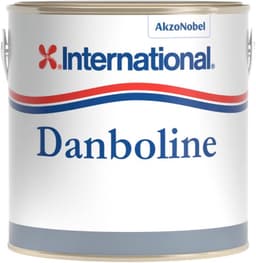
A white bilge enamel belongs inside lockers, engine spaces or the bilge, where an easy-clean, light-reflective finish is useful. It is not a topside gloss merely because its review score is high. In the current extract, International Danboline shows 4.8 from 26 reviews, but that evidence concerns a bilge product rather than its suitability for an exterior hull. See our topside paint versus bilge paint guide if those are your two candidates. Non-slip deck paint solves another problem. It sacrifices the smooth finish you want on topsides to add texture underfoot, so it belongs on suitable walking surfaces rather than a glossy hull panel.

Decide which white you mean

White is not one standard marine colour. Snow White, Polar White and Pure White are named shades, not interchangeable promises of an exact match. The selection also includes pale cream and RAL 9001, both of which can look warm beside a colder, brighter white. Even two products described as white may differ visibly once they sit next to an aged gelcoat or an existing painted panel. Choose the product role before the shade.

Work out how much paint to buy

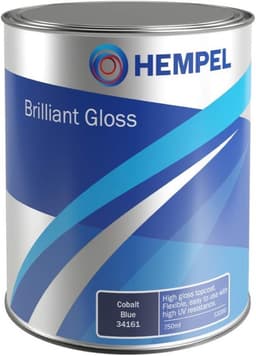
Published spreading rates are useful for comparing tins, but they are not a promise for your boat. The products in this market are commonly around 9–12 m² per litre, with International Toplac Plus stating a practical rate of about 12 m²/L and Hempel Brilliant Gloss about 11 m²/L. Teamac’s 1 litre listing states 10–12 m²/L. At 10 m²/L, a 750 ml tin gives a theoretical 7.5 m² for one coat before losses. Some marketplace fields in the extract show only “Coverage: 1”. That figure has no unit, so it is not usable as one square metre, one litre or one coat. Check the manufacturer’s current product data sheet instead.

What to leave alone

Antifouling is not ordinary white hull gloss. It is a coating for the underwater hull intended to control fouling, and the RYA notes that antifouling products use active substances for that purpose. A topside enamel that is explicitly unsuitable for permanent immersion should not be carried below the waterline just because both coatings are available in white. If the existing coating is unknown or the product instructions call for professional spray facilities, ask a competent boatyard to identify the system.

Common questions

Is white boat paint the same as antifouling?
No. White topside paint is normally a decorative finish for the visible hull above the waterline. Antifouling is formulated for the immersed hull to discourage marine growth and may contain active substances. Choose by location and manufacturer specification, not colour; a white topside enamel marked “not for permanent immersion” does not become bottom paint.
Do I need a different tin for the bilge?
Usually, yes. Bilge enamel is intended for internal bilges, lockers and machinery spaces, where a light, washable finish matters. Topside gloss is intended for exterior surfaces above the waterline. Check the product data for substrate and chemical resistance, especially around fuel or oil, rather than using a topside rating to judge a bilge coating.
Will Snow White match Pure White or Polar White?
Do not assume it will. These are named colours within particular manufacturers’ ranges, and pale cream or RAL 9001 is warmer again. Match the maker, colour name and part number where possible, then test a small area. Existing paint may also have faded, so even the original shade can stand out when newly applied.
Is a 750 ml tin enough?
It depends on measured area, number of coats and the stated practical spreading rate. At a rule-of-thumb 10 m²/L, 750 ml theoretically covers about 7.5 m² for one coat before waste. Multiply your area by the coat count, then add an allowance for the surface and application losses rather than relying on boat length.
Can I use household gloss on a GRP hull?
Household gloss is not the safe default. A marine coating system provides instructions for relevant substrates, primers, weather exposure and use above the waterline; domestic gloss generally does not document that job. Check the existing coating and select a compatible marine primer, undercoat and topcoat system. If the old finish is unknown, identify it before sanding or overcoating.
Is a two-pack paint the default DIY option?
No. One-pack marine enamel is generally the more approachable DIY topside route because it avoids mixing resin and hardener. Two-pack products may offer a harder finish, but compatibility, exact mixing, working time and protective controls are less forgiving. Follow the specific data sheet, and leave specialist spraying to a properly equipped operator.

Related pages

Sources

Manufacturer sheets and UK public sources for coverage, immersion limits and safety. Shelf prices, stars and review counts are the amazon.co.uk lines in these eleven listings from 15 October 2026. Prices move.

  1. International Toplac Plus datasheet, 15 November 2023 (retrieved 15 October 2026)
  2. Hempel Brilliant Gloss 53200 product data sheet (retrieved 15 October 2026)
  3. Hempel Non-Slip 56251 product data sheet (retrieved 15 October 2026)
  4. Hempel Bilge & Locker 5112B product data sheet (retrieved 15 October 2026)
  5. Teamac Marine Gloss (retrieved 15 October 2026)
  6. HSE, regulated biocides (retrieved 15 October 2026)
  7. HSE, isocyanates in coatings (retrieved 15 October 2026)
  8. Volatile Organic Compounds in Paints, Varnishes and Vehicle Refinishing Products Regulations 2012 (retrieved 15 October 2026)