Independent comparisons. We may earn from shop links. More info

How to apply plastic primer

Updated: 23 October 2026

The can is already on the bench, and the usual failure is a thick coat on plastic that is still greasy, or a topcoat that goes on inside the wrong dry window. How to apply plastic primer, for the products in this set, means wash, degrease, take the shine off, then several thin coats, and wait the interval printed for that product. A generic hour is how a United Kingdom Hycote reviewer ended up with a reaction when the next product went on too soon. Which can to buy is on the [plastic primer comparison](/hub/paints-and-varnishes/plastic-primer). The Products Compared editorial team wrote this on 21 October 2026 from the makers’ sheets, HSE guidance on solvent spraying, and the review themes in our files. We did not run a booth trial. A qualifying purchase can earn a commission at no extra cost to you.

The can is already on the bench, and the usual failure is a thick coat on plastic that is still greasy, or a topcoat that goes on inside the wrong dry window.

Our top picks

On this page

Clean plastic, then primer

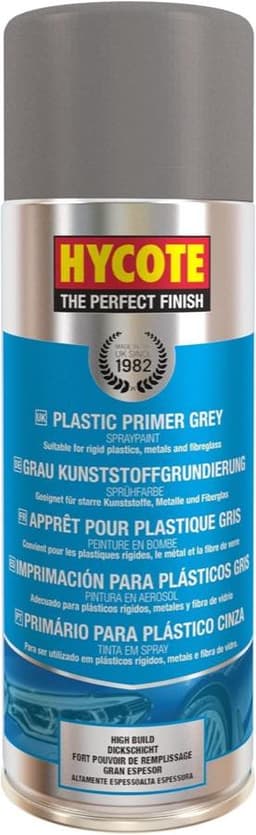
Plastic holds mould release, silicone polish, wax and fingerprints more willingly than bare metal holds dust. Primer does not cancel that film. A primer is not the whole system, and contamination or a mismatched topcoat still lets the paint come off. Start with a detergent wash and a clean rinse, then a solvent wipe that the maker of your can actually names. Hycote’s sheet is the clearest in this set: detergent, then a solvent wipe, then the primer. Let the wipe flash off. If the cloth comes away grey or glossy, wipe again. Take the shine off a glossy moulding so the primer has a tooth. Use a fine abrasive pad that your paint supplier is happy to put on plastic, keep the scratches shallow, and dust off afterwards. A deep scratch in a bumper cover becomes a witness line under gloss. On a miniature, keying can be nothing more than a gentle pass, because you are trying not to erase eyelids and straps. Mask what must stay bare, including rubbers and glass on a car, and the base of a figure if you still need it to sit flat. Then spray or brush a test patch on a hidden edge or a piece of sprue. Wait the full interval for that product before you decide the patch has worked. A patch that is still soft when you press it is not a pass. If you cannot name the plastic, stop before you commit a whole cover. A promoter cannot replace a greasy surface, and it cannot turn an excluded plastic into an allowed one.

Aerosol passes

Shake the aerosol for as long as that can asks. Hycote’s sheet says about two minutes. Army Painter’s colour-primer guide says about a minute, then a test spray away from the model. Distance is not one number for every brand. Hycote prints about 20–25 cm. Army Painter’s bullets print 15–20 cm and short bursts. Simply Auto and Montana do not give you those centimetres on the amazon.co.uk fields we saved, so you follow the can in your hand rather than borrowing Hycote’s span. Hold the can upright, start the pass before the part and release after it, and move across. A pause in the middle is how you build a run. Two or three light coats beat one wet coat. Hycote states that pattern, with about 15 minutes between coats. Montana’s use page also asks for thin layers, with about five minutes between them on that page. Overpaint guidance on Montana’s own URLs does not agree with itself, so the can you bought wins. Autotek’s UK reviews are the picture of what heavy looks like: a film that needs flatting, and runs and streaks when the same can is aimed at a flat model. If the coat looks like grey paint rather than a mist, you have gone too far. Let it harden and flat the nibs if the job is a panel. Ventilation is part of the method. The Health and Safety Executive’s note on spraying points at poor ventilation and high-solvent spray as a real exposure, which is the situation a garage with the door shut becomes on a still day. Work outdoors or with the door open and the vapour moving away from you. A listing line that says non toxic does not make a closed room acceptable. Wear the eye and breathing protection the can asks for, and keep aerosols away from flames and from the boiler. The Army Painter bullets already tell you to avoid extreme heat, cold and humidity. A damp British morning is a reason to wait, not a reason to spray in the kitchen.

Bottles and airbrush

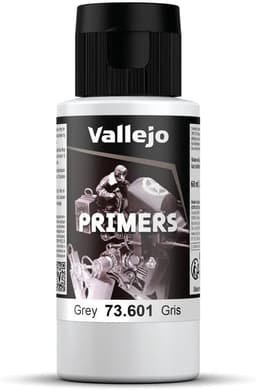
Airbrush primer fails in the opposite direction from a rattle can. It goes on too wet, or so thin that it will not cover, or it dries in the nozzle. Nicpro’s three-colour set says it is ready to spray and, in the same bullets, says to thin it if compressor airflow is below 20 litres per minute. United Kingdom reviews split on that point. Some people dilute it and say the coverage lasts. Some call it too watery straight from the bottle. If your compressor is a small hobby unit, assume you are in the check-the-20-litres group. Spray a plastic spoon or a spare base first. If the film crawls or looks like dirty water, it is too thin. If it floods a detail and stays open, it is too heavy or you are too close. Vallejo’s 60 ml grey is the bottle UK reviewers describe using indoors when the weather is poor, often with little thinning and an even coat. One review still lost adhesion after soap and isopropyl alcohol. Soap can leave a film if you do not rinse. Alcohol can be the right degreaser on a figure and the wrong last step if the primer you chose does not like the residue. Do not treat 2,030 mostly happy reviews as a promise for a greasy resin cast. The Army Painter 100 ml matt black bottle is the product to read twice. The title says airbrush primer. The bullets describe a thinner and flow improver at about one part medium to one or two parts paint. Item form says aerosol and the container says bottle. UK reviews include people who brushed it on with no extra thinner, and people who blocked a nozzle, scratched the film because they handled it early, or wiped it off a PLA print after it looked dry. If your goal was a primer, the 400 ml colour primer or the Vallejo bottle is the clearer instruction. If your goal was to thin a Warpaints colour, the bullets are the instruction and the title is the trap. Brush-on gesso is outside this spray method. The Nicpro gel is thick enough that a review says to water it down, and it is not water resistant.

Recoat times in this set

These clocks are printed on the listing or the maker sheet we used. They are not an average, and they are not a warranty that your topcoat will match. Hycote’s listing prints 24 hours for dry time and full cure. The maker sheet is more useful in the middle: about 15 minutes between the light primer coats, then 24 hours before later finishes. That is the interval a rushed topcoat violates. Autotek’s listing also prints 24 hours for dry time and full cure. We do not have a separate between-coat minute for Autotek in the saved fields, so you use the can. Simply Auto prints 0.5 hours. Full cure is not stated. Do not stretch that half hour into a promise that a gloss black topcoat will be safe the same afternoon. The only UK review we have is a short note about bonnet grills. It does not time the recoat. Army Painter’s matt white colour primer prints 1 hour dry and 2 hours full cure. The maker’s guide still talks about hours or overnight before you trust the figure to handling and paint. UK reviewers already say it can take longer than some other primers. If you are painting an army in the evening, overnight is the cautious reading. The listing also says it is not water resistant. Vallejo prints 3 hours dry and 4 hours full cure. Nicpro’s airbrush set prints 4 hours dry and 2 hours full cure, which cannot both be the last word. When a file disagrees with itself, wait for the longer figure and test a corner. The Army Painter 100 ml bottle prints 24 hours, and the reviews that mention scratches are the ones who did not wait a day or two. Montana prints 24 hours, and between-coat minutes on the maker’s how-to page are about five on the page we used. Quote the can in your hand. Cold slows solvent. It does not shorten the window.

When the job is no longer DIY

Stop if you need a colour match on a bumper that has to blend into factory paint. A grey primer from this set is not a tinted basecoat, and a domestic aerosol is a poor tool for a fade across a wing. A bodyshop sees that blend every week. You will not reproduce it from a £7.99 can and a kitchen roll of masking tape. Stop if the system in front of you is a two-pack product that contains isocyanate. The Health and Safety Executive’s INDG388 is about that hazard for sprayers. It is a boundary, not a method. This page does not tell you how to mix or spray two-pack in a garage. If the tin you were given is a professional clear or a hardener, hand the job over. Stop if paint is peeling off in sheets after a repair you already made. Another grey can on top of a failed film repeats the failure. The film has to come off back to sound plastic, the plastic has to be identified, and the next product has to be one that names that plastic. Wrinkling, fisheyes or a reaction within minutes of the topcoat are the same signal: the window or the chemistry was wrong. A small trim, a roof box in an allowed plastic, or a squad of figures is still a home job if you can ventilate, wait, and accept a careful DIY repair rather than a factory refinish.

Common questions

What do I do before the first coat?
Wash with detergent, rinse, then degrease with the solvent your can names, and let that flash off. Knock the gloss back lightly so the primer has a tooth, dust the part, and try a hidden patch. Primer will not grip through wax, silicone or mould release. If you do not know whether the plastic is polypropylene, identify it before you coat a whole bumper.
How thick should a coat be?
Thin enough that you can still see you have built it in two or three passes, not one wet flood. Hycote specifies two or three light coats. Army Painter specifies short bursts from 15–20 cm. A coat that runs, or that fills the straps on a miniature, is too heavy. Flat a run after it has hardened instead of burying it.
How long do I wait before a topcoat?
Use the clock for the product you opened. Hycote’s sheet says 24 hours before later finishes, with about 15 minutes only between the primer coats themselves. Army Painter’s listing says 1 hour and 2 hours, and the maker guide still allows hours or overnight. Simply Auto’s 0.5 hours is a dry-time field with no full cure beside it. Do not share one wait across the set.
Can I use the same wait for every can in this set?
No. Vallejo prints 3 hours and 4 hours. Nicpro’s airbrush set prints 4 hours dry and 2 hours full cure, which disagree. The Army Painter 100 ml bottle prints 24 hours, and reviewers who handled it early saw scratches. Montana’s between-coat note is not Hycote’s 15 minutes. Averaging them is the mistake this page is here to prevent.
Can I spray the aerosol indoors?
Not in a closed room. HSE guidance treats poor ventilation and solvent spray as an exposure problem. Spray outside or with vapour leaving the space, and follow the can’s own warnings. A non toxic line on a listing does not change that. Extreme cold, heat and humidity are already a no on the Army Painter bullets, which rules out a lot of British weather.
What if the airbrush primer is too thin or too thick?
Test on a spoon or a spare base. Nicpro’s set tells you to thin below 20 litres per minute of airflow, and UK reviews still call some bottles too watery. Vallejo’s indoor reviews often use little thinning, with one adhesion miss after soap and alcohol. The 100 ml Army Painter bottle may be a thinner rather than a primer. Flooded detail means too much, too close, or too wet. Crawling and a blocked nozzle mean stop and read the bullets again.
When do I stop and call a bodyshop?
When you need a colour match into existing car paint, when the product is a two-pack isocyanate system, or when a previous repair is peeling in sheets. Also stop if the plastic code is polypropylene and none of the cans you own name that plastic. A weekend trim on an allowed rigid plastic can stay at home if you can ventilate and wait the full window.

Related pages

Sources

Public sources from the research digest, last checked on 22 October 2026. Shelf prices and star lines are the amazon.co.uk figures in the display file. The price band is this set, not a market average. No listing was lab-tested.

  1. VOC in Paints, Varnishes and Vehicle Refinishing Products Regulations 2012 (retrieved 22 October 2026)
  2. SI 2012/1715 Schedule 2, VOC limits (retrieved 22 October 2026)
  3. HSE: vehicle spray painters and COSHH (retrieved 22 October 2026)
  4. HSE INDG388: safety in isocyanate paint spraying (retrieved 22 October 2026)
  5. Hycote plastic primer technical data sheet (retrieved 22 October 2026)
  6. Montana: how to use plastic primer (retrieved 22 October 2026)
  7. Army Painter: using colour primers (retrieved 22 October 2026)
  8. Tetrosyl: Autotek grey plastic primer 500 ml (retrieved 22 October 2026)