Independent comparisons. We may earn from shop links. More info

Plastic primer: which product the job actually needs

Updated: 23 October 2026

You have searched for a plastic primer and the results mix a £7.99 grey car aerosol, a matt white spray with more than 11,000 reviews, and a tub of artist gesso. They are not interchangeable. A plastic primer here is a first coat that gives later paint something to grip, and the right one depends on whether the part is a bumper, a miniature or a board. This guide sorts the nine amazon.co.uk listings on the [plastic primer comparison](/hub/paints-and-varnishes/plastic-primer) by job. It does not crown a winner. The Products Compared editorial team wrote this on 21 October 2026 from those saved listings, their review counts and the makers’ own pages. We did not spray a panel in a lab. A qualifying purchase can earn a commission at no extra cost to you.

You have searched for a plastic primer and the results mix a £7.99 grey car aerosol, a matt white spray with more than 11,000 reviews, and a tub of artist gesso. They are not interchangeable.

Our top picks

On this page

Three products under one name

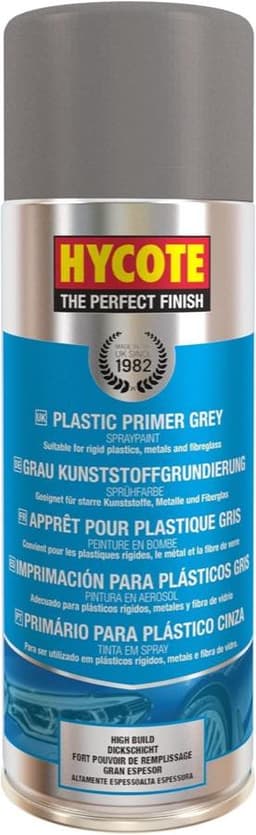
A shopper who types plastic primer is usually looking at one of three things, and the tin does not always say which. The first is a grey acrylic aerosol sold for car plastic: Hycote, Autotek, Simply Auto and, on a different surface list, Montana. The second is a hobby primer for figures and small models, either a rattle can or an airbrush bottle. The third is artist gesso, a thick white gel that mentions plastic among canvas, wood and paper. The grey aerosols in this set are coloured films. Hycote’s page says the grey primer is for rigid plastics such as many bumpers and wheel trims, and that it is not for polyolefins. Polyolefins include polypropylene and polyethylene, the plastics many modern bumper covers are moulded from. A clear adhesion promoter made for those blends is a different product, often colourless and sold through motor factors. None of the nine rows is that clear promoter. Treating grey plastic primer and adhesion promoter as synonyms is how a bumper ends up peeling in sheets. Hobby primers leave a thin tooth on a figure, not a fill on a wheel arch. The Army Painter matt white 400 ml can is crafts and model making, ranked in toys, with bullets about a 15–20 cm pass. Vallejo’s 60 ml grey bottle is an airbrush primer for resin, PVC and similar modelling surfaces. Nicpro’s three-colour set sits in the same hobby lane. The Army Painter 100 ml matt black bottle is the awkward one, because the title says primer and the bullets describe a thinner. Gesso is the third lane. The Nicpro white gel at £14.99 lists plastic, and one United Kingdom review calls it an undercoat for painting plastic. The same listing is for acrylic and oil painting, it is not water resistant, and it is not a bumper product. If the part is a canvas, a terrain board or a small craft piece, gesso can be the honest buy. If the part is a bumper or a miniature with sharp edges, leave this row. Vehicle-refinishing rules put plastic primers in the primer category under the 2012 solvent regulations, and they keep ordinary decorative paints in a different box. That is why these car cans are not just spray paint. It is not a measured solvent figure for any can in this set.

What this set actually stocks

Prices are the amazon.co.uk shelf figures saved with these listings. They will move. The review counts are the point, because a star with no sample is not a decision. Hycote’s 400 ml can is £7.99 with 4.6 from 1,410 reviews. Autotek’s 500 ml can is £9.94 with 4.6 from 895. Simply Auto’s 500 ml can is £8.99 with 5.0 from 3. Montana’s 400 ml can is £13.95 with 4.0 from 123, and the written reviews stored for that listing are not labelled United Kingdom. If you only need a grey film for a rigid plastic the sheet allows, the first two prices are the ones with a crowd behind them. Simply Auto’s perfect score is three people. Army Painter’s matt white 400 ml spray is £11.99 with 4.5 from 11,306 reviews, the largest count in the folder. Vallejo’s grey airbrush primer is £8.06 with 4.6 from 2,030 reviews, and that £8.06 buys 60 ml, not a 400 ml can. Nicpro’s black, grey and white airbrush set is £14.99 with 4.4 from 612, about 250 ml of each colour. The Army Painter 100 ml matt black bottle is £11.50 with 4.5 from 407, and it is the title that disagrees with its own bullets. Nicpro gesso is £14.99 for 513 ml with 4.6 from 189. A 60 ml bottle can look like the bargain because £8.06 is close to Hycote’s £7.99. It is not the cheap way to coat a bumper, and the Vallejo surfaces do not include that job. The opposite mistake is the £7.99 car can on a box of miniatures. United Kingdom reviews of the car aerosols already describe heavy film, hidden detail and streaks on flat models. A score of 80 on a miniature spray does not answer a bumper question, and a 5.0 from three reviews does not outrank 4.6 from 1,410.

Two traps before you sort by stars

Hycote’s product page presents the grey primer as suitable for bumpers and wheel trims. The technical sheet then excludes polyolefins, flexible plastics, acrylic and polystyrene. Both sentences are true at once, and the second one decides the buy. If the moulding mark says PP, PP-EPDM or PE, bumper on the tin is not permission. Polystyrene matters for a different reader: many injection-moulded kits are that plastic, and the same sheet tells them not to. Army Painter Warpaints Air, the 100 ml matt black bottle, is titled as an airbrush primer. The bullets describe a thinner and flow improver, mixed at about one part medium to one or two parts paint. The item form says aerosol and the container type says bottle. A printed weight of 18 g cannot be the fill of 100 ml. United Kingdom reviews go both ways: some people brush it on, and others report sludge, a blocked nozzle and primer that wiped off a PLA print. A 4.5 from 407 is a real sample. It is not the same product as the 400 ml colour primer. Simply Auto’s special-features line says adhesion promoter, which sounds like the clear bumper product the trade shops sell. The saved evidence is one United Kingdom review about bonnet grills under gloss black, plus two other reviews that make up the five-star line. That is not a test on polypropylene. Read the excluded plastics, the dry time, and whether the bottle is a primer or a thinner, before you read the stars.

Which page to open next

If the part is a bumper, a wheel trim, a mirror cover, a lamp housing or a roof box, open the bumper page before you add a grey can. That page keeps Hycote’s bumpers line and its polyolefin exclusion in the same breath, and it names clear promoters this comparison does not stock. A roof box can still be a fair Hycote job when the plastic is one the sheet allows. A polypropylene bumper cover is not. If the part is a figure, a resin miniature or a small styrene kit, open the miniatures page. The useful split there is outdoor spray against an indoor airbrush bottle, because a British wet afternoon is a normal constraint. Car high-build aerosols stay off that page as the default, even though some reviewers use them on models and then complain about detail. If you already hold a can or a bottle from this set, the how-to page refuses a single waiting time. Hycote’s sheet asks for 24 hours before later finishes. The Army Painter colour-primer listing prints 1 hour dry and 2 hours full cure, while the maker’s guide still says hours or overnight. Simply Auto prints 0.5 hours and does not state a full cure. Averaging those into about an hour is how the next coat reacts. Gesso shoppers can stay on the comparison row. There is no bumper method borrowed from a gel that is not water resistant.

Common questions

What is a plastic primer, in one sentence?
A plastic primer is a first coat meant to help later paint grip a plastic surface, and in this set that phrase covers grey car aerosols, hobby sprays and bottles, and one artist gesso. The sentence only helps after you know which plastic and which job you have. A product that primes a resin figure is not automatically a product that primes a bumper cover.
Do I need a different product for a bumper and for a miniature?
Yes, in this comparison. Bumper and trim work points at the grey aerosols, and only when the plastic is on that maker’s list. Miniatures point at the Army Painter 400 ml spray or a hobby bottle such as Vallejo. Using the car can on a figure risks a heavy film. Using the figure spray on a bumper ignores a different plastic and a different duty.
Is a grey aerosol the same as a clear adhesion promoter?
No. The grey cans here are coloured primers with their own exclusion lists. A clear promoter aimed at polypropylene and PP-EPDM blends is a different chemistry, sold by motor factors, and it is not one of these nine amazon.co.uk rows. A special-features line that says adhesion promoter does not by itself make a grey can into that clear product.
Which rows are car primers, which are hobby, and which is gesso?
Hycote, Autotek, Simply Auto and Montana are the car or general plastic aerosols. Army Painter’s matt white spray, Vallejo, the Nicpro three-colour set and the Army Painter 100 ml bottle are the hobby rows, with the 100 ml bottle in dispute. Nicpro’s 513 ml white gel is gesso. Prices and review counts for each sit on the main comparison.
Why is the cheapest 60 ml bottle not the cheapest way to coat a bumper?
Vallejo at £8.06 is close to Hycote at £7.99, and the bottle is 60 ml. The Hycote can is 400 ml and is at least aimed at car plastic. Covering a bumper from a 60 ml modelling bottle would be several bottles, and the Vallejo surface list does not name that job. Cheap per bottle is not cheap per panel.
Does a 5.0 from 3 reviews outrank a 4.6 from 1,410?
No. Simply Auto’s 5.0 from 3 is a thin record, which is why its comparison score sits at 62. Hycote’s 4.6 from 1,410 is a large UK sample with known complaints, including smell and a fast spray, and that is more useful than a perfect line from three people. Stars without a count are not a ranking.
Where do polypropylene and PLA get decided?
Polypropylene and polyethylene are decided on the bumper page, against Hycote’s exclusion and Montana’s different list. PLA shows up in stored reviews as a miss: a non-UK Montana text and a UK note that the Army Painter 100 ml product wiped off a print. Neither plastic is settled by buying the row with the most stars.

Related pages

Sources

Public sources from the research digest, last checked on 22 October 2026. Shelf prices and star lines are the amazon.co.uk figures in the display file. The price band is this set, not a market average. No listing was lab-tested.

  1. VOC in Paints, Varnishes and Vehicle Refinishing Products Regulations 2012 (retrieved 22 October 2026)
  2. SI 2012/1715 Schedule 2, VOC limits (retrieved 22 October 2026)
  3. HSE: vehicle spray painters and COSHH (retrieved 22 October 2026)
  4. HSE INDG388: safety in isocyanate paint spraying (retrieved 22 October 2026)
  5. Hycote plastic primer technical data sheet (retrieved 22 October 2026)
  6. Montana: how to use plastic primer (retrieved 22 October 2026)
  7. Army Painter: using colour primers (retrieved 22 October 2026)
  8. Tetrosyl: Autotek grey plastic primer 500 ml (retrieved 22 October 2026)