Independent comparisons. We may earn from shop links. More info

Primer for plastic miniatures

Updated: 23 October 2026

The figures are washed, the British afternoon is damp, and the cheapest primer in the cupboard is a grey car aerosol that builds like a panel coat. Primer for plastic miniatures has a narrower job: a thin tooth on styrene, resin or PVC so the paint grips, without filling straps, faces and rivets. Use a model primer. Use the Army Painter 400 ml matt white spray when you can work outdoors in mild air. Use Vallejo’s grey bottle when you need to airbrush indoors. Do not default to a high-build car can. The nine listings and their prices are on the [plastic primer comparison](/hub/paints-and-varnishes/plastic-primer). The Products Compared editorial team wrote this on 21 October 2026 from the amazon.co.uk listings, Army Painter’s UK guide, and the review notes in our files. We did not prime a display board in a lab. A qualifying purchase can earn a commission at no extra cost to you.

The figures are washed, the British afternoon is damp, and the cheapest primer in the cupboard is a grey car aerosol that builds like a panel coat.

Our top picks

On this page

What a miniature primer has to do

A miniature primer is a key, not a filler. On a 28 mm figure the straps are a fraction of a millimetre proud of the coat. A wet pass that would be a sensible first coat on a wheel trim will round those edges off and pool in the eyes. You want a dull, even film you can still see the sculpt through. If the detail has gone soft, the primer was too close, too slow, or the wrong product. The plastics in a typical UK hobby box are not bumper plastics. Injection-moulded kits and many games figures are polystyrene. Resin casts and a lot of modern PVC toys sit on a different list. Vallejo’s bottle names resin and PVC. Army Painter’s matt white spray names metals, plastics and resins. Hycote’s car sheet, by contrast, excludes polystyrene. Some UK reviewers still use car primer on slot-car bodies and models. The sheet and the heavy film are why that is not the default here. This page’s spray row is the matt white listing we actually saved, model CP3002. Stored reviews of other Army Painter colours are not a test of this ASIN. White shows missed spots and makes bright colours cleaner. It also shows every grain of dust. Weather decides the tool before brand loyalty does. A rattle can wants still, mild, dry air. A bottle and an airbrush want a desk. In the UK the second option is often the one that is actually available on a weekday evening.

Army Painter matt white spray

The Army Painter colour primer, B005WH3Z12, is 400 ml of matt white at £11.99, model CP3002, 4.5 from 11,306 amazon.co.uk reviews. That is the largest review count in the whole plastic-primer set, and it is a miniature sample, which is why the comparison score leads and why the score note refuses to call it a bumper test. Country of origin on the listing is Italy. Dry time prints as 1 hour and full cure as 2 hours. The primer is not water resistant. The rank is in toys and model-building surface primers, not in DIY spray paint. The bullets and the maker’s UK guide agree on the handling. Shake for about a minute, spray outdoors, keep 15–20 cm off the figure, use short bursts and thin coats, and test away from the model first. The guide still talks about hours or overnight before you trust the figure, which is more cautious than the two-hour full-cure field. United Kingdom reviewers describe covering a batch, including a Spearhead-sized force, and a film that survives handling. The same sample includes a nozzle that had fallen off in the cap and a dry time longer than some other primers. Check the nozzle is seated before you point it at a character you have already cleaned. If the first pass looks speckled, you are too far or the can is cold. If it looks wet and the face has gone smooth, you are too close. Cold and damp are the British limit. The bullets tell you not to spray in extreme heat, cold or humidity. A garage at 8°C after rain is that warning. Warm the can in a pocket, not on a radiator, and still wait for a milder hour if the air is wet. Overnight in a dust-free box is the practical reading of hours or overnight when you are painting the next day. Because the listing is not water resistant, do not store primed figures in a damp shed and expect the claim to cover them. This is the spray to buy when you have a squad or a vehicle kit, a dry mild spell, and somewhere outdoors. It is a poor buy if you only ever paint at the kitchen table after dark.

Vallejo and the Nicpro set

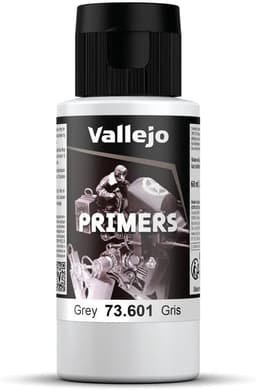
Vallejo surface primer, B005HXHNPA, is the indoor route. It is 60 ml of grey, model VJ73601, £8.06, 4.6 from 2,030 reviews. The surfaces named are resin, PVC, brass, white metal and wood. A polyurethane line appears in the bullets. There is no bumper sentence. Is Waterproof is true on the file, dry time is 3 hours and full cure is 4 hours, and coverage is printed as 10–15 square metres per litre. Do not convert that into a claim that this bottle coats a tank hull: 60 ml is a small fraction of a litre. United Kingdom reviews describe airbrushing it when the weather is poor, with little thinning and an even coat. One review says it did not stick after soap and isopropyl alcohol. Rinse soap off. Treat alcohol as a step you have checked against this bottle, not as a universal last wipe. You need a compressor and a brush you can strip. Without that kit, the £8.06 bottle does not replace the spray on a dry day. The Nicpro set, B0DWK8BCRY, is the three-colour alternative at £14.99, 4.4 from 612 reviews. You get black, grey and white, about 250 ml each, with a size line of 750 ml. It is not water resistant. The bullets say ready to spray and also say to thin it if airflow is below 20 litres per minute, which is a lot of small hobby compressors. UK reviews follow that split: some dilute it and stay happy, some call it too watery to use as it pours. Dry time prints as 4 hours and full cure as 2 hours. Those two numbers disagree, so wait out the longer one and handle a test figure before you pack a commission. Choose this set when you want all three colours in one order and you will spend ten minutes on a plastic spoon. Choose Vallejo when you want one grey with a longer review trail. Price per bottle flatters Vallejo against the £11.99 spray until you are priming more than a handful of figures. The spray’s 400 ml is the bulk buy. The 60 ml bottle is the bad-weather buy. The Nicpro set is the bulk buy only if you use the black and the white as well as the grey.

The 100 ml Army Painter bottle

Army Painter Warpaints Air, B09RSKLJZM, is £11.50 for 100 ml of matt black, 4.5 from 407 reviews, and it is not the same product as the 400 ml spray. The title says airbrush primer. The bullets describe a thinner and flow improver, at about one part medium to one or two parts paint, for use with Warpaints colours. Item form says aerosol. Container type says bottle. A printed weight of 18 g is not a 100 ml fill, so ignore that gram figure. Surfaces are listed as plastic, metal and resin. Dry time and full cure both print as 24 hours. It is not water resistant. United Kingdom reviews do not settle the argument. Some say it covers models with no extra thinning and that you can brush it. Others say it sludges, blocks a nozzle, scratches unless you leave it a day or two, and wiped off PLA after it had dried. A 4.5 from 407 means a lot of people were content with whatever they thought they had bought. It does not mean the title and the bullets describe one behaviour. If you wanted a primer, buy the 400 ml colour primer or the Vallejo bottle. If you wanted a thinner for Army Painter airbrush colours, read the ratio on the bottle and ignore the word primer in the title until a test spoon behaves. Do not put this 100 ml bottle in the same basket as the spray and assume you have bought a backup of the same film. The scratch complaints are what happens when the 24-hour line is treated as optional.

Car primer and PLA

Car aerosols are cheaper per litre and they are built to hide stone chips, not eyelids. Autotek’s UK reviews, when people aimed that grey can at miniatures and terrain, describe runs and streaks. Hycote’s UK reviews include slot cars and models, and they also include a fast spray that hides detail, plus a strong smell. Hycote’s sheet excludes polystyrene, which is the plastic in a great many kits. That exclusion is the reason not to use the £7.99 can on a new boxed set. A large slot-car shell is closer to the uses reviewers already describe, and even then you are outside the sheet if the body is polystyrene. Flat the car primer and you may get a tabletop terrain piece. You will not get back a face you have filled. Some automotive sprays craze plastic or flood detail, so people test on sprue and keep the coats light. Crazing is a solvent attack. If a test spoon softens or goes shiny and wrinkled, that can is finished with that plastic. Do not continue across the squad. PLA is a limit, not a recommendation. A UK review of the 100 ml Army Painter bottle says the film wiped off a PLA print after drying. A stored Montana review that is not UK-labelled reports poor adhesion on PLA when the coat was built up. Nicpro gesso has a short UK line as an undercoat for painting plastic, and other notes use it on 3D prints, but it is a thick artist gel, not water resistant, and it is not the figure default. If you print miniatures, nothing in this set is a settled PLA primer. Test a ruined print, scratch it the next day, and be ready for a product outside these nine rows. Gesso can be a ground for terrain or a display board. It is a blunt instrument on a 28 mm face. Prime on a handle, in thin coats, and stop while you can still see the sculpt. The spray is for the dry day. The Vallejo bottle is for the wet one. The car can stays with the car.

Common questions

Spray can or airbrush bottle for plastic figures?
Use the Army Painter 400 ml matt white spray when you can work outdoors in mild, dry air and you have more than a few figures. Use Vallejo’s 60 ml grey when you must stay indoors and you have an airbrush. The spray is £11.99 and 400 ml. The bottle is £8.06 and 60 ml. Neither is a car bumper primer.
What if it is raining in the UK?
Do not take the rattle can into a closed room, and do not spray in the damp the Army Painter bullets already warn you about. That is the situation the Vallejo reviews describe: airbrushing indoors because the weather is poor. If you have no airbrush, wait for a milder dry hour rather than forcing the aerosol. Cold cans speckle. Wet air ruins the film.
Will car primer fill the detail?
It can. Autotek reviews mention runs and streaks on flat miniature surfaces. Hycote reviews mention a fast spray that hides detail, and the maker sheet excludes polystyrene, the usual kit plastic. A panel aerosol is built to cover. A figure needs a thin model primer. Test on sprue if you insist, and stop if the plastic crazes or the face fills.
Is Hycote suitable for polystyrene kits?
The maker sheet excludes polystyrene, so it is not the suitable default for a typical plastic kit. Some UK reviewers still use Hycote on slot-car bodies and models. That is a report, not a change to the sheet. For injection-moulded figures and kits, use the Army Painter spray or a hobby bottle that names plastics, resin or PVC.
Army Painter matt white or Vallejo grey?
Matt white spray when the day is fit for aerosols: 400 ml, £11.99, 4.5 from 11,306, 15–20 cm, not water resistant. Vallejo grey when you are indoors at an airbrush: 60 ml, £8.06, 4.6 from 2,030, with one adhesion miss after soap and alcohol. White shows gaps. Grey is the indoor film. We are not ranking other Army Painter colours, because those cans are not this listing.
Is the Nicpro three-colour set ready to spray?
The bullets say yes, and they also say to thin it below 20 litres per minute of airflow. UK reviews include both a watery complaint and people who dilute it and keep using it. It is £14.99 for black, grey and white, about 250 ml each, and it is not water resistant. The dry-time and full-cure fields disagree, so test a spoon and wait.
Is the Army Painter 100 ml air primer the same as the 400 ml spray?
No. The 400 ml can is a colour primer with a straight method. The 100 ml bottle is titled as a primer while the bullets describe a thinner at roughly one part to one or two parts paint. Reviews split between easy cover and clogs, scratches and PLA wipe-off. Buy it as a medium only after you have read those bullets. Do not buy it as a spare of the spray.
Does primer stick to PLA prints?
Not reliably, from the notes we have. A UK review said the 100 ml Army Painter product wiped off PLA. A non-UK Montana review reported weak adhesion when the coat was built up. Gesso is used on some prints and is still a thick art gel, not a miniature primer. Test a scrap print and scratch it the next day before you prime a set you care about.

Related pages

Sources

Public sources from the research digest, last checked on 22 October 2026. Shelf prices and star lines are the amazon.co.uk figures in the display file. The price band is this set, not a market average. No listing was lab-tested.

  1. VOC in Paints, Varnishes and Vehicle Refinishing Products Regulations 2012 (retrieved 22 October 2026)
  2. SI 2012/1715 Schedule 2, VOC limits (retrieved 22 October 2026)
  3. HSE: vehicle spray painters and COSHH (retrieved 22 October 2026)
  4. HSE INDG388: safety in isocyanate paint spraying (retrieved 22 October 2026)
  5. Hycote plastic primer technical data sheet (retrieved 22 October 2026)
  6. Montana: how to use plastic primer (retrieved 22 October 2026)
  7. Army Painter: using colour primers (retrieved 22 October 2026)
  8. Tetrosyl: Autotek grey plastic primer 500 ml (retrieved 22 October 2026)