Independent comparisons. We may earn from shop links. More info

Plastic primer for bumpers

Updated: 23 October 2026

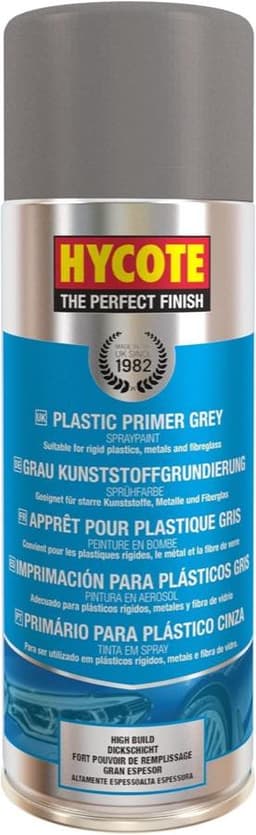
The bumper cover is scuffed, the aerosol says it is for bumpers, and a fortnight later the paint can still lift in a sheet. Plastic primer for bumpers only works when the plastic on the cover is one that primer is allowed to touch. Many covers are polypropylene or a polypropylene blend. Hycote’s grey can names bumpers and wheel trims and, on the same product family, excludes polyolefins. Both lines stay. This page is for a bumper, a wheel trim, a mirror cover, a lamp housing or a roof box. It is not a miniature guide. Prices for the nine listings are on the [plastic primer comparison](/hub/paints-and-varnishes/plastic-primer). The Products Compared editorial team wrote this on 21 October 2026 from those amazon.co.uk listings, Hycote’s and Montana’s own pages, and two UK trade pages for promoters we do not stock. We did not refinish a bumper. A qualifying purchase can earn a commission at no extra cost to you.

The bumper cover is scuffed, the aerosol says it is for bumpers, and a fortnight later the paint can still lift in a sheet.

Our top picks

On this page

Bumper plastic is not one material

A bumper cover is a moulding, and the moulding mark is the specification. ABS is a rigid plastic that many grey primers are happy to name. Polypropylene, often marked PP, is a polyolefin, and so is polyethylene, marked PE. A lot of modern covers are PP mixed with EPDM rubber so the wing can flex. That blend is not plastic in the vague sense a shelf label uses. A primer that grips ABS can sit on PP like dust on a bin lid. Look on the inside of the cover, behind a wheel-arch liner, or on the back of a mirror shell. You want a short code. PP, PP+EPDM, PE and HDPE are the marks that should make you put a grey bumper aerosol back. ABS, and some polycarbonate or polyurethane parts, can stay in the conversation only if the sheet for the can you bought includes them. Hycote’s sheet does mention uPVC among materials it accepts, beside GRP, polyurethane and most thermosets. It still refuses flexible plastics and polyolefins. If you cannot find a code, do not guess from the colour of the primer. A black textured bumper is not automatically polypropylene, and a smooth grey one is not automatically ABS. A bodyshop or a breaker can often tell you the cover for that model year. A test patch in a hidden corner, left for the full recoat window and then picked at with a fingernail, is the home version of that question. UK solvent rules cap the vehicle-refinishing primer sub-category, which includes plastic primers, at 540 grams per litre. That figure is the legal ceiling in Schedule 2 of the 2012 regulations. It is not a measured value for the Hycote, Autotek, Simply Auto or Montana can in this set.

Grey aerosols in this comparison

Hycote XUK612 is the grey can people mean when they search this job. On amazon.co.uk it is 400 ml at £7.99, 4.6 from 1,410 reviews, dry time 24 hours. The maker’s page is comfortable saying bumpers and wheel trims. The technical sheet then excludes polyolefins, flexible plastics, acrylic and polystyrene, and it includes GRP, polyurethane, uPVC and most thermosets. If your code is ABS or another allowed rigid plastic, this is the best-value aerosol in the set, with a large UK sample. If your code is PP, the bumper sentence loses. United Kingdom reviews near this job mention roof boxes, motorcycle parts and a strong smell. A roof box can be a fair use when its plastic is allowed. A smell is a ventilation problem, not proof of adhesion. Reviewers also describe a fast spray and a reaction when the next product was early. Autotek AT00PPG500 is 500 ml at £9.94, 4.6 from 895 reviews, with Is Waterproof set to true. Tetrosyl’s trade description is metals and rigid plastics, with a fan nozzle. That is not an approval for pure polypropylene. Amazon reviews in the UK talk about wheels and plastic items that are not always cars, and about a heavy film that needs flatting. Item weight of 48.5 g on the listing is a bad catalogue figure next to 500 ml and a 460 g size line. Use Autotek when the part is rigid plastic or metal, you want the extra volume and the waterproof line, and you will flat the coat. Do not use it as the clever alternative once you have discovered the cover is PP. Simply Auto SP-050 is 500 ml at £8.99, 5.0 from 3 reviews, and the special features include the words adhesion promoter. One United Kingdom review mentions bonnet grills under gloss black. Three reviews and one trim story are not a polypropylene proof, and a half-hour dry time with no full cure is not a bumper system. The words on the feature line are why this can is easy to misread as a clear promoter. It is still a grey aerosol with a tiny sample. None of these three is a colour-matched topcoat. If the bumper has to blend into the wing, that is a bodyshop job.

Montana’s named list

Montana’s plastic primer, 400 ml at £13.95 on amazon.co.uk, 4.0 from 123 reviews, is the one grey can in this set whose maker page talks about modified polypropylene. The how-to names modified PP/EPDM, ABS, GRP, hard PVC, PUR, PS and PA, and it tells you not to use it on HDPE. That is a more specific yes, and a specific no, than Hycote’s blanket polyolefin exclusion. If the mark on your cover is a modified PP-EPDM and you are willing to follow Montana’s own page, this is the row to read. It is not an automatic upgrade because it costs more. The 4.0 from 123 is the amazon.co.uk star line. The written reviews saved in the file are labelled United States or Australia, not the United Kingdom. They include a leaking or faulty nozzle, broken stems, a can that looked part-used, and poor adhesion on PLA when the coat was built up. A PLA miss is a 3D-print story. It is not a UK bumper test, and it does not prove the PP-EPDM line either way. Colour is not stated on the listing we saved. Coverage is about 12–15 square metres, which is the maker’s claim. Overpaint times on Montana’s site are not stable enough for us to print one number. The can you have in your hand is the clock. Do not borrow Hycote’s 15 minutes between coats and call it Montana’s method. You are choosing this can for the surface list, with a thinner review trail than Hycote or Autotek, at the highest grey-can price in the set. HDPE stays off the list even here. A water butt, a jerry can and some cheap trims are polyethylene. Montana’s no on HDPE and Hycote’s no on polyolefins agree on that family.

When this set does not have the right can

If the cover is polypropylene or a PP-EPDM blend and you do not want to rely on Montana’s list plus a non-UK review file, the product you are describing is a clear plastic adhesion promoter. This comparison does not stock one. Two UK trade examples show the gap, and their prices are trade-page prices, not amazon.co.uk shelf prices from our saved listings. Lechler Clarprimer is sold on a UK trade site as a colourless bond primer for PP-EPDM, at £25.30 excluding VAT when that page was checked for this guide. Novol’s plastic primer aerosol is described as a colourless promoter that includes polypropylene mixtures, at £10.45 on another UK trade page. Neither is an ASIN in our table, so neither gets a score, a badge or a pretend review count. They are here so you can see that the cheap grey can and the clear promoter are different films. Mixing a bargain grey with a leftover topcoat from a different brand is a common way to get the peel you were trying to avoid. Hobby products in the same comparison are the wrong basket for this job. The Army Painter matt white spray is a miniature colour primer, not water resistant, with its reviews on figures. Vallejo’s 60 ml bottle does not list bumpers. Nicpro’s airbrush set and the 100 ml Army Painter bottle are model products, and the 100 ml title does not even agree with its thinner bullets. Nicpro gesso mentions plastic beside canvas and paper and is not water resistant. If the paint you already applied is peeling, do not buy a second grey can and spray it over the loose film. The loose film has to come off, the code has to be read, and the next product has to name that plastic. A cover that has to match the car next to it should go to someone who paints cars for a living.

Common questions

Will a grey plastic primer stick to a polypropylene bumper?
Not on the strength of the word bumper. Hycote’s sheet excludes polyolefins, which include polypropylene and polyethylene, even though the product page talks about bumpers and wheel trims. Autotek’s trade line is rigid plastics and metals. Simply Auto’s three reviews do not prove polypropylene. If the mark says PP or PE, a grey can from this set is the wrong assumption.
Hycote says bumpers and also says no polyolefins. Which line wins?
The exclusion wins when the plastic is a polyolefin or a flexible plastic. The bumper line wins only for bumper parts made of a plastic the sheet allows, such as the rigid materials it names. Read the code on the cover. A roof box or a wheel trim in an allowed plastic is a different case from a PP-EPDM rear bumper.
Is Autotek a bumper product?
It is a grey plastic primer for rigid plastics and metals, 500 ml at £9.94, with UK reviews that mention wheels and a heavy film. Tetrosyl does not call it a pure polypropylene promoter. Use it on rigid plastic when you want the waterproof listing line. Do not use it to dodge Hycote’s polyolefin exclusion.
Is Montana better for modified polypropylene?
Montana’s own page names modified PP/EPDM and excludes HDPE, which is the only maker list in this set that says that. The amazon.co.uk price is £13.95 and the star line is 4.0 from 123, with written reviews that are not UK-labelled. It is the can to read if your code matches that list. It is not a proven UK bumper trial and it is not better merely because it costs more.
What if I cannot find a plastic code?
Do not guess from the colour of the aerosol. Check the inside of the cover, ask a breaker or a bodyshop for that model, or run a hidden test patch and try to lift it after the full waiting time. Spraying the whole bumper first is how you discover the code by watching the paint peel.
Why is a £10 clear promoter not in the comparison table?
Because the nine rows are amazon.co.uk listings we kept, and the clear PP promoters we found are trade-shop products. Novol at £10.45 and Lechler Clarprimer at £25.30 excluding VAT are examples of that other shelf, not scored ASINs. Their prices are not our amazon.co.uk prices. They explain the gap. They are not a secret tenth row.
Can I use the miniature spray on a bumper?
The Army Painter 400 ml matt white is built for figures, it is not water resistant, and its huge review count is not a car-plastic test. Vallejo’s bottle is 60 ml for resin and PVC models. A bumper needs a product that names the bumper plastic, usually a grey aerosol from this set or a clear promoter this set does not stock.
The paint peeled. Do I buy another grey can?
No. Peel means the film, the plastic or the topcoat did not belong together. Strip back to sound material, read the code, and choose a primer that names that plastic. Another coat of the same grey aerosol over loose paint repeats the failure. If the panel has to match factory colour, a bodyshop is the next call, not a second tin.

Related pages

Sources

Public sources from the research digest, last checked on 22 October 2026. Shelf prices and star lines are the amazon.co.uk figures in the display file. The price band is this set, not a market average. No listing was lab-tested.

  1. VOC in Paints, Varnishes and Vehicle Refinishing Products Regulations 2012 (retrieved 22 October 2026)
  2. SI 2012/1715 Schedule 2, VOC limits (retrieved 22 October 2026)
  3. HSE: vehicle spray painters and COSHH (retrieved 22 October 2026)
  4. HSE INDG388: safety in isocyanate paint spraying (retrieved 22 October 2026)
  5. Hycote plastic primer technical data sheet (retrieved 22 October 2026)
  6. Montana: how to use plastic primer (retrieved 22 October 2026)
  7. Army Painter: using colour primers (retrieved 22 October 2026)
  8. Tetrosyl: Autotek grey plastic primer 500 ml (retrieved 22 October 2026)