Safety glasses fogging up: why anti-fog still mists
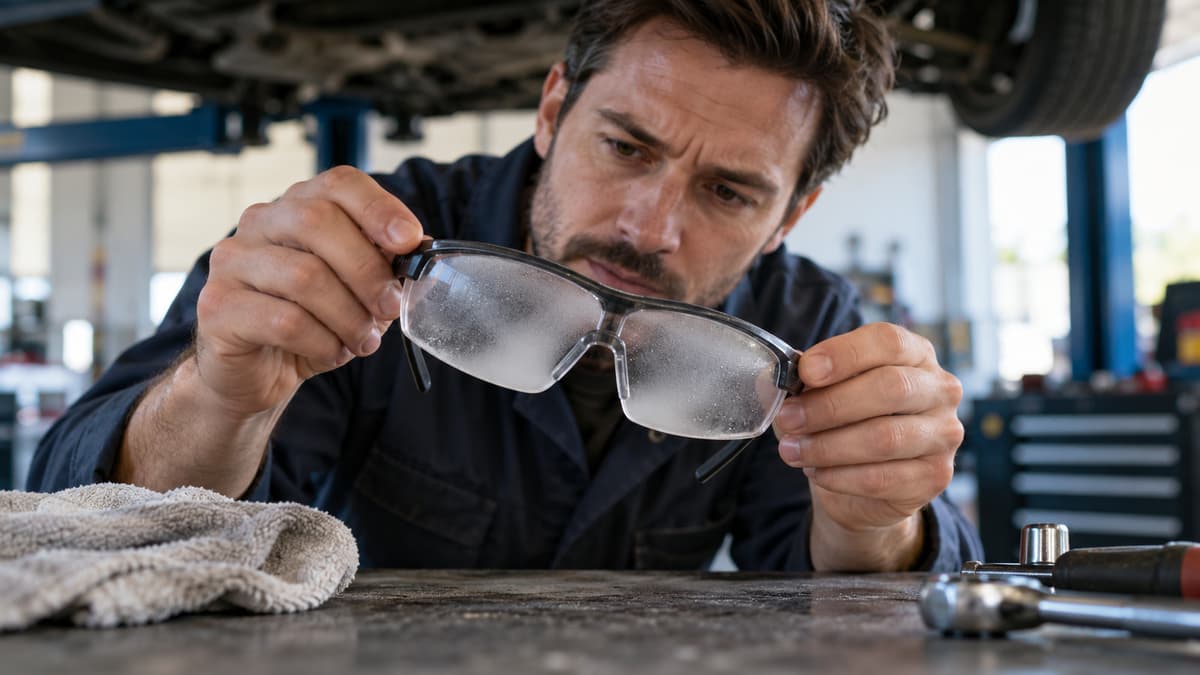
Safety glasses fogging up is warm breath on a cool lens. Anti-fog in a title is not an N mark, and these amazon.co.uk tables do not print one. Check the lens.
On this page
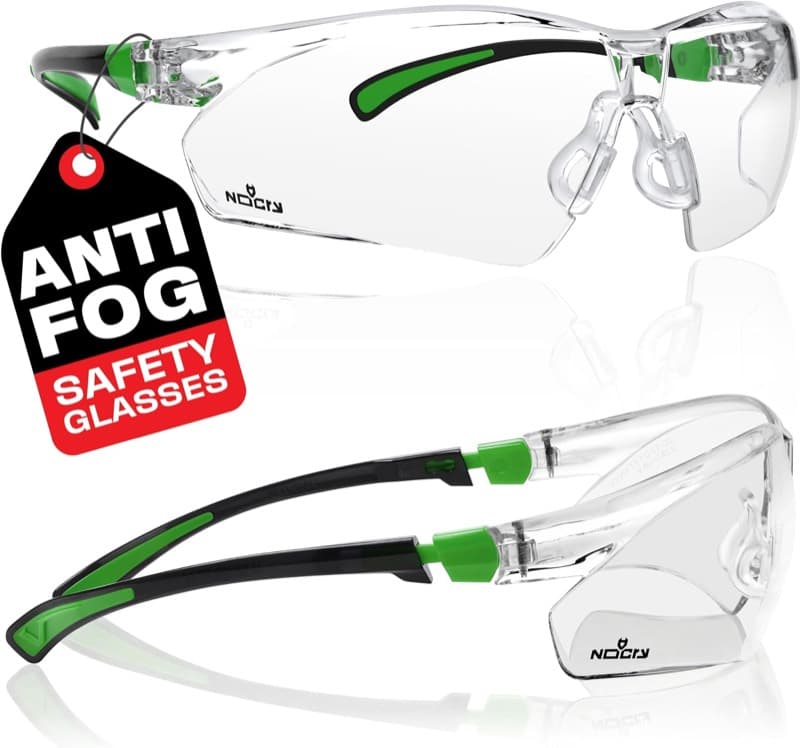
You lean over the bench, or you are on your back under the car, and the lens goes milky in a few breaths. That is safety glasses fogging up. The moisture is water leaving warm air on a cooler lens. A line that says anti-fog is a coating claim. It is not the optional N test on the lens.
Peter F. read the twelve amazon.co.uk listings in this set, captured on 19 October 2026, plus HSE's L25 guidance and JSP's notes on markings. We did not run a fog test. A qualifying purchase through our links can earn a commission at no extra cost to you. None of the specification tables print an N.
In short
Safety glasses fog because warm moist air meets a cooler lens. Anti-fog in a title is a coating claim, and N, the optional fog test, is absent from the specification tables in this amazon.co.uk set. A mask leak, cold air, and a tight wrap each make the film worse. A vented goggle is the next shape when a spectacle will not stay clear, and a vent is a weaker seal against splash.
Where the moisture comes from
The film on the inside of the lens is condensation. Air from your nose and mouth holds water. Polycarbonate in a cold garage is colder than that breath, so the water the air can no longer hold sits on the plastic as a fine mist. A spectacle still leaves a gap underneath, which is why chips from the front are the job and a liquid around the rim is a different protector. That gap also lets some air through, so a loose pair can clear between breaths. Pull the frame closer and the moist air stays.
HSE's L25 guidance asks you to consider misting when eye protection is issued, and it records that anti-mist treatments and ventilated protection exist. That is a choice at the point of issue, not a promise that every coated spectacle on amazon.co.uk will stay clear. If the lens is white, you stop or you swap.
Anti-fog claims versus the N mark
N is a test mark, and JSP's UK guide puts that letter on the lens. It is optional. A pair can be a sound impact spectacle and carry no N. K works the same way: no letter means that scratch test was not claimed. F is the low-energy impact letter usual on side-arm glasses, tested at 45 m/s. Those letters answer different questions from mist. Anti-fog and a brand coating name are claims in the title, not an N on the lens.
None of the twelve specification tables print N. Ansell's KleenVision lists visible light transmission at 50 per cent while the colour cell says clear. NoCry claims a coating and prints no EN line. One reviewer quotes a stamp that includes 1 FT and CE, which is one person's reading and not an N. EN 166:2001 lost its presumption of conformity for new certification on 11 November 2025. An in-date certificate can still be sold until it expires, up to about five years, and that date does not print an N onto a blank table.
What these reviews actually say
Honeywell's A800, model 1015370, was £4.13 on 19 October 2026, with 4.5 from 4,256 reviews. The title says anti-scratch, and UK reviews still include mist on cold humid days. The URL ASIN is B002C6FG8G and the details ASIN is B0H3WY1V8B, first listed on 3 June 2026. Some wearers lost the lens to condensation. Those stars are not a fog test of the card in the basket, and the lens material is not in the table.
DeWalt, model DEWSGRFS, was £24.99, with 4.7 from 11,445. The title claims no coating. One UK review says they still fog slightly. The URL is B000FPANVG, the details ASIN is B0HHSLG667, first listed on 4 September 2026. Slight fog is one sentence, and it does not attach to a single proved ASIN until the live page is one product and one price.
DTD at £42.99 is praised for an anti-fog coating under a car and condenses when the pair sits tight. The details ASIN clashes, and one reviewer says the frames are marked EN166-F and the lenses are not. The top pick is NoCry EyeArmor+ in black and green, B01AWK1XAS, at £13.99, with matching ASINs. The table prints no N, so cold-air fog is a reason to skip that wrap. The rows are on the safety glasses comparison, and the checks are on the buying guide.
Masks, cold air, and a tight seal
A face mask changes the path of the breath. If the top edge leaks, the air goes up behind the glasses, even when the same pair was fine on its own. Seat the mask over the nose first, then set the glasses over it. Air at the brow means the gap is still open. A coating in the title does not close it. Cold air makes the lens colder. A spare in a pocket is faster than waiting for one lens to clear while the tool is still running.
A close curve covers more of the side for chips and leaves less room for air across the lens. NoCry reviews say the curve will not go over ordinary glasses. Stacking everyday glasses over the safety pair puts an unmarked lens in front. The fit-over two-pack claims the job and has no written review. Under a hard hat, a thick arm lifts the shell. A spray can fight a factory coating, so try it only on a pair you can spoil. Mild soap and air drying are on how to wear safety glasses.
When vented goggles are the next step
Move to a goggle when the hazard needs a rim against the face, or when you keep taking the glasses off because you cannot see. A goggle uses a strap and a rim. HSE separates spectacles, goggles, and faceshields. Spectacles cannot carry field 3 for liquid droplets, field 4 for large dust above 5 microns, or field 5 for gas and fine dust. JSP's notes put field 4 on indirect-vented or non-vented goggles, and field 5 only on non-vented goggles. A temples-and-gap pair whose title says goggles does not gain those fields.
Direct vents move air and fog less, and they let dust and liquid through. Indirect vents are the usual compromise for large dust and droplets. A full seal fogs sooner because the moist air has nowhere to go. The dust goggles comparison is that shape, from £1.99 to £16.99 in that capture. The £1.99 Blackrock is vented, at 4.4 from 1,227 ratings, and neither it nor the £16.99 eight-pack prints a full EN 166 line. Cheap vented pairs still draw mist complaints. A named chemical, dust that also needs a respirator, welding, or a laser needs a competent person to match the protector. The shape split is on safety glasses versus goggles.
What to try on the pair you have
Work in this order, and stop when a step would put a white or unmarked lens back in front of a moving tool.
- Read the lens for N. If lens and frame disagree, claim the lower mark.
- Fit the mask on the nose first, then the glasses. Air at the brow means the leak is still open.
- Loosen a clamped wrap, or swap to a spare when the lens films over. Two NoCry pairs are two times £13.99.
- Rinse grit off, use mild soap if the care line allows it, and air dry. Skip glass cleaner, paper towel, silicone polish, and heat.
- Stay with glasses for chips from the front. Move to a goggle for splash or fine dust, and match the vent to the hazard.
- Replace the pair when you cannot see through it, the lens is deeply scratched, or the frame is bent. At work the employer replaces it when the assessment still needs eye protection.
Chemical splash, molten metal, arc, and a dust or gas field you cannot match are the moment to call a competent person. Use the review sentences as clues about mist, and use the lens in your hand for N.
Common questions
Why do safety glasses fog?
Does anti-fog in the title work?
What is the N mark?
Why do safety glasses fog more with a face mask?
Do close-fitting wraps fog more?
Will an anti-fog spray fix a coated lens?
When should I switch to vented goggles?

Peter F. is the editor for DIY & tools at productscompared.co.uk. Comparisons in this category are checked against amazon.co.uk listings, review evidence and public UK sources.
Related articles
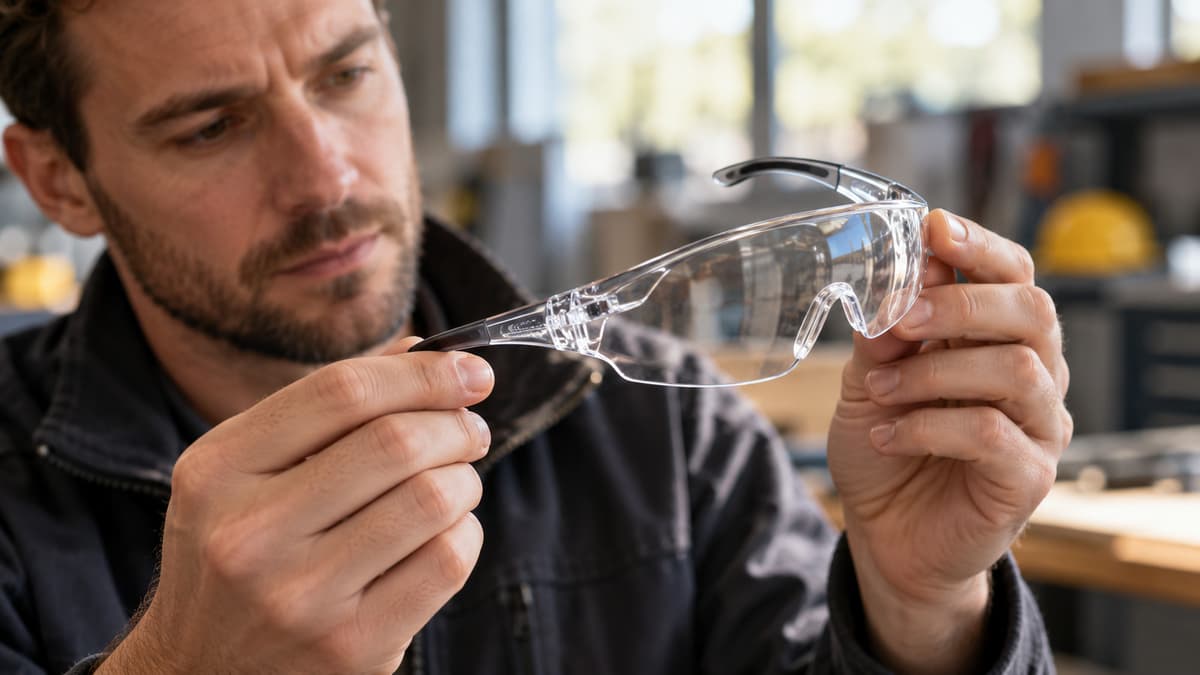
How to read EN 166 markings
The letters on the lens are the record. N is the optional fog test. Anti-fog in a title is a different thing.

How to clean coated safety lenses
Mild soap and air drying suit a coated lens. Household glass spray and a dry paper towel are how coatings come off.

Safety glasses or goggles for the hazard
A spectacle leaves a gap for chips. A rim that meets the face, and a vent, belong on a goggle page.