EN 166 markings: read the lens and frame letters

EN 166 markings on the lens and the frame show optical class, impact, and K or N. A blank amazon.co.uk specification table still leaves that stamp unread.
On this page
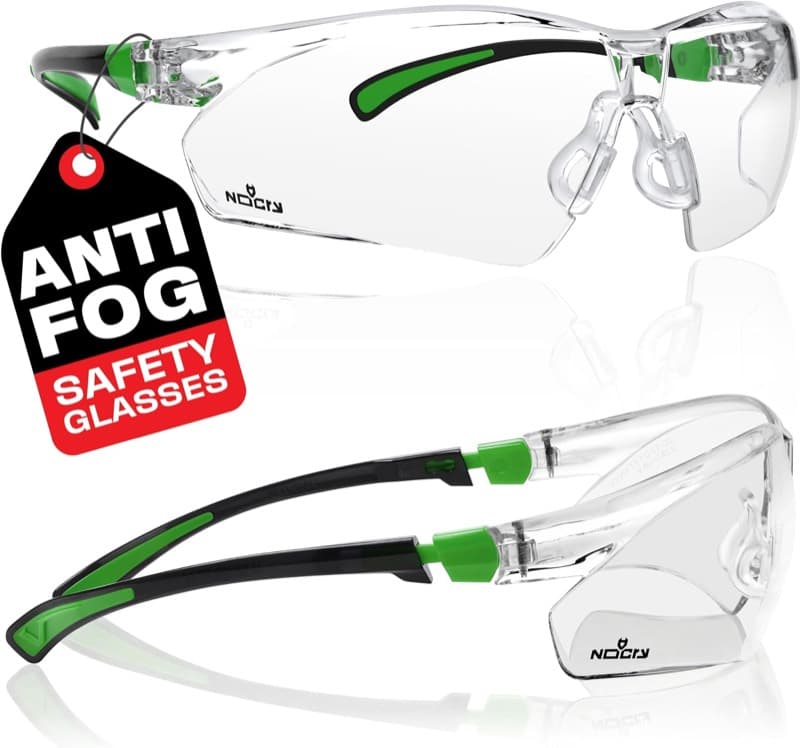
You turn a pair of safety glasses over and the lens carries a short line of letters nobody on the job has explained. The frame may carry a different line, or nothing you can find. Those EN 166 markings are the record of which tests that eyewear was put through. A blank specification table on amazon.co.uk is a separate fact from a stamp moulded into the plastic.
The notes are twelve amazon.co.uk listings in the safety glasses comparison, captured on 19 October 2026, plus JSP's UK marking guide, GOV.UK notice 0112/25, and BSI on EN ISO 16321. No ball test and no fog chamber. A qualifying purchase through our links, tag pcuk26-21, can earn a commission at no extra cost to you. The top pick is NoCry EyeArmor+ on amazon.co.uk.
In short
EN 166 markings belong on the lens and on the frame, and the weaker of the two is the one you can claim. Optical class 1 is the class for continuous wear, F is the usual impact ceiling for spectacles, and K and N are optional tests a title does not replace. From 11 November 2025, EN 166:2001 no longer gives a presumption of conformity for new certification, while an in-date certificate can still be sold until it expires.
Where the letters sit
Look at the lens first, then the temple or the brow bar. A complete mark is printed or moulded on both. JSP's buyer guide sets the order: a filter code when the lens is tinted or UV-rated, a short maker code, the optical class, the mechanical strength, then optional letters such as K or N. The frame carries its own strength mark. One UK review of the DTD carton, ASIN B0F9DTMWPD at £42.99, says the frames were marked EN166-F and the lenses were blank. The details ASIN does not match the URL. A frame-only stamp is the case to reject.
The same order answers what 1 FT means. The 1 is the optical class, F is low-energy impact, and T means the impact test was also run at about -5 °C to +55 °C, which is why T matters on a winter site or in a cold store. EN166 certified beside an empty table has not shown the class, the F, or the T. If the parts disagree, Protec Direct keeps the weaker letter: a lens at F in a frame marked only S is an S pair, because increased robustness is a heavier, slower ball.
Class, impact, and the lower mark
Optical class is the number after the maker code. Class 1 is for continuous wear on a full shift. Class 2 is for occasional wear. A higher number is the weaker optical result, so class 3 is a poor choice for hours at a bench. The number says nothing about impact.
F is low-energy impact, a 6 mm ball of about 0.86 g at 45 metres a second, and the usual ceiling for side-arm spectacles. B, at 120 metres a second, is the medium-energy mark UK notes attach to goggles and faceshields. A, at 190 metres a second, belongs on a faceshield. Temples and a gap stay a spectacle even when a title says grade B glasses for an angle grinder. Medium energy belongs on the dust goggles comparison, or on face protection when the whole face is in the way.
If the lens reads 1 FT and the frame reads F, you have F, and you have T only when both parts carry T. A hammer blow in a review is a different event from that ball at a stated speed.
K, N, and filter codes
K is resistance to surface damage by fine particles. N is resistance to fogging. Both are optional, so a proper F spectacle can carry neither, and a title that says anti-fog or anti-scratch has not sat the test. Anti-fog is a title claim on most of the twelve listings. Honeywell's A800 says clear anti-scratch, and NoCry claims a coating much more fog resistant than ordinary glasses. Reviews on those two split. Printed N tests that lens. It says nothing about the gap between a mask and your face.
2C-1.2 is the clear UV code at the front of a marked lens line: 2C for the filter, 1.2 for a light shade that keeps colour usable. Confirm it is printed. Ansell's Nemesis cell lists 50% visible light transmission, a darker clear than that code. EN 170 leaves the designated list on the same date as EN 166. Field numbers 3, 4, and 5 cover liquid droplets, large dust, and gas and fine dust. WISE Worksafe states that spectacles are not the splash sample. Numbers 8 and 9, for arc and molten metal, belong on a faceshield, not on an F spectacle.
EN 166 after 11 November 2025
EN 166:2001 lost its presumption of conformity for new certification on 11 November 2025. Notice 0112/25 removes it with EN 169, EN 170, EN 172, and EN 379. EN ISO 16321-1 is what BSI describes for new occupational and educational eyewear, plano or prescription. The scope leaves out lasers, sport, surgery, solar-only lenses, and arc-flash faceshields, so a laser job stays on the laser safety glasses comparison.
An existing certificate can run until it expires, up to about five years, and uvex's UK guide gives distributors no end date for selling that stock. A buyer in October 2026 can still be sold an in-date EN 166 pair, and wearing it the next morning remains lawful. The newer standard uses C, D, and E for 45, 80, and 120 metres a second. Spectacles stay on the low grade, and older pairs are still read as F, B, and A. If the listing says EN ISO 16321 and the plastic shows only EN166-F on the frame, with a blank lens, record the plastic and leave the newer number until both parts show it.
What these listings actually show
Twelve amazon.co.uk listings captured on 19 October 2026 run from £4.13 to £42.99, and the tables almost never print an EN mark. The top pick is the NoCry EyeArmor+ black and green wrap, B01AWK1XAS, at £13.99: 28 g, adjustable arms, matching ASINs, and 4.4 from 61,350 reviews shared with the red colour. The table has no EN 166 or EN ISO 16321 line. One reviewer quotes 1 FT and CE, which is a stamp reading, not a field on the page. The curve will not go over prescription glasses, so a fit-over is on the safety glasses for people who wear glasses comparison. If the assessment must name a printed UK mark, leave this row.
Ansell's Nemesis, B0FXY1HFXX, is £8.14, with matching ASINs and 4.3 from 315 reviews. The captured line is CSA, a Canadian stamp. The best-value score is price and credibility. DTD at £42.99 is a carton in one UK review, about thirty pairs at about £1.43, which the listing does not confirm. The details ASIN mismatches, and that review is the frame-only EN166-F note. Honeywell's A800 at £4.13 has a details ASIN that disagrees with the URL, so 4.5 from 4,256 is not a clean card. A marked single outside this table, such as the Riley Flux at £10.99, still needs both stamps and a matching ASIN.
When the letter cannot answer the hazard
Spectacles have temples, side cover, and a gap, and they suit chips from the front and the side. Goggles meet the face when liquid or fine dust would go around that gap. A faceshield covers the face and usually still needs eyewear underneath. HSE separates the three. Sullei's title says welding safety goggles and clear safety glasses, at £6.99 for eight clear spectacles, with no shade number. Ears and a gap in the photo are the product, and the word goggles does not create mark 3, 4, or 5.
Leave the page for chemical splash, molten metal, arc, laser, or fine dust when nobody can match the field number, and for prescription safety lenses. A blank batch, or a stamped frame with a bare lens, is the same stop. L25 says you replace a deeply scratched lens or a bent frame. An eye injury at work is a reporting matter. At work the employer provides suitable eye protection free when the assessment needs it, including for limb (b) workers. That duty does not make an amazon.co.uk title a certificate.
Common questions
What does F mean on safety glasses?
What is optical class 1?
What are K and N?
Do both the lens and the frame need a mark?
Is EN 166 finished?
What is 2C-1.2?
Is Z87.1 the same stamp as EN 166?

Peter F. is the editor for DIY & tools at productscompared.co.uk. Comparisons in this category are checked against amazon.co.uk listings, review evidence and public UK sources.
Related articles

ANSI Z87 on a UK site
A Z87.1 or CSA line on amazon.co.uk is a US or Canadian stamp. The UK record uses the letters on the lens and the frame.

Safety glasses or goggles for the hazard
Temples and a gap are spectacles. Splash and fine dust need a seal. The word goggles in a title leaves the shape unchanged.

Who has to pay for eye protection at work
When the assessment still needs eye protection, the employer provides it. A personal amazon.co.uk order is a separate purchase.