Safety glasses or goggles: match the UK hazard

Match safety glasses or goggles to the hazard on a UK site. Spectacles, a sealed goggle, a faceshield and laser glasses are different amazon.co.uk buys.
On this page
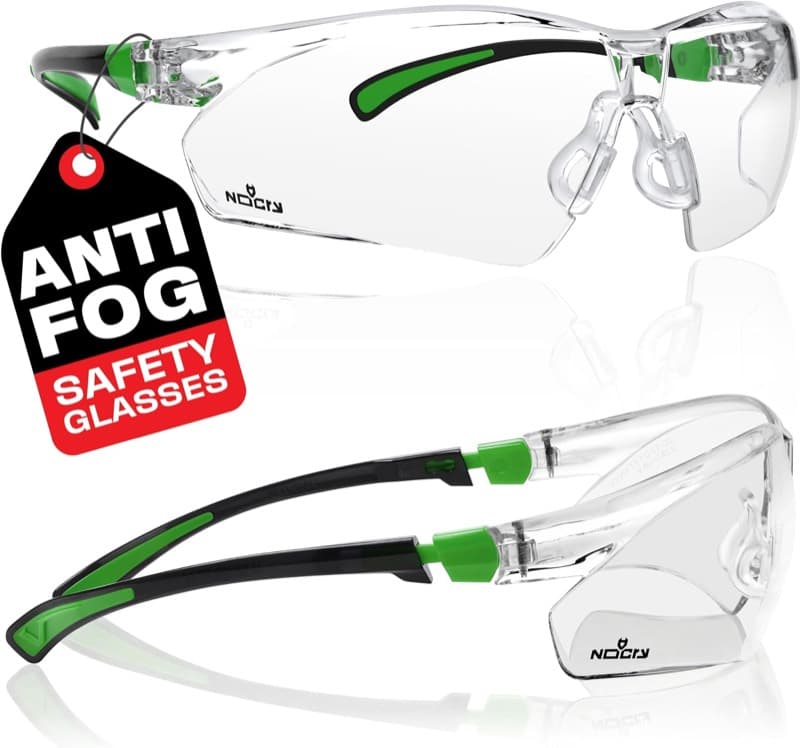
You are at the mitre saw, or you have a bottle of cleaner in one hand, and the amazon.co.uk title says goggles. The photo shows clear spectacles with temples and a gap under the lens. Safety glasses or goggles are different shapes, and the hazard decides which one belongs in the basket. Listings in the safety glasses, dust goggles, face protection and laser safety glasses comparisons were checked against Health and Safety Executive guidance, the University of Reading safety note SN55, and WISE Worksafe's note on what spectacles are tested for. There was no lab test.
Shelf prices below are the amazon.co.uk figures in those comparison files, captured in October 2026. A qualifying amazon.co.uk purchase can earn a commission at no extra cost to you.
In short
Buy spectacles when the risk is a flying chip from the front and the side. Buy a sealed goggle when liquid or dust can travel around that gap. Add a faceshield when the face is in the way, and keep the eyewear the assessment still asks for. Laser glasses follow a different standard. The word goggles in a title does not change the photo.
Safety glasses or goggles as three shapes
HSE's page on the right type of PPE treats spectacles, goggles and face shields as different protectors. Spectacles, including a one-piece wrap, cover the front and the sides and leave a gap at the brow, the cheek and under the lens. That gap is acceptable when the particle is coming at you, which is the usual saw chip or a flake of rust under a car. The same gap is the wrong geometry when the hazard can curl around the rim and sit on the eye.
Goggles use a strap and a frame that bears on the face. Direct vents, indirect vents or a full seal trade mist against how much gets in. A faceshield covers the face and still leaves a path to the eye unless glasses or goggles stay on underneath. HSE's chainsaw guidance lists a mesh visor and safety glasses as separate lines.
Laser eyewear is a fourth buy, even when the photo looks like a spectacle. Impact glasses follow EN 166 or EN ISO 16321-1. Laser glasses follow EN 207 or EN 208 and state a wavelength and an optical density.
Match the hazard before the listing
Start with what can reach the eye. Chips from the front, as from a circular saw or a wire brush, suit spectacles with side cover. The NoCry EyeArmor+ at £13.99, 28 g, with 4.4 from 61,350 reviews, is the top pick when you will read a stamp the table does not print. Reviewers say the curve will not sit over prescription glasses.
Liquid that can run under a temple frame needs a seal. University of Reading note SN55 treats marks 3, 4 and 5 as goggle territory, and WISE Worksafe states that spectacles are not tested for liquid splash or large dust. Mark 3 is the droplet number. The safety data sheet and a COSHH assessment decide the chemical. A coated wrap does not close that file.
Dust that hangs in the air and finds the gap is a goggle problem. Mark 4 is large dust. Mark 5 is gas and fine dust on an unvented seal. Indirect vents ease fog and admit more than a full seal. Goggles do not filter breathed air, so a lung hazard is a second purchase.
Grinding is the mis-buy. F, at 45 metres per second, is the low-energy mark on side-arm spectacles. B, at 120 metres per second, sits on goggles and faceshields. A grade B claim on a glasses title is not the grinder standard.
The Oregon Q515061 is a mesh browguard at £22.79, with 4.7 from 12,284 reviews. The bullets name CE EN 1731 and CE EN 352.1. Mesh lets fine dust through, and it is not a hard hat.
Lasers sit off this ladder. The Control of Artificial Optical Radiation at Work Regulations 2010 put screens and interlocks first. The FreeMascot title says OD 4+ from 190 to 550 nm at £13.99, with 4.3 from 1,106 reviews, and no EN 207 scale in the details. Do not look into the beam to test the tint.
What the letters on the lens allow
Read the lens and the frame. If they disagree, the lower mark counts. Optical class 1 is for continuous wear. K is an optional scratch test. N is an optional fog test. Anti-fog in a sentence is a coating. It is an N mark only when N is stamped.
Marks 3, 4 and 5 are the liquid and dust fields Reading keeps on goggles. A spectacle with an F can still say nothing about splash, and that silence is the limit. Several rows print no standard at all, so you read the pair in your hand.
EN 166:2001 lost presumption of conformity for new certification on 11 November 2025. EN ISO 16321-1 is the successor. An in-date EN 166 certificate can still be sold until it expires, which BSI puts at up to about five years, and a marked pair already in use can stay in service.
The new impact letters are C, D and E, for 45, 80 and 120 metres per second. A letter C is an impact grade, and it is not the old chemical field 3. ANSI Z87.1 or CSA on a UK page is a US or Canadian claim. HSE still expects a CE or UKCA mark. Northern Ireland follows the CE route.
When the amazon title says goggles
Sellers type the word shoppers search. Sullei's title says welding safety goggles and also clear safety glasses. The product is eight clear spectacles at £6.99, with no shade number and 5.0 from two reviews. A welding word without a shade does not filter an arc. If you can fold a temple over your ear and see daylight under the lens, you are holding glasses.
The same trap sits on strap products with no field mark. The HowseHold pack in the dust set is £16.99, titled anti-fog and splash resistant, with 4.5 from 72 reviews. It is the top pick there on price and review count. The table lists no standard. One reviewer cites CE EN166 on the frame and no rating sheet in the pack.
A strap and a rim are the right shape for dust. Splash resistant in the title waits for mark 3 on the lens. Check the photo, then the form, then the stamp on lens and frame. Temples and a gap mean glasses. A headband and a rim on the face mean goggles. A wavelength means you have left impact eyewear.
Which comparison to open
Open the safety glasses comparison when you can point at the chip. The NoCry wrap is the top pick when you will check the stamp and you do not need a fit over prescription glasses.
Open the dust goggles comparison when the path is around the lens. Look for a strap, a rim on the face, and mark 3, 4 or 5 as the hazard requires. Everyday glasses can lift the gasket, so try a pair for ten minutes. The over-glasses comparison is the frame that goes over spectacles.
Open the face protection comparison when the face is in the path as well as the eye, and keep glasses or goggles underneath. The Oregon set is the top pick there for debris and muffs. It is not a chainsaw helmet, the 25 decibel line is not an SNR, and mesh is not a dust or splash seal.
Open the laser safety glasses comparison only when the wavelength matches the machine. EN 166 states no optical density. If the details block has no EN 207 scale, the OD line stays a title claim. A competent person takes over when the class or the open beam is unclear.
Replace a deeply scratched lens or a bent frame. HSE guidance L25 treats that damage as the end of the pair, because you can no longer see the hazard. The employer still has to supply the right shape free when the assessment needs it.
Common questions
Do I need safety glasses or goggles for a saw?
Which eye protection suits chemical splash?
When is a dust goggle the right shape?
When should I add a faceshield?
Can a spectacle carry an EN 166 B mark?
Why does the amazon.co.uk title say goggles?
Where do laser glasses sit?

Peter F. is the editor for DIY & tools at productscompared.co.uk. Comparisons in this category are checked against amazon.co.uk listings, review evidence and public UK sources.
Related articles
How to read EN 166 markings
The letters on the lens and the frame decide the hazard. Anti-fog in a title is not an N mark.
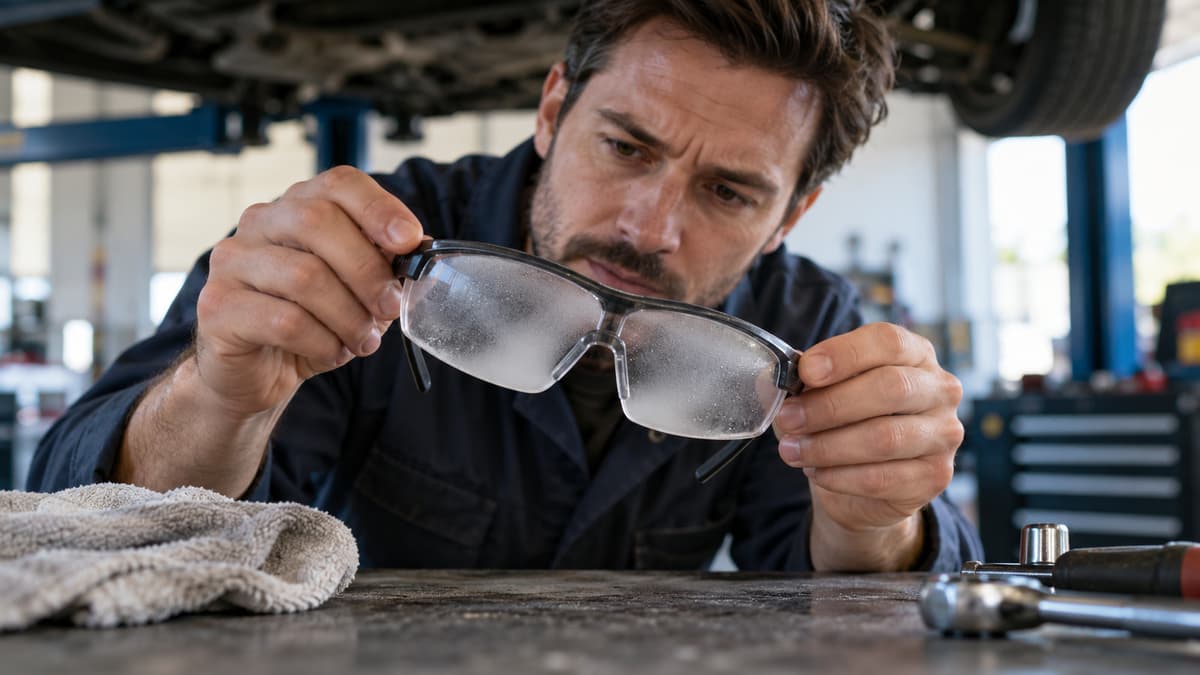
Why safety glasses fog
A coating claim still mists with a mask or in the cold. What an N mark would have shown on the lens.

When to bin scratched safety glasses
A hazed lens hides the hazard you wore the pair to see. Condition decides, and a deep scratch ends the pair.